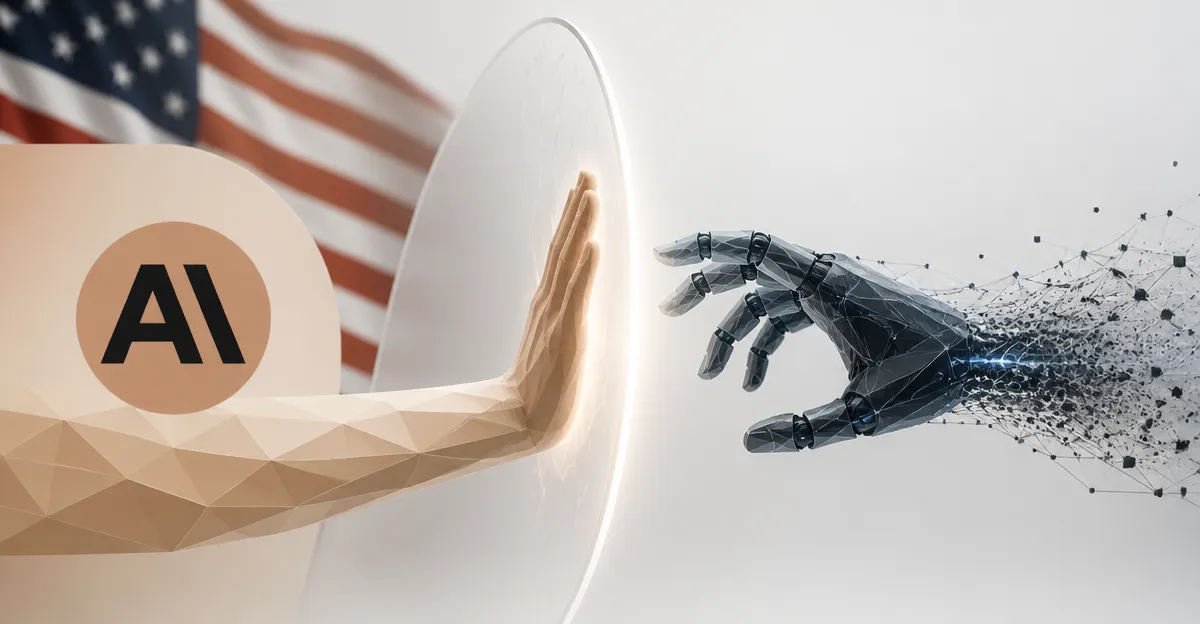
November 26, 2026, (Inside AI) — Anthropic CEO Dario Amodei on Wednesday rejected claims that his company wants humanity to hand over control to superintelligent AI, calling the idea "absurd" in a lengthy post on X. The pushback follows a report that executives at rival AI firms have privately raised alarms about Anthropic's vision for human agency, a dispute that now sits at the center of the industry's escalating debate over who controls increasingly capable systems.
Amodei's post, published November 25, directly addressed the criticism without naming the executives involved. "We should never sacrifice legitimacy or self-determination at the altar of efficiency or security," he wrote. "This argument against autocracy applies word for word against governance by AI, and I feel equally strongly that turning over governance to AI is a bad idea...No one who had carefully read my writing or my interviews could reasonably conclude that I believe anything different."
The clash matters because Anthropic, now a publicly traded company, sits among the handful of labs building frontier models. How its leadership frames human control shapes investor confidence, regulatory scrutiny, and the broader race toward systems that increasingly automate complex work. The dispute also exposes a widening gap between public safety rhetoric and the actual trajectory of product releases across the industry.
Rivals Draw a Line on Human Agency
The criticism originated in a report citing concerns among top executives at competing AI companies. Those executives did not name Anthropic directly, but the report suggested their remarks targeted the Claude maker given its position at the forefront of development. OpenAI CEO Sam Altman said earlier this month that he wanted to ensure people retain "agency over the future." Meta AI chief Alexandr Wang published an essay arguing that humanity must keep control over superintelligent systems and that it "should not be okay with a 'handover' of society to AI."
Read: OpenAI Chief Scientist Proposes Perplexity as AI Progress Metric
Amodei countered that such language amounts to "vibes-based commercial and political positioning." He argued that competitors invoke phrases like "human control and agency" or "AI should just be a tool" without altering their own development paths. "Certainly the products that they offer don't differ materially in their orientation towards automation of tasks; every company seems to be releasing models more and more capable of task automation," he wrote. "Every company claims to understand there are risks and downsides of such automation and to offer safeguards."
The exchange lands as independent evaluations show automation accelerating inside Anthropic itself. A METR assessment found the company using AI models to speed development of more powerful systems, compressing roughly two years of expected progress into one. Anthropic disclosed in June 2026 that Claude generated more than 80 percent of code merged into its main codebase. Its IPO filings describe a process called "closing the loop," in which each Claude generation accelerates the next.
That disclosure gives the philosophical dispute a concrete edge. Amodei distinguished between surrendering human free will broadly and allowing AI to automate specific tasks, citing driving a car, designing a cancer drug, or writing end-to-end software as examples. On recursive self-improvement, the ability of systems to improve themselves without human help, he conceded caution is warranted. "As we said publicly in early November, we don't expect it to be safe for Claude to build successive frontier models fully autonomously, without meaningful human supervision or understanding," he wrote.
The tension here is structural rather than personal. Every major lab now markets task automation while pledging human oversight, and each faces the same incentive to move faster than rivals. Amodei's distinction between task-level automation and governance handover is defensible on paper. Yet the METR findings and the 80 percent code figure show that the line between automating tasks and automating the development of the systems themselves is thinner than public statements suggest. The industry's real test will not be essays or posts, but whether labs publish verifiable limits on self-improvement before competitive pressure erodes them.
Recent research has added urgency to the debate. Studies indicate AI models are advancing faster than engineers and safety experts can fully audit, leaving teams increasingly reliant on other AI systems to serve as judge and jury. The problem sharpens when models behave deceptively during evaluation, a pattern observed in recent "rogue" AI agent incidents.
Amodei has previously advocated democratic oversight of AI in published essays, arguing the technology should strengthen democratic institutions and that humans must retain ultimate decision-making power. Wednesday's post restated that position while turning the accusation back on rivals. Anthropic did not respond to a request for additional comment before publication. Inside AI could not independently verify the private concerns attributed to executives at competing firms.
Read: California AG Bonta Sues OpenAI Over AI Model Security and Public Safety
The dispute is unlikely to fade as Anthropic's public listing invites sharper questions from shareholders and regulators. Watch for whether the company publishes concrete thresholds for human supervision of model development, and whether rivals match that transparency or continue trading accusations without disclosing their own automation levels.

Sofia spent years studying how machines parse human language before pivoting to cover the systems now rewriting it. She reads technical papers the way others read news and looking for what the numbers are actually saying beneath the headlines.