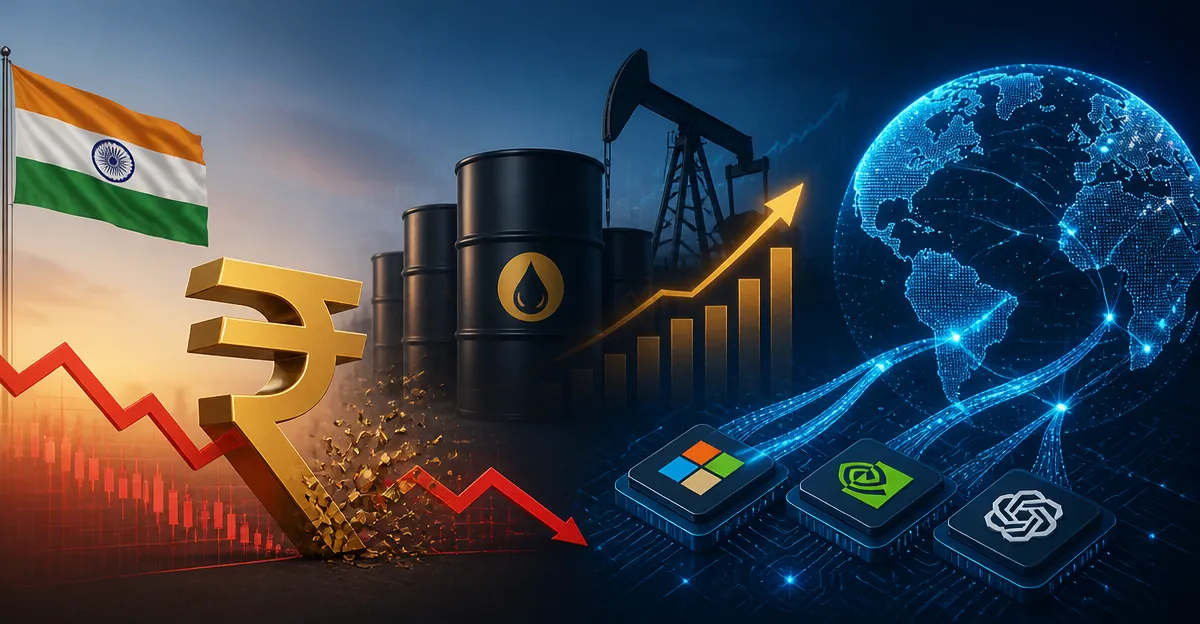
November 26, 2026, (Inside AI) — The Indian rupee is set to open slightly weaker on Thursday, with traders projecting a range of 92.32 to 92.36 against the dollar, down from Wednesday's close of 92.23. The immediate pressure comes from a 3.5% jump in Brent crude prices, which climbed to $94.90 a barrel in Asian trade on concerns over Middle East supply disruptions. Higher oil prices typically widen India's trade deficit and weigh on the currency.
But the more consequential force shaping the rupee's near-term path is not oil. It is the global unwind of the AI trade. After two years of foreign investors largely shunning Indian equities in favor of AI-linked markets in the US, South Korea, and Taiwan, that flow is showing signs of reversal. Foreign investors have poured nearly $15 billion into Indian equities this month alone, helping drive a recovery in the rupee and prompting a rethink of the currency's outlook.
The shift is tied to a sharp pullback in AI stocks. The Nasdaq settled 0.6% lower on Wednesday after falling as much as 4% during the session, a move that traders read as tentative stabilization rather than a clean recovery. Investor sentiment remains fragile, and that fragility is doing something unusual: it is supporting the rupee.
Why The AI Selloff Is Lifting The Rupee
The mechanism is straightforward. When AI-linked equities were surging, global capital concentrated in a handful of technology-heavy markets. India, with a smaller tech weighting, was largely bypassed. Now that AI valuations under pressure, some of that capital is rotating into markets that were previously overlooked. The rupee has recently moved in the opposite direction to its Asian peers, benefiting from these inflows.
"What happens to the AI trade is probably the single most important factor for the rupee right now," a currency trader at a bank said.
The trader added that the shift in overall risk appetite has worked in India's favor, noting that the rupee has largely moved in the opposite direction to its Asian peers recently, benefiting from foreign inflows.
This dynamic is a notable reversal from the past two years, when India's equity market underperformed AI-heavy benchmarks and the rupee faced persistent outflow pressure. The question now is whether the AI correction is a durable rotation or a brief pause. If AI stocks stabilize and resume their climb, the inflows could reverse just as quickly. If the correction deepens, India could absorb more of that capital.
The broader risk backdrop remains mixed. Asian equities rose on Thursday, led by AI-heavy markets in South Korea and Taiwan, while most regional currencies advanced. Markets largely shrugged off a fresh round of US tariffs announced by President Donald Trump on Wednesday, targeting 14 major trading partners. India, which has yet to reach a trade deal with the Trump administration, would face a 17% tariff rate if an agreement is finalized and 25% if talks fail.
For now, traders are focused on the AI trade and oil. The rupee's opening range of 92.32 to 92.36 reflects a modest depreciation, but the currency's recent resilience suggests that foreign inflows are providing a buffer. Whether that buffer holds depends on whether the AI selloff deepens or fades.
The rupee's unusual sensitivity to AI equity flows highlights a structural shift in how emerging market currencies are being priced. India's traditional vulnerability to oil prices remains intact, but the new variable is the global allocation of AI-driven capital. That makes the currency a proxy for sentiment on a technology theme that has little direct connection to India's domestic economy. Traders will be watching both Brent crude and the Nasdaq in the sessions ahead, with the rupee's direction likely to be decided by which force proves stronger.

Shamil has a low tolerance for AI that only works in controlled demos. He covers agentic systems and generative AI with the skepticism of someone who has seen too many “revolutionary” tools quietly disappear six months after launch.