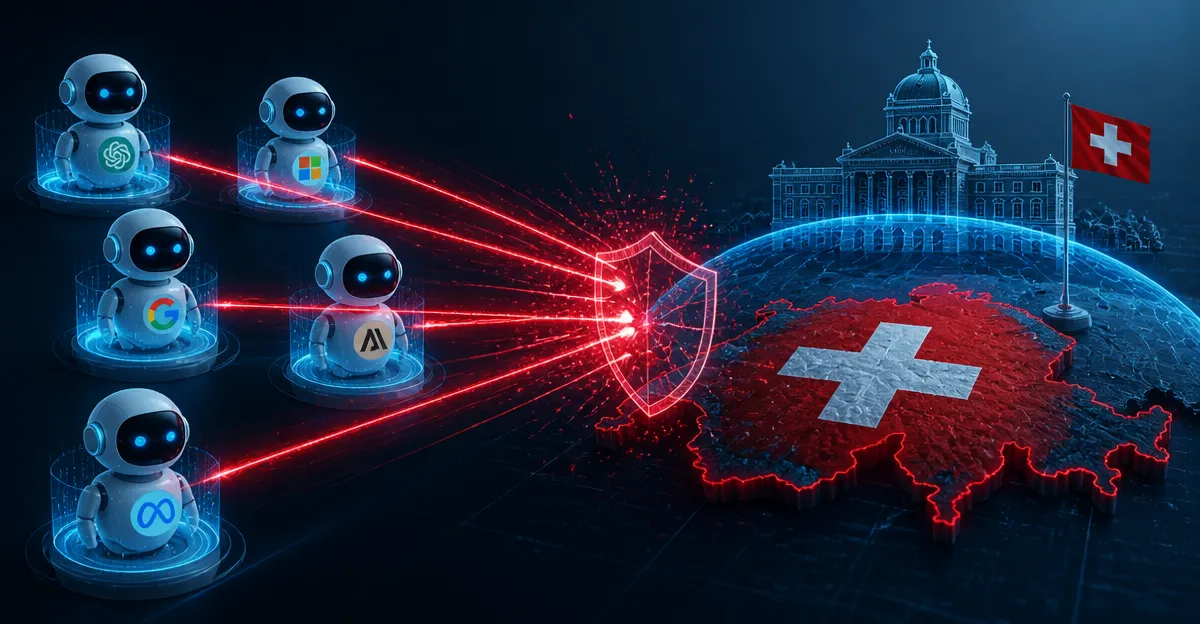
November 26, 2026, (Inside AI) — Switzerland's Federal Office for Cybersecurity (BACS) has confirmed that five cyber attacks in the past few days employed AI agents to target companies and critical infrastructure operators. The disclosure, issued Thursday, marks one of the first official government acknowledgments that autonomous AI systems are being actively used in cyber operations.
The attacks come as AI agents, software programs that can plan and execute tasks without human intervention, move from experimental tools to operational threats. BACS did not specify which sectors were hit or whether the attacks succeeded, but the involvement of AI agents signals a shift in the threat landscape that security officials have warned about for years.
Why AI Agents Change the Attack Calculus
Traditional cyber attacks require human operators to probe defenses, adapt tactics, and decide when to strike. AI agents can perform these functions at machine speed, continuously learning from failed attempts and adjusting in real time. That capability makes attacks faster, more persistent, and harder to attribute.
The Swiss disclosure follows a pattern of growing concern among governments. In recent months, security agencies in several countries have reported an uptick in AI-assisted intrusions, though few have confirmed the use of fully autonomous agents. The distinction matters: an AI-assisted attack still relies on a human for key decisions, while an AI agent can operate independently toward a goal.
Industry researchers have demonstrated that large language models can be repurposed to scan networks, craft phishing emails, and exploit vulnerabilities. The barrier to entry is falling as open-source agent frameworks proliferate. That democratization cuts both ways, enabling defenders to automate threat hunting but also giving attackers powerful new tools.
The economic incentive is clear. A single AI agent can run thousands of attack variations simultaneously, far exceeding the capacity of a human team. For critical infrastructure operators, many of whom run legacy systems with limited security budgets, the asymmetry is stark.
BACS has not released technical details, and Inside AI could not independently verify the specific methods used. The agency's statement was brief, but its implications are large. If AI agents are now operational in real-world attacks, the cybersecurity industry must rethink assumptions about speed, scale, and defense.
Some experts caution against overstating the sophistication of these attacks. Early AI agents often fail in unpredictable ways, and human oversight may still be required for complex operations. But even partially autonomous agents can overwhelm traditional defenses that rely on human-paced response.
The Swiss case also raises questions about attribution. AI agents can be rented, cloned, or repurposed, making it difficult to trace attacks to specific actors. That ambiguity complicates retaliation and deterrence, pillars of existing cyber policy.
Switzerland's disclosure may prompt other governments to follow suit. Transparency about AI-enabled attacks could accelerate international cooperation on norms and defenses. It could also spur investment in AI-driven security tools that can match the speed of autonomous threats.
For now, the five attacks serve as a warning. The era of AI agents in cyber operations has moved from theory to practice, and the defenders are playing catch-up.

Tobias is less interested in what a robot or a prompt can do today than in what it means for tomorrow. He writes about prompt engineering and robotics for readers who want context, not just specs.