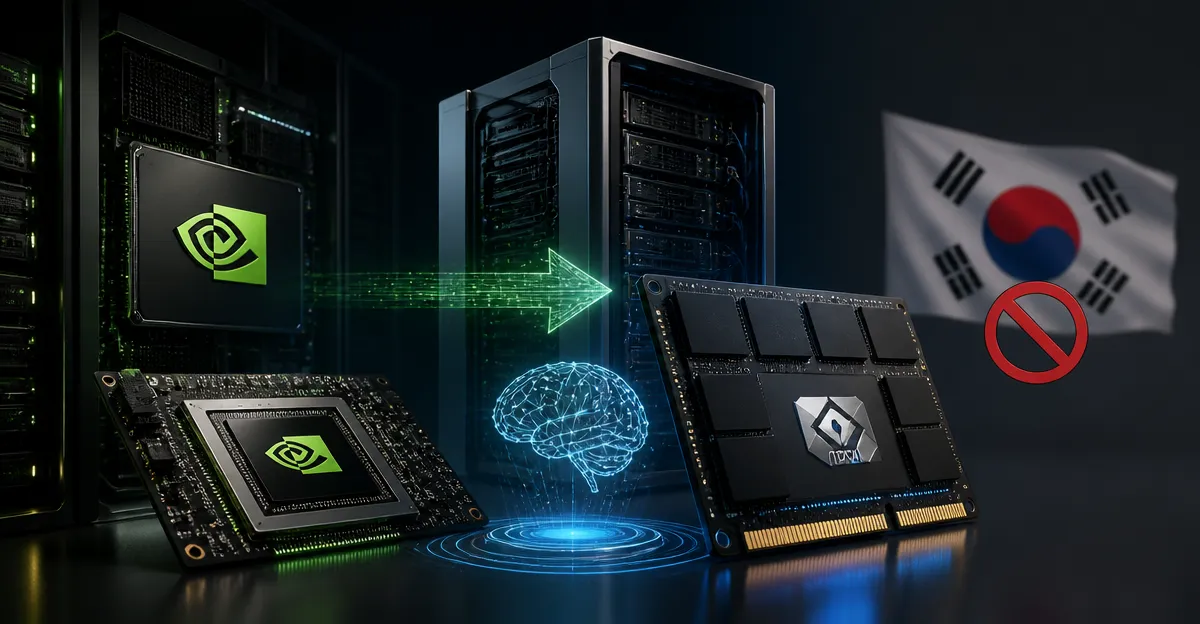
November 27, 2026, (Inside AI) — Japanese chipmaker Kioxia Holdings has begun a proof-of-concept test with Nvidia on memory for AI servers, according to sources. The collaboration aims to challenge South Korean dominance in high-bandwidth memory (HBM), a critical component for AI accelerators. The test combines Kioxia's memory technology with Nvidia's GPUs in a rack-scale system.
The partnership signals a potential shift in the AI memory supply chain, which is currently led by SK Hynix and Samsung Electronics. Both Korean firms have dominated the HBM market, which is essential for training and running large AI models. Kioxia's entry could introduce new competition and diversify sourcing for Nvidia, the leading designer of AI chips.
Details remain scarce, but the proof-of-concept likely involves Kioxia's BiCS FLASH technology, a 3D NAND flash memory. While HBM uses stacked DRAM, NAND flash offers higher density and lower cost per bit, though it is slower. Kioxia may be positioning its memory for specific AI workloads where capacity and cost matter more than raw speed, such as inference at scale.
Nvidia has not commented on the collaboration. Kioxia declined to provide specifics, but an official said the company is exploring "various memory solutions for AI applications." The test is part of a broader trend of Japanese semiconductor firms seeking to regain relevance in advanced chip markets.
Read: South Korea Says Nvidia Will Keep 260,000 GPU Pledge After Huang's Resignation
Why Nvidia Is Looking Beyond Korea
South Korean suppliers have faced production challenges and price volatility. SK Hynix, the primary HBM supplier to Nvidia, has struggled to meet surging demand. Samsung has faced yield issues. By working with Kioxia, Nvidia may be hedging against supply risks and seeking cost-effective alternatives.
The move also aligns with Nvidia's strategy to optimize its rack-scale systems, such as DGX and HGX, which integrate GPUs with high-speed memory. Kioxia's memory could be used in these systems for tasks like data preprocessing or caching, freeing up HBM for compute-intensive operations.
This is not Kioxia's first foray into AI memory. The company has been developing XL-FLASH, a low-latency NAND technology, which could be adapted for AI. However, the proof-of-concept with Nvidia is a significant endorsement.
Industry analysts note that the collaboration could accelerate the adoption of NAND in AI servers, but challenges remain. NAND has lower endurance and slower random access than DRAM, which may limit its use in critical AI tasks. Still, for inference and storage-tier memory, it could be viable.
The partnership also reflects Japan's push to revitalize its chip industry. Kioxia, formerly Toshiba Memory, has received government support and is investing in advanced production. The collaboration with Nvidia could boost its credibility.
As AI models grow larger, memory bandwidth and capacity become bottlenecks. Nvidia's interest in alternative memory sources underscores the need for innovation. The proof-of-concept will test whether Kioxia's memory can meet Nvidia's performance and reliability standards.
Read: South Korea Hits $1 Trillion in Exports on AI Chip Boom
If successful, the partnership could lead to commercial products, potentially disrupting the HBM market. However, the timeline is unclear, and the two companies have not disclosed when results will be available.
In the meantime, South Korean suppliers are ramping up HBM production. SK Hynix plans to invest billions in new facilities, and Samsung is aiming to catch up. The competition is intensifying, and Nvidia's move with Kioxia adds another dimension.
The collaboration also highlights the growing importance of memory in AI. As compute becomes more specialized, memory hierarchy is critical. Nvidia's willingness to explore alternatives shows that no supplier is irreplaceable.
For now, the proof-of-concept is a test. But it could be the first step toward a more diverse supply chain for AI memory, with Japan playing a larger role.

If a research paper dropped this week, Mahesh has already read it. He covers AI tools and vibe coding for builders who need to know what is worth their time and what is not.