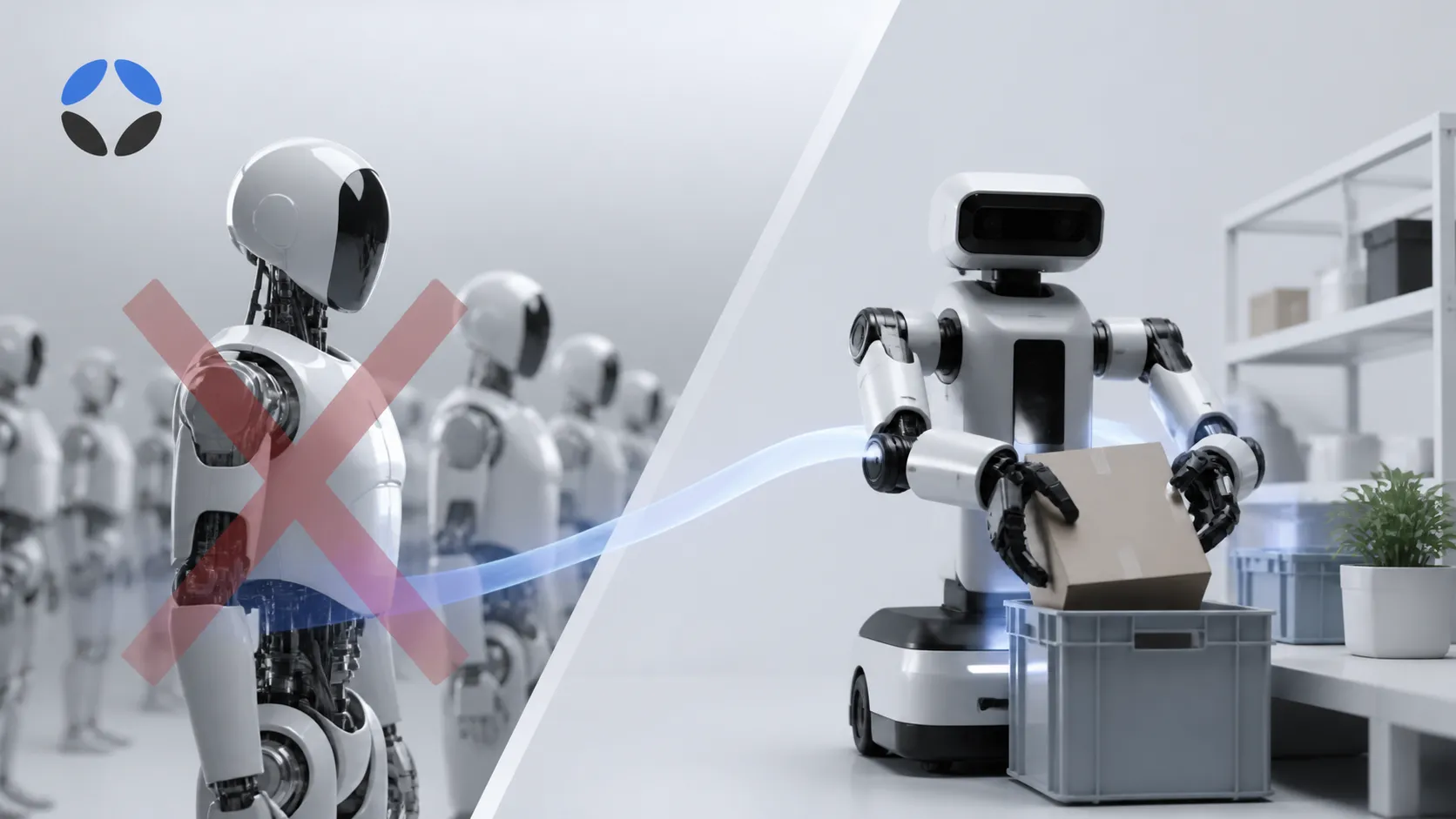
June 20, 2026, (Inside AI) — French robotics startup Genesis AI has unveiled Eno, a general-purpose robot that defies the industry’s humanoid obsession. Instead of mimicking human form, Eno pairs a wheeled base with a folding, extendable tower of articulated panels, prioritizing function over familiarity.
The Bet Against Anthropomorphism
Backed by former Google CEO Eric Schmidt and a $105 million seed round, Genesis AI challenges rivals like Tesla and Figure AI. The company argues that businesses need capable machines, not mechanical coworkers. Eno’s design reflects this: it collapses to suitcase size for transport and extends vertically for tasks.
Its standout feature is a pair of proprietary hands. With 20 active, back-drivable degrees of freedom and human-scale dimensions, they let Eno use existing tools and workspaces without costly retrofits. This dexterity, not a face or legs, is where Genesis AI invests its engineering.
A Foundation Model as the Brain
Eno runs on GENE, a robotics-focused foundation model. Genesis AI calls it a “true physical agent” that reasons, adapts, and manages complex tasks end-to-end. Unlike pre-programmed bots, Eno understands context, retains memory, and adjusts to changing conditions with millimeter-level precision.
Read: India Sits Out the US-China Embodied AI Robot Race
To build trust, an optional cognitive interface displays the robot’s intent, reasoning, and status in real time. This transparency could ease integration in human-centric settings like hospitals and hotels.
From Factories to Homes
Dozens of units are already built, with production scaling later this year. Initial deployments target logistics, manufacturing, and labs. Genesis AI plans to expand into hospitality and healthcare, then consumer markets. Eno might handle entire workflows: restocking lines, coordinating logistics, or prepping facilities for shifts.
The launch intensifies a robotics race fueled by AI, computer vision, and manipulation advances. But Genesis AI’s bet is distinct: dexterity over anthropomorphism. With Schmidt’s backing and a focus on human-level capability, Eno questions whether the future of general-purpose robots needs a human face.
Industry analysts note the risk of ignoring humanoid familiarity, which could ease social acceptance. Yet Genesis AI counters that wheeled mobility and compact storage offer practical advantages in dynamic workplaces. The company has not disclosed pricing, but its seed funding suggests aggressive scaling plans.
Read: Anthropic Unveils Model Hardware Standard to Let AI Agents Control Physical Machines
As deployments begin, Eno will test whether businesses truly value capability over appearance—and whether a folding robot with human-like hands can outperform its two-legged rivals.