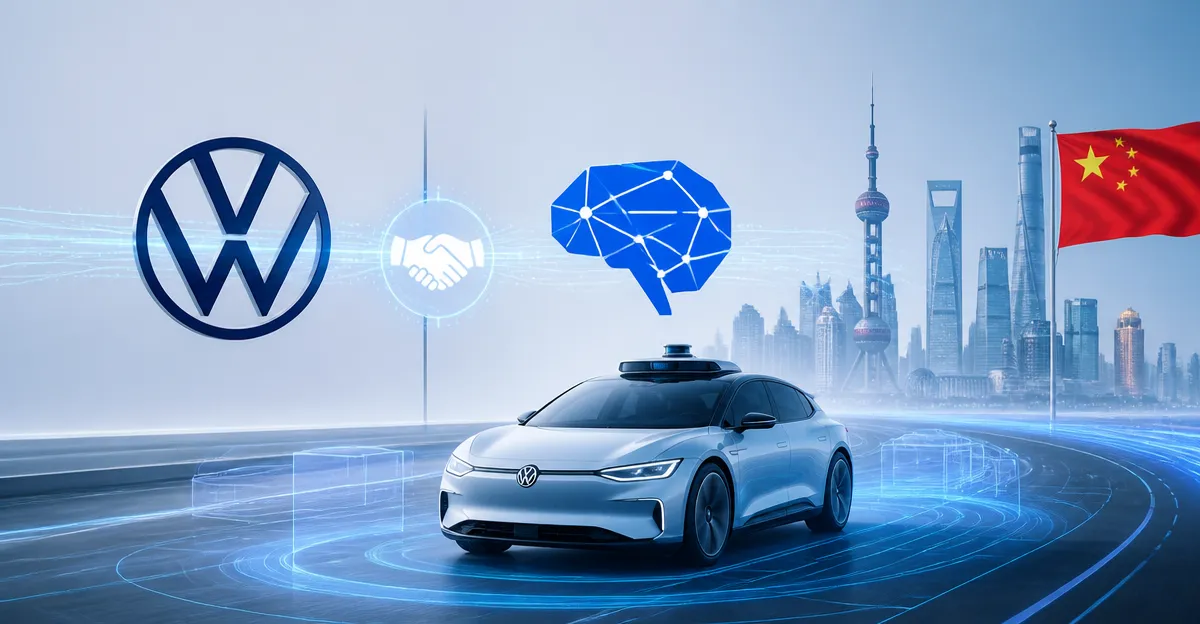
July 22, 2026, (Inside AI) — Volkswagen’s China-based automated driving unit CARIZON is deepening its partnership with Horizon Robotics to accelerate the development of Level 3 and Level 4 self-driving technologies. The German carmaker announced the move on Wednesday, targeting initial deliveries of Level 3 capabilities in the second half of next year.
The collaboration aims to integrate Horizon Robotics’ advanced automotive-grade chips and perception algorithms into Volkswagen’s next-generation vehicles. CARIZON, established in 2023 as a joint venture between Volkswagen’s software arm CARIAD and Horizon Robotics, serves as the focal point for this intensified effort. The partnership leverages Horizon Robotics’ expertise in edge AI computing to bring hands-free, eyes-off driving to Chinese consumers within a competitive timeline.
Level 3 automation allows drivers to disengage from active control under specific conditions, while Level 4 enables fully autonomous operation in defined areas. Volkswagen’s timeline places it in direct competition with domestic players like Xpeng and Baidu’s Apollo, who are already testing similar systems on public roads. The announcement underscores the strategic importance of China’s market, which accounts for over 40% of Volkswagen’s global vehicle sales.
The Architecture Behind the Ambition
Horizon Robotics’ Journey 6 series chips are central to the partnership. These systems-on-chip deliver up to 560 TOPS of computing power, designed specifically for urban autonomous driving scenarios. Unlike general-purpose processors, they integrate a dedicated neural processing unit that accelerates transformer-based perception models—critical for real-time object detection and path planning in complex Chinese traffic.
The technical roadmap involves fusing high-definition maps with sensor data from lidar, radar, and cameras. CARIZON’s engineering teams are adapting Horizon’s open-source software stack to Volkswagen’s vehicle platforms, a process that requires rigorous validation across millions of kilometers of road testing. Industry analysts note that the collaboration mirrors a broader trend of Western automakers partnering with Chinese tech firms to bypass lengthy in-house development cycles.
“The deliveries of Level 3 capabilities are targeted to begin in the second half of next year,” Volkswagen said in a statement. The company has not disclosed which vehicle models will first feature the technology, but insiders suggest the ID. Buzz and ID.7 electric vehicles are likely candidates given their modular electric architecture.
Navigating a Fractured Regulatory Landscape
China’s regulatory framework for autonomous driving is evolving faster than in Europe or the U.S. Cities like Beijing and Shanghai have already issued permits for Level 4 robotaxi services, while national standards for Level 3 remain under development. Volkswagen’s partnership with Horizon Robotics provides a compliance advantage, as the Chinese firm’s systems are pre-certified for domestic data security requirements—a growing concern given geopolitical tensions over technology transfer.
However, competing viewpoints from safety advocates caution against aggressive deployment timelines. A 2025 study from Tsinghua University found that edge cases in Chinese urban environments—such as unmarked intersections and erratic pedestrian behavior—still challenge current perception systems. Volkswagen’s phased rollout, starting with highway-only Level 3, appears designed to mitigate these risks while building consumer trust.
The partnership’s deepening also reflects Volkswagen’s broader restructuring. After disbanding its Cariad unit’s independent self-driving efforts in 2024, the company pivoted to a collaborative model. CARIZON now employs over 1,200 engineers, with plans to double headcount by 2027. Horizon Robotics, which went public in Hong Kong in 2024, has seen its market valuation exceed $8 billion, driven by partnerships with BYD and Great Wall Motors.
Looking ahead, the success of this collaboration hinges on seamless integration of hardware and software. Volkswagen’s global scale provides a massive data collection network, while Horizon’s localized expertise addresses unique Chinese driving norms. As the automotive industry consolidates around a few key autonomous platforms, this partnership could set a template for cross-border technology alliances in an era of decoupling supply chains.