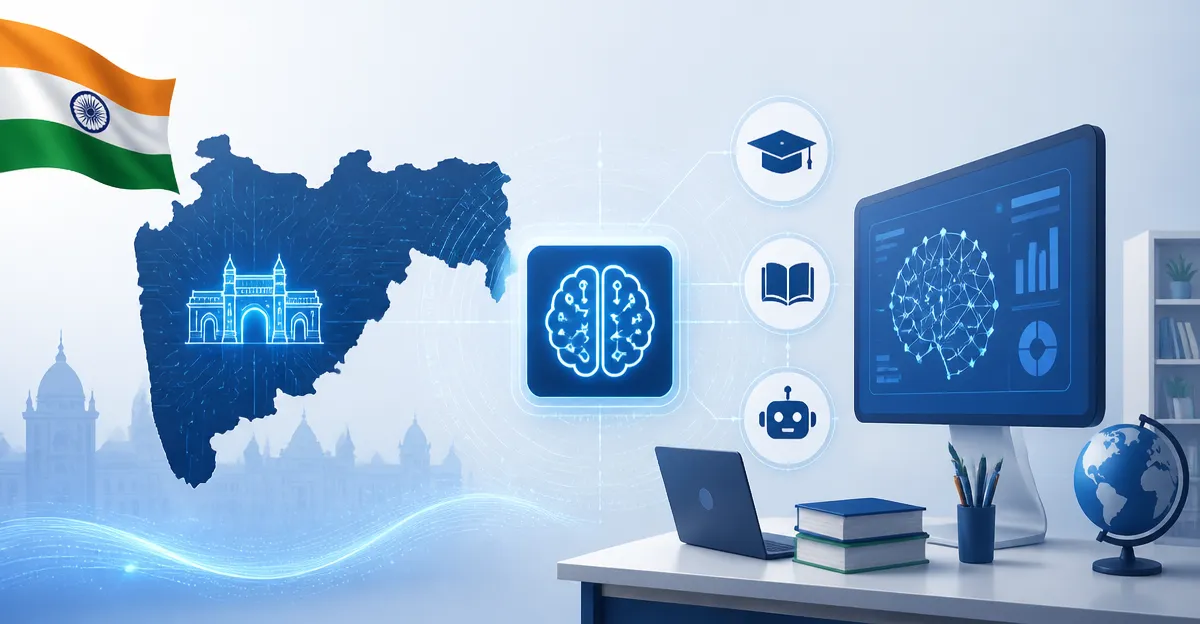
July 23, 2026, (Inside AI) — Every government school teacher in Maharashtra, from primary to higher secondary level, must now complete a mandatory artificial intelligence training course by September 30, according to a directive from the State Council of Educational Research and Training (SCERT). The four-hour online module, called 'AI Saathi', is hosted on the central government's DIKSHA portal and has been developed with the Kotak Education Foundation.
The circular, issued by SCERT Director Dr Hemant Vasekar, frames the training as essential preparation for the growing presence of AI tools in lesson planning, assessments, data analysis, and administrative reporting. The course will count toward the 50-hour annual professional development requirement under the National Education Policy (NEP) 2020 framework, with registration open until August 31.
This move marks one of India's most sweeping state-level mandates for AI literacy among educators, directly targeting the entire teaching workforce across Classes 1 to 12. The training covers AI and machine learning fundamentals, classroom and administrative tools, and ethical principles for safe and responsible use.
A Statewide Push Into Uncharted Classroom Terrain
Maharashtra's order goes beyond the typical pilot programs seen in other states. By making AI training compulsory for all teachers, SCERT is betting that foundational AI knowledge is now as critical as digital literacy was a decade ago. The course is designed to help teachers integrate AI into instruction and school management, not just use it passively.
Dr Vasekar's circular explicitly links the initiative to the NEP 2020's emphasis on continuous professional development. The policy requires teachers to complete 50 hours of training annually, and the 'AI Saathi' module will contribute 4 hours toward that target. This integration ensures the mandate aligns with existing frameworks rather than adding an extra burden.
However, the directive raises questions about infrastructure readiness. Many government schools in Maharashtra still struggle with basic internet connectivity and device availability, with only 47.5% of government schools had functional computers, and internet access was even patchier. Without addressing these gaps, the training risks becoming a theoretical exercise for many teachers.
The course content includes practical applications like using AI for creating instructional materials and automating report writing, but it stops short of hands-on tool training. This is a deliberate choice, likely to avoid vendor lock-in and focus on conceptual understanding. Yet, teachers may struggle to apply these concepts without access to actual AI tools in their classrooms.
Ethics and Equity: The Unspoken Curriculum
One standout element of the 'AI Saathi' course is its emphasis on ethical and responsible AI use. This is a crucial addition, given the risks of bias, privacy violations, and misinformation that can accompany AI tools in education. The module addresses these concerns head-on, preparing teachers to critically evaluate AI outputs rather than accepting them blindly.
Still, the training's brevity—just four hours—may limit its depth. Research from UNESCO on AI and education suggests that effective teacher training requires ongoing support and community practice, not one-off modules. Maharashtra's approach risks being a checkbox exercise unless followed by sustained mentoring and resource provision.
The collaboration with Kotak Education Foundation hints at a public-private partnership model, but details on funding and long-term support are scarce. Without transparency, there's a danger of inequitable implementation, where urban schools with better resources benefit more than rural ones.
As the September deadline approaches, the real test will be whether this mandate translates into meaningful change in classrooms or becomes another compliance metric. For now, Maharashtra's teachers are on the clock to become AI-literate—ready or not.