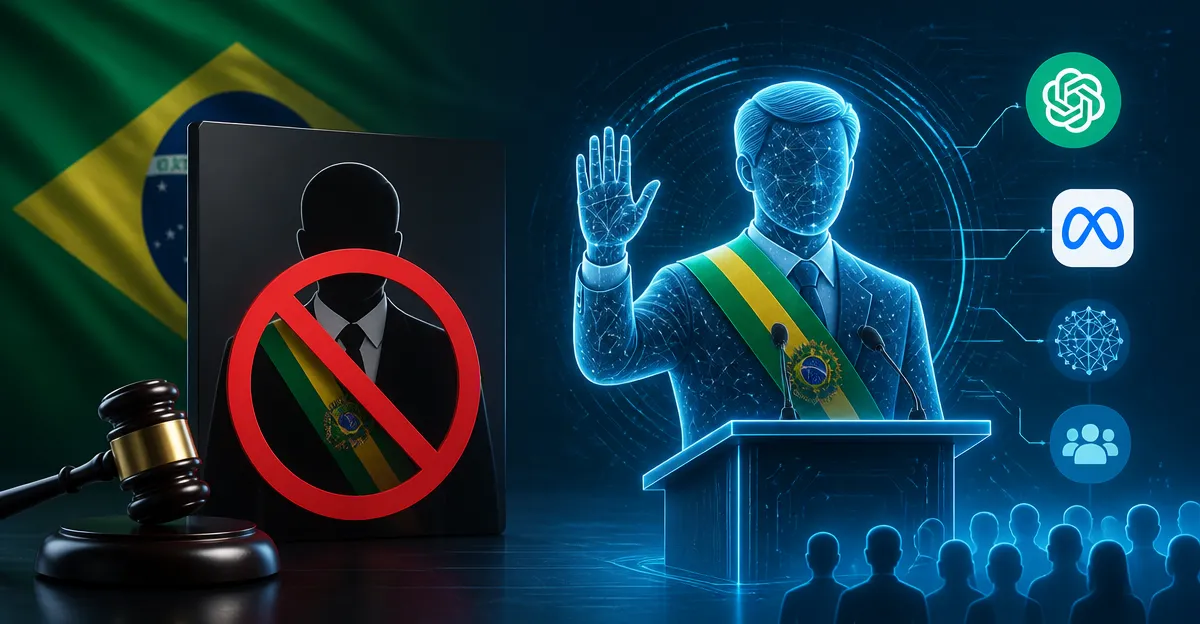
July 28, 2026, (Inside AI) — An AI-generated avatar of Brazil's jailed former president Jair Bolsonaro appeared at his son Flavio's presidential campaign launch on Saturday, igniting a legal and electoral firestorm. The synthetic video, disclosed as AI-made, urged supporters to back Flavio in October's election against incumbent Luiz Inacio Lula da Silva, directly challenging a judicial ban on Bolsonaro's public communications.
Leftist parties filed an emergency petition Sunday, arguing the avatar violates electoral rules against synthetic content that can sway voters. The case tests whether AI can serve as a political surrogate for leaders muzzled by the state, expanding the debate beyond deepfake misinformation into the realm of sanctioned campaign tools.
Bolsonaro is under house arrest for plotting to overturn his 2022 loss to Lula, and is barred from public messaging. The avatar's message was unambiguous.
"No prison will silence the feeling of hope we have stirred," the avatar said, after telling the audience it had been made with artificial intelligence. "It's why I ask you to welcome with open arms the person I chose to replace me."
The stunt, first reported by Reuters, forces Brazil's Superior Electoral Court (TSE) to interpret its own AI rules. The court's president, Justice Kassio Nunes Marques, a Bolsonaro appointee, told O Estado de S. Paulo that using AI for campaigning is permissible, but not to harm someone. He declined to comment on the specific case.
The TSE's rule bans fabricated or manipulated content in electoral ads that spreads false or misleading information undermining election fairness. But the avatar was labeled as AI and did not make false claims, complicating enforcement. Ivar Hartmann, an associate law professor at Insper in Sao Paulo, said Bolsonaro likely avoids penalties because he can argue he neither recorded nor authorized the message.
"The challenge with artificial intelligence is that it is virtually impossible to control," Marco Aurelio Mello, a former justice who has also led Brazil's Superior Electoral Court (TSE), told Reuters.
The episode highlights a regulatory vacuum. While global AI election fears center on deepfakes, Brazil's case is novel: a candidate using AI to channel a banned figure's persona with plausible deniability. The campaign told O Globo that Bolsonaro was not informed in advance, and that disclosing the AI origin provided sufficient legal cover.
This mirrors tactics in other nations. In 2024, a Pakistani party used an AI clone of jailed ex-PM Imran Khan to deliver speeches. But Brazil's electoral code is more specific, banning synthetic content that reproduces real people to influence voter intent, as the leftist petition argues.
Technically, the avatar was likely created using a combination of voice cloning and lip-sync models, similar to open-source tools like Coqui TTS. Such systems can generate convincing speech from text with minimal training data. The campaign has not disclosed the exact technology used.
Legal scholars note a key tension: if the avatar is not deceptive and is labeled, it may fall outside the TSE's prohibition on misleading content. But the petition argues that any synthetic representation of a real person inherently manipulates voters, a view supported by research on AI persuasion showing that personalized synthetic media can shift political attitudes.
The TSE must now decide whether the avatar's mere existence, even with disclosure, constitutes an unfair influence. The ruling could set a precedent for how democracies handle AI proxies for sanctioned politicians, a scenario likely to recur as voice and video synthesis become commoditized.
Senator Flavio Bolsonaro's campaign has not commented on the video. The former president remains a powerful conservative figurehead, and his virtual endorsement could mobilize his base while skirting communication bans. Whether this becomes a recurring campaign feature depends on the court's ruling and the campaign's risk appetite.
The incident also exposes a gap in platform policies. Major social networks have rules against manipulated media, but enforcement is inconsistent, and the video spread rapidly on messaging apps like WhatsApp, where moderation is minimal. Brazil's electoral authority has previously threatened to ban platforms that fail to curb disinformation, but AI avatars present a new challenge.
As October approaches, the avatar's legacy may be less about Bolsonaro and more about forcing a global reckoning on AI's role in circumventing judicial orders. For now, the virtual ex-president has already made his mark, blurring the line between campaign innovation and electoral subversion.