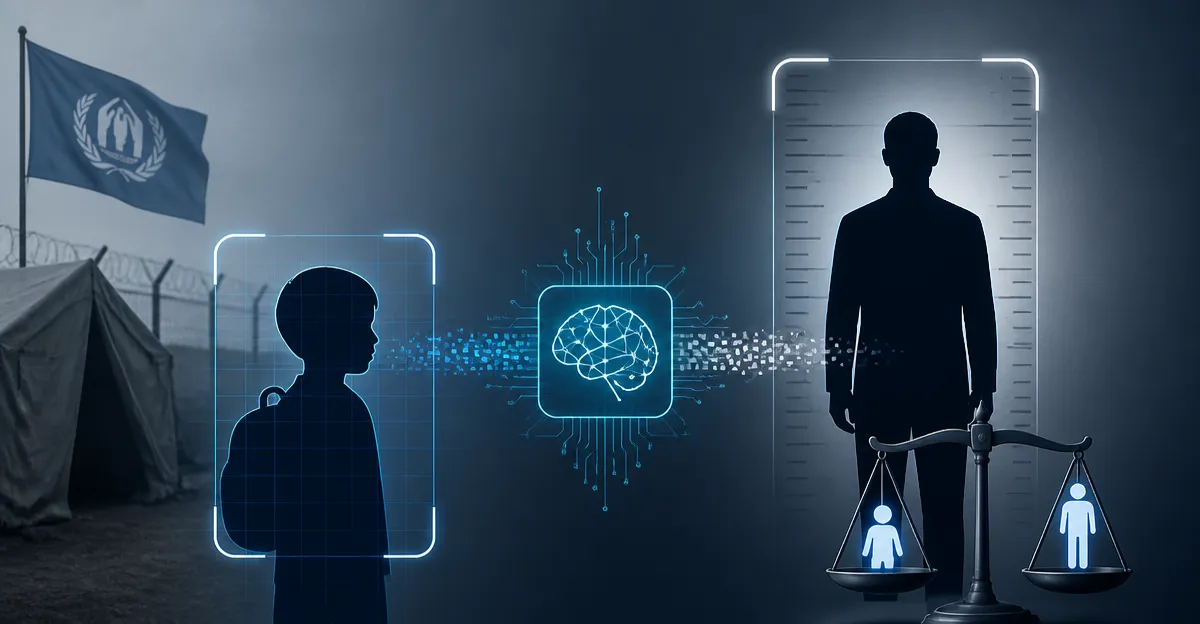
July 29, 2026, (Inside AI) — The UK Home Office’s plan to deploy AI-powered facial age-estimation technology on migrant children has triggered sharp warnings from human rights groups, who say the system’s documented racial bias will push more vulnerable minors into adult detention and removal proceedings.
The Humans for Rights Network, alongside other charities, is urging ministers to halt the rollout, citing a 30-month margin of error admitted by the government and evidence that the software overestimates the ages of Black children, particularly those from sub-Saharan Africa.
Maddie Harris of the Humans for Rights Network said the charity had already seen hundreds of children wrongly assessed as adults by immigration officers. She called the AI a “cheap process” that would not fix existing failures.
“This is not about protecting children - this is about shoring up the decisions that [the authorities] are making,” Maddie Harris, Humans for Rights Network
The technology, developed by German firm Cognitec, was contracted in May. An investigation by Lighthouse Reports in June found it showed clear bias against sub-Saharan Africans, tending to overpredict minors’ ages. The UK tech monitor Foxglove has labeled the systems as relying on “racist bias” and said the government should not test experimental tech on children.
The Refugee and Migrant Children’s Consortium added that trauma, malnutrition, and arduous journeys can physically age a child’s appearance, undermining the accuracy of any facial analysis. Harris warned that misclassification exposes children to detention, removal, and housing with adults—risks amplified by rising anti-asylum protests targeting accommodations.
In 2025, 755 children were incorrectly identified as adults on arrival, according to Home Office figures revealed by the Helen Bamber Foundation in May. The AI system is intended to supplement, not replace, officer assessments, but critics say it will merely reinforce existing biases.
A Home Office spokesperson defended the move: “Age assessments are a vital tool in maintaining border security. As part of our work to make this process more robust and consistent, we are exploring cutting-edge AI technology to verify migrants' ages.”
The controversy echoes broader European failures in border tech. Petra Molnar, co-founder of Migration and Tech Monitor, noted that previous AI-powered lie-detection pilots for refugees proved to be “snake oil” and never advanced beyond trials. She compared the age-estimation software to the discredited 19th-century pseudoscience of phrenology.
“It's effectively 'neo-phrenology' by categorising people based on physical features,” Petra Molnar, Migration and Tech Monitor
Molnar stressed that context is critical: dehydration, torture, and even the journey itself alter facial features. A study on facial age estimation highlights how environmental factors degrade accuracy, while a technical overview of Cognitec’s FaceVACS details the algorithms under scrutiny. The Home Office has not disclosed specific validation data for the migrant screening context.
The pushback comes as the UK grapples with rising asylum applications and a contentious political debate over border control. Rights groups argue that the AI’s deployment risks institutionalizing discrimination, with Harris noting that children from Sudan and Somalia are already “adultified” by the system.
Unaccompanied minors could be placed in adult accommodation, exposing them to violence and the volatile environments seen in recent protests. The consortium’s concerns underscore a fundamental tension: using technology to streamline border processes may come at the cost of child safety.
As the government moves forward, the debate is likely to intensify, with legal challenges possible. For now, the Home Office maintains that age assessments are essential for security, but critics see a flawed experiment that could cause irreparable harm to the most vulnerable.