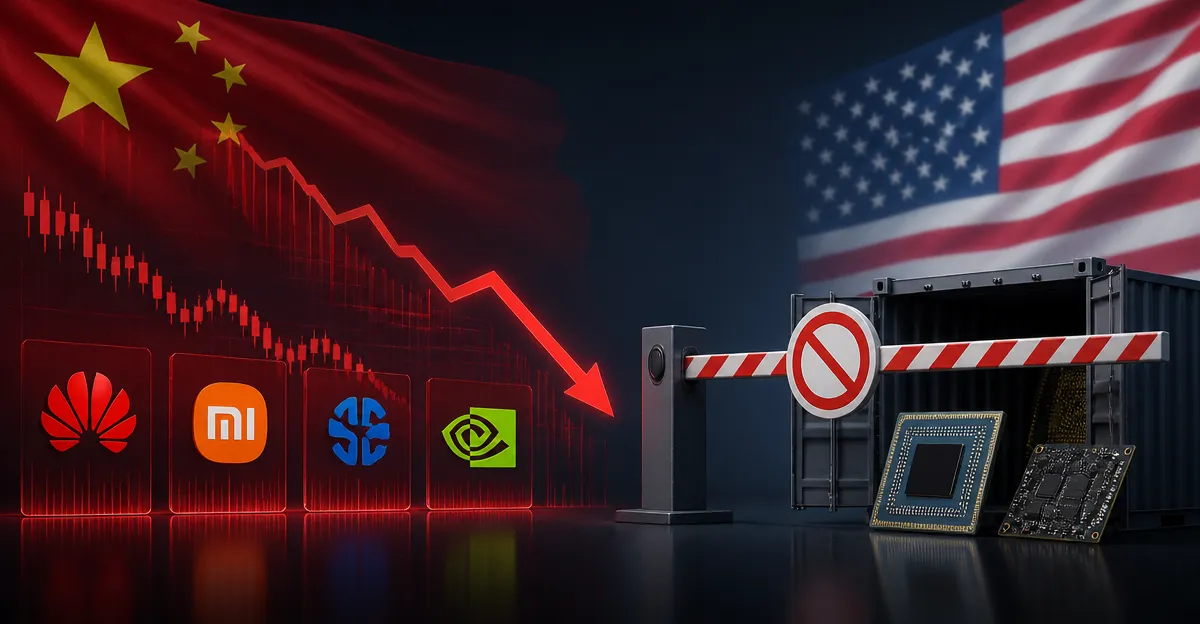
August 5, 2026, (Inside AI) — Chinese AI hardware stocks plunged Wednesday after Reuters revealed the Trump administration is drafting a ban on U.S. imports of new Chinese data center components, specifically targeting optical transceivers.
The CSI300 Telecommunication Services Index dropped 6% in early trading. Shares of key exporters like Zhongji Innolight, Eoptolink Technology, and Suzhou TFC Optical Communications all opened sharply lower.
Optical transceivers are critical for high-speed data transmission inside data centers, converting electrical signals to light for fiber-optic cables. The proposed ban threatens to sever a vital supply chain link, as Chinese firms dominate global production of these components.
This move escalates the tech cold war, shifting from restricting advanced chips to choking off the passive infrastructure that enables AI scaling. It follows years of U.S. efforts to curb China's AI ambitions, including export controls on Nvidia GPUs and sanctions on Huawei.
Zhongji Innolight, which generated 62% of its revenue from the U.S. in the first quarter, saw shares fall roughly 8% in both Shanghai and Hong Kong. The company is a leading maker of high-speed optical modules, essential for 800G and emerging 1.6T networks.
Optical Supply Chain at the Center of Tech Tensions
The ban targets new models of optical transceivers, components that enable data to travel at light speed within data centers. Chinese firms like Innolight and Eoptolink have invested heavily in next-gen designs, often using silicon photonics to reduce power consumption.
U.S. hyperscalers such as Amazon, Microsoft, and Google rely on these imports for their expanding AI infrastructure. A disruption could delay deployments and raise costs, as alternative suppliers in the U.S. and Japan lack equivalent scale.
The news compounds a savage sell-off in Chinese AI stocks, already reeling from weak domestic demand and global trade jitters. The CSI Artificial Intelligence Index has fallen over 20% this year, reflecting broader skepticism about the sector's profitability.
Industry analysts note that optical transceivers are a chokepoint. A LightCounting report estimates Chinese vendors hold over 50% of the global market for high-speed modules, a dominance built through aggressive pricing and government subsidies.
Escalation Beyond Chips Raises Stakes for AI Buildout
Previous U.S. actions focused on cutting-edge logic chips and manufacturing tools. The October 2022 export controls crippled China's ability to produce advanced semiconductors, but optical components were largely untouched until now.
By targeting transceivers, the administration is acknowledging that AI infrastructure depends on more than just processors. A single data center can require hundreds of thousands of optical links, making them a strategic vulnerability.
China's Ministry of Commerce has not yet responded, but past retaliation has included rare earth export curbs and antitrust probes into U.S. tech firms. The move could accelerate China's push for self-sufficiency in photonics, a field where it already has significant research output.
A 2023 paper in Nature Photonics highlighted China's rapid progress in integrated photonics, but commercializing advanced transceivers without U.S. components remains a challenge. The ban may inadvertently boost domestic champions like Accelink Technologies.
For now, the immediate impact is market turmoil. The CSI300 tech sub-index extended losses, with traders bracing for a prolonged trade conflict that could reshape the global AI supply chain.