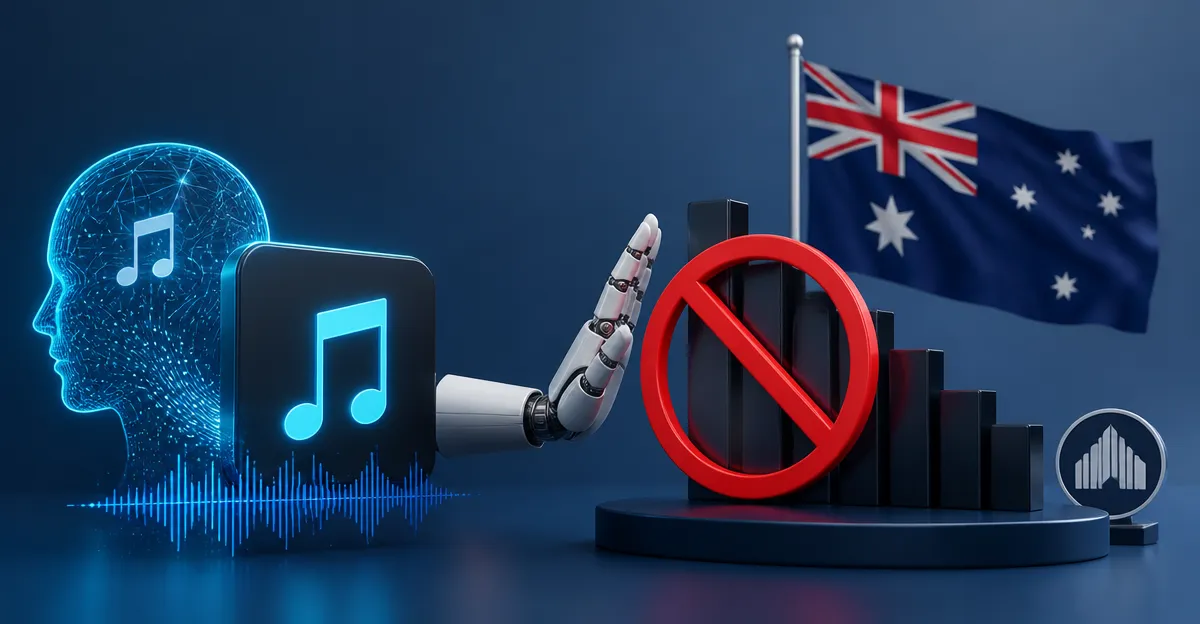
August 26, 2026, (Inside AI) — Australia’s official music charts will ban wholly AI-generated tracks starting this week, a move that follows a viral dispute over a Madonna cover that climbed the rankings without clear disclosure of synthetic production.
The Australian Recording Industry Association, or ARIA, confirmed Tuesday that fully AI-created recordings are no longer eligible for its weekly charts. Songs that use generative AI in a supporting role can still qualify, but only if the work is “substantially human made” and raises no concerns around streaming or chart manipulation.
This policy shift targets a specific flashpoint: Queensland-based DJ Josh Fawaz saw his cover of Madonna’s 1989 hit “Like a Prayer” become the most-played song on Australian radio and reach No. 4 on two ARIA charts in July. Some producers alleged generative AI had been used without initial disclosure.
ARIA will apply definitions from a labelling standard announced by the global music community in July to distinguish AI-generated recordings from AI-assisted ones. The distinction matters because major record labels are actively pursuing new licensing arrangements as synthetic music floods streaming platforms and consumers struggle to tell human and machine-made songs apart.
Read: German Court Rules AI Music Firm Suno Broke Copyright Rules
“The ARIA charts will always remain a transparent measurement of the music Australia consumes, but a chart that rewards unlicensed AI output would undercut the very basis of the recorded music we exist to represent,” Annabelle Herd, ARIA CEO, said.
ARIA compiles Australia’s most popular songs and albums, released every Friday on Apple Music and Spotify. The exclusion of fully synthetic tracks is a structural guardrail, not a one-off penalty. It signals that chart integrity now requires a human authorship test, a standard that could ripple across other national rankings.
Why a Madonna Cover Became the Breaking Point
Fawaz’s cover did not just chart; it dominated radio airplay. That visibility made it a proxy for a larger industry anxiety: can unlicensed AI output compete with human artists on equal footing? Producers who questioned the track’s production method argued that failing to disclose AI use distorted listener expectations and chart fairness.
Responding to a music producer’s criticism on Instagram in June, Fawaz said that although he used AI “as a tool, it’s not that deep”, adding he had been releasing music long before AI and his focus was to provide his listeners “good music.”
Inside AI could not independently verify the specific production techniques used in the cover. However, the incident mirrors a global pattern. In 2023, an AI-generated track mimicking Drake and The Weeknd was pulled from streaming services after rights holders objected. In 2024, Universal Music Group sued an AI startup for training on copyrighted lyrics. Australia’s chart ban is the first national ranking system to codify a human-made requirement.
Read: Sony, Warner Music Sue Anthropic Over Songs Used in AI Training
What the New Eligibility Standard Actually Means
The practical test is whether a recording is “substantially human made.” ARIA has not published a quantitative threshold, such as a minimum percentage of human-generated audio or composition. Instead, it leans on the global labelling standard announced in July, which is expected to require clear metadata tags for AI-assisted works.
This ambiguity could create enforcement challenges. A producer might use AI to generate a backing vocal, then manually edit and mix it. Would that qualify as AI-assisted or AI-generated? ARIA’s reliance on external definitions suggests a case-by-case review process, but the organization has not detailed how it will audit submissions.
The broader context is commercial. Major labels are negotiating licensing deals with AI companies to protect catalogues. If charts reward unlicensed synthetic output, those negotiations lose leverage. ARIA’s move aligns the chart ecosystem with the legal and economic interests of rights holders.
For Australian listeners, the immediate effect is subtle. Most chart-topping songs are human-made. But the precedent is significant: it establishes that national rankings can serve as enforcement points for AI disclosure norms, not just popularity metrics.