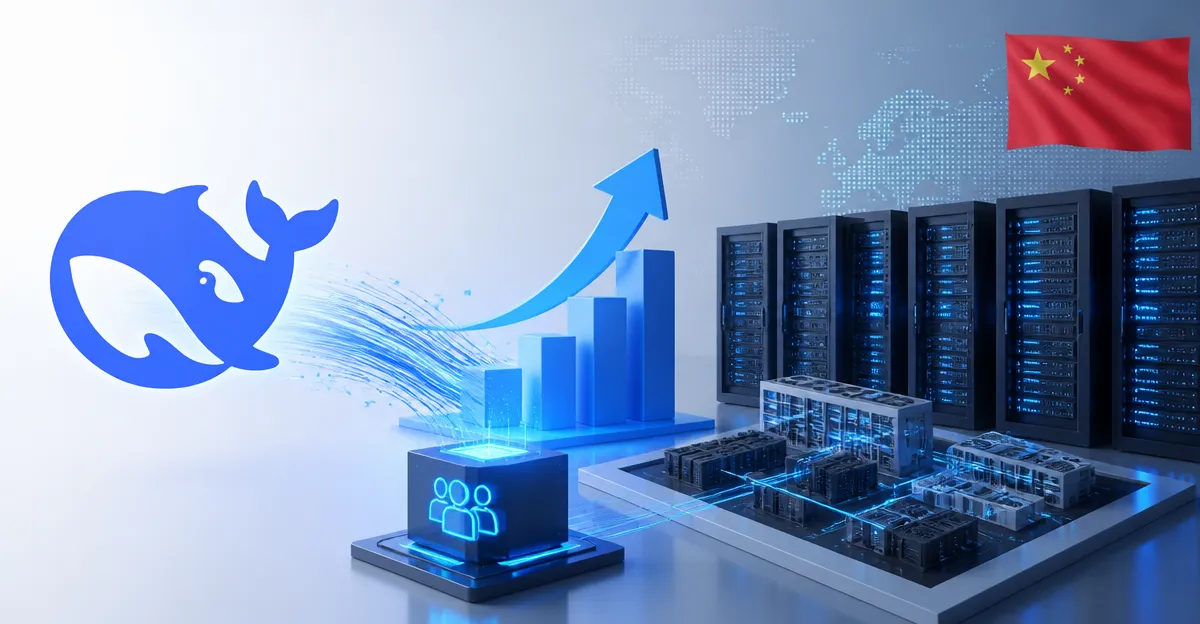
August 12, 2026, (Inside AI) — DeepSeek is quietly building a massive AI infrastructure team, signaling a strategic shift from pure model research into owning the physical backbone of artificial intelligence. The company has posted a flurry of job listings for a new IDC data-center unit across Beijing, Hangzhou, and Ulanqab, seeking specialists in planning, construction, testing, and operations.
The move marks a departure for the Chinese AI lab, which rose to prominence on the back of efficient, open-source large language models. By bringing data-center expertise in-house, DeepSeek is positioning itself to control every layer of the AI stack, from silicon to software, at a time when compute infrastructure has become the scarcest resource in the industry.
The listings span a striking breadth of disciplines: electrical engineering, HVAC, automation, energy systems, communications, computer science, environmental engineering, and civil engineering. The roles reference both traditional IDC facilities and dedicated AI computing centers, with cooling technologies ranging from conventional air-based systems to advanced liquid cooling. The scale is equally ambitious, with projects described from megawatt-level server rooms to gigawatt-scale campuses.
This infrastructure push comes as global AI labs grapple with the exploding costs and energy demands of training frontier models. Rivals like OpenAI and Anthropic have struck multibillion-dollar deals with cloud providers and are reportedly exploring dedicated AI data centers, while Google and Microsoft pour tens of billions into custom silicon and campus expansions. DeepSeek’s decision to build its own team suggests it sees infrastructure independence as a competitive moat, rather than a commodity to rent.
The choice of locations is telling. Beijing and Hangzhou are established tech hubs with deep talent pools, but Ulanqab, in Inner Mongolia, has emerged as a strategic site for hyperscale data centers due to its cool climate, abundant renewable energy, and government incentives. It already hosts facilities for Alibaba, Tencent, and Huawei, making it a logical base for DeepSeek’s most power-hungry workloads.
DeepSeek has not publicly commented on the scale of its investment, but the job descriptions hint at a long-term, vertically integrated vision. The company is recruiting for roles that span the entire lifecycle of a data center, from initial site planning and civil engineering to ongoing operations and testing. This suggests it is not merely retrofitting existing colocation space but likely designing and building facilities from the ground up.
The Cooling Conundrum
One detail stands out in the listings: explicit references to both air- and liquid-cooling systems. As AI chips like Nvidia’s H100 and B200 push power densities beyond the limits of traditional air cooling, liquid cooling has become a necessity for large-scale training clusters. DeepSeek’s early embrace of this technology could give it a cost and performance edge, especially if it designs custom cooling loops optimized for its own model architectures.
Industry analysts note that liquid cooling can reduce energy consumption by up to 40% compared to air cooling in high-density environments, a critical factor as electricity costs and carbon footprints come under increasing scrutiny. By hiring HVAC and energy specialists directly, DeepSeek may be aiming to innovate beyond off-the-shelf solutions.
From Software to Silicon Sovereignty
DeepSeek’s pivot mirrors a broader trend among leading AI companies to internalize infrastructure. OpenAI has reportedly held talks with SoftBank and Oracle on a $100 billion data-center project, while Meta has designed its own custom chips and cooling systems for years. For a company like DeepSeek, which has built its reputation on algorithmic efficiency, controlling the physical layer could unlock new levels of optimization that cloud providers cannot offer.
Yet the move is not without risk. Building and operating data centers demands a fundamentally different skill set from AI research, and the capital expenditures are enormous. DeepSeek will need to navigate supply-chain bottlenecks for critical components like transformers and cooling equipment, as well as regulatory hurdles around energy consumption and land use in China.
The listings also raise questions about DeepSeek’s relationship with cloud partners. The company has previously relied on external compute providers, but a full-fledged data-center team could signal a shift toward self-sufficiency, potentially reducing its reliance on Alibaba Cloud or Tencent Cloud. This would align with a broader push by Chinese tech giants to decouple from Western technology and build sovereign AI capabilities.
As the AI arms race intensifies, the battleground is shifting from algorithms to atoms. DeepSeek’s infrastructure hiring spree is a clear signal that it intends to compete not just on model quality, but on the raw physical capacity to train and serve the next generation of AI.