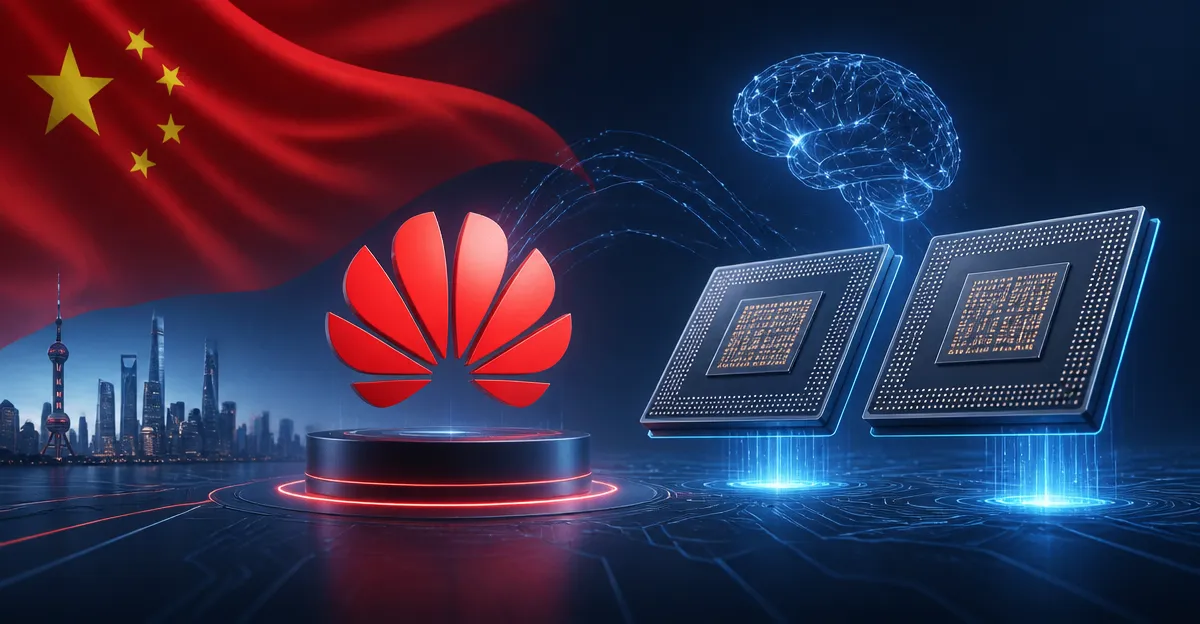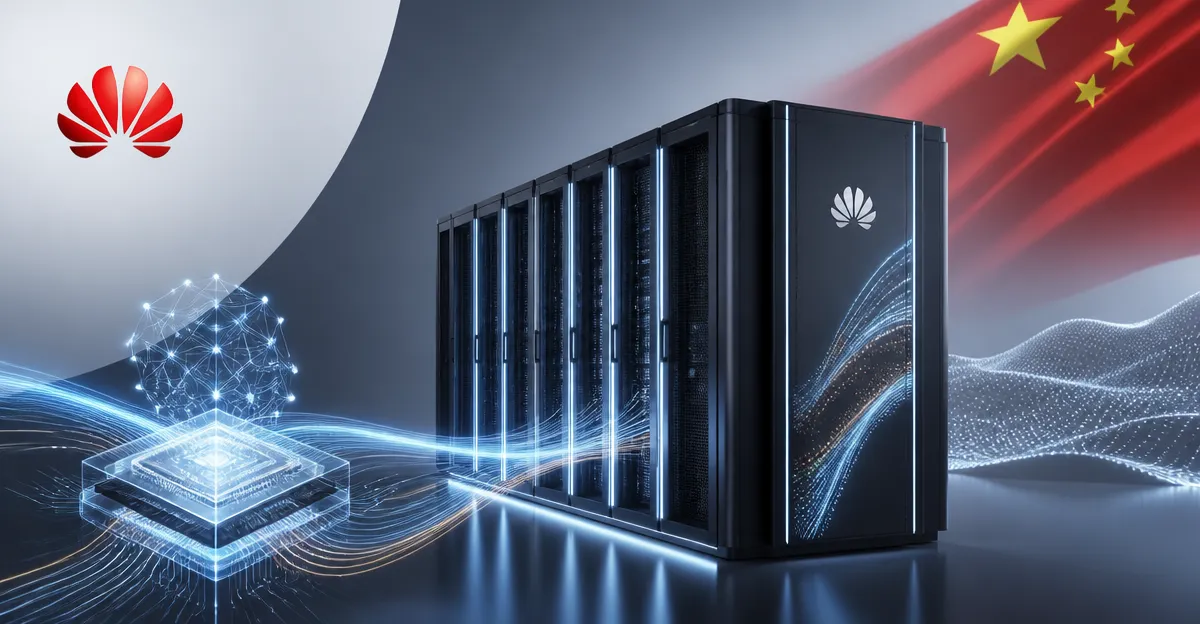
September 17, 2026, (Inside AI) — Huawei unveiled the Ascend 960 SuperPoD at HUAWEI CONNECT 2026 in Shanghai today, claiming it is the industry's first supercomputer cluster to use Near-Packaged Optics (NPO). The system supports up to 4,096 NPU cards and delivers 8 exaflops of FP8 computing power with 1 petabyte of HBM capacity. The announcement signals a shift from optimizing individual chips to engineering entire AI infrastructure as a single coordinated system.
The launch addresses a growing bottleneck in AI training: communication between chips. In a 100,000-card AI cluster, data exchange can consume more than 40% of training time under traditional architectures. Huawei's SuperPoD approach connects multiple computing nodes through high-speed interconnects, allowing them to share unified memory and operate like one giant computer. This architecture is designed for models reaching the 10-trillion-parameter scale, where adding more servers alone no longer improves performance.
At the center of the Ascend 960 SuperPoD is Huawei's Hi-ONE, an NPO product that brings optical components closer to computing chips. According to Huawei, each Hi-ONE engine delivers 7.2 terabits per second of transmission capacity. In the Ascend 960 SuperPoD, around 5,500 Hi-ONE units replace the 48,000 800G optical modules that would otherwise be required, reducing power consumption by more than 550 kilowatts. The system's mean time between failures will double, and availability will reach 99.8%.
"Advancing the Agentic World, Building a Solid Silicon Foundation," said Wang Tao (David Wang), Huawei Deputy Chairman and Rotating Chairman, during his keynote. He outlined Huawei's vision for AI infrastructure that goes beyond raw chip performance to include interconnects, storage, and system architecture.
Read: DeepSeek Plans 160,000-Chip Huawei Cluster
The move reflects a broader industry trend. As AI models grow, the performance of a single chip is only one part of the picture. How chips connect, how data moves, how memory is shared, and how storage works together can be just as important. Huawei's work around the Ascend 960 SuperPoD, NPO, and UnifiedBus is essentially about turning more computing resources into one coordinated system.
This system-level approach contrasts with the chip-centric strategies of competitors like Nvidia and AMD. While those companies focus on advancing process technology and memory capacity, Huawei is betting that interconnect and packaging innovations will define the next phase of AI infrastructure. The company is already discussing AI clusters with up to one million cards, anticipating demand from AI agents, autonomous driving, and AI-enabled devices.
Huawei's emphasis on NPO also highlights a critical challenge: traditional copper connections and pluggable optical modules struggle with bandwidth, latency, power consumption, and connection density as clusters scale. By shortening the distance that high-speed electrical signals must travel, NPO reduces power and improves reliability. This is not just a incremental improvement; it is a architectural shift that could influence how future data centers are built.
The Ascend 960 SuperPoD is part of Huawei's broader push to build a solid silicon foundation for the agentic world. As AI agents run continuously and devices from phones to cars gain more AI capabilities, demand for computing power will only continue to grow. The future of AI may not simply be about building a bigger model. It may be about building a massive infrastructure made up of chips, computing power, networks, and storage.
For now, Huawei's announcement sets a new benchmark for AI infrastructure. The company is not just launching a more powerful AI chip. It is trying to solve the challenges of chips, interconnects, storage, and system architecture as one problem. If successful, this approach could reshape the competitive landscape and accelerate the deployment of large-scale AI systems.