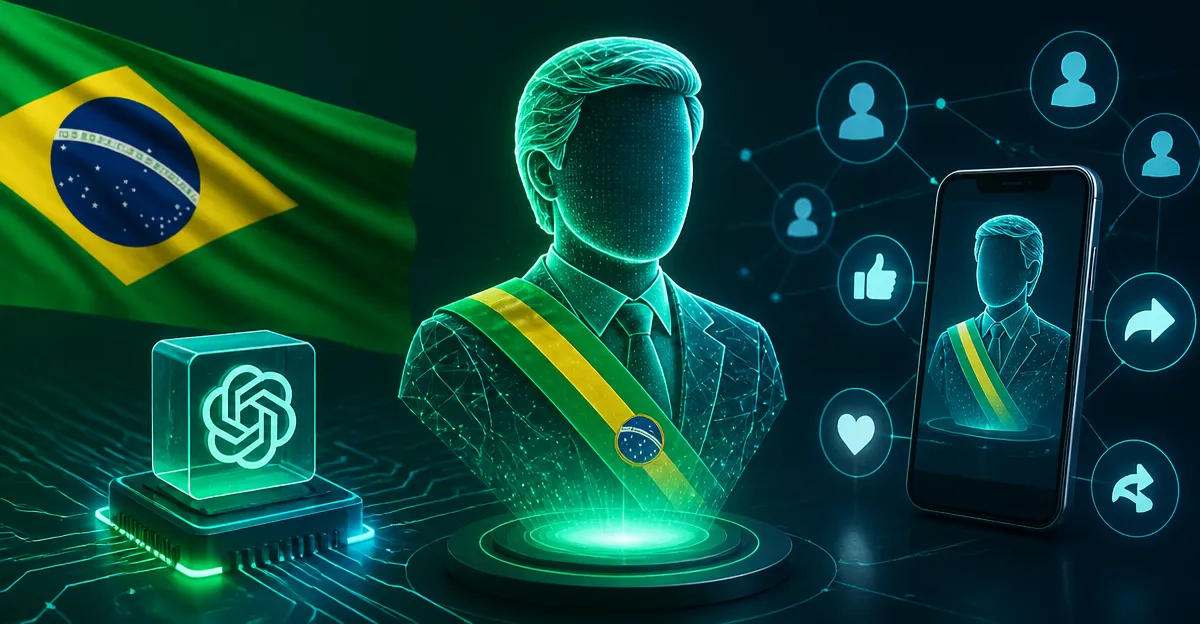
July 29, 2026, (Inside AI) — Former Brazilian President Jair Bolsonaro appeared via an AI-generated avatar at his son Flavio's campaign launch in Rio de Janeiro on July 25, marking a provocative fusion of artificial intelligence and electoral politics. Bolsonaro is currently under house arrest for allegedly plotting against democratic institutions, and his digital surrogate delivered a speech to supporters, raising immediate legal and ethical alarms.
The avatar, a realistic video representation mimicking Bolsonaro's voice and mannerisms, was used to circumvent his physical confinement. Law professor Ivar Hartmann of the Insper Institute in São Paulo described the move as
"a very clear violation" of Brazil's electoral rules.
This incident tests the boundaries of Brazil's Electoral Code, which prohibits candidates from using synthetic media to impersonate opponents but remains ambiguous on self-representation by restricted individuals. The Superior Electoral Court (TSE) has previously banned deepfakes in campaign ads, yet enforcement mechanisms for avatar-based appearances are untested.
Bolsonaro's legal team argued the avatar constitutes a protected form of political expression, citing his right to participate in family events. However, electoral authorities are reviewing whether the act breaches the spirit of the law, which aims to prevent misinformation and unfair advantage. The TSE could impose fines or disqualify Flavio's candidacy if the avatar is deemed an illegal campaign contribution.
Technically, the avatar was likely generated using a combination of voice cloning and facial reenactment models. Such tools require only a few minutes of source audio and video to produce convincing outputs. The Bolsonaro camp has not disclosed the specific technology used, but experts note that off-the-shelf solutions like HeyGen or Synthesia could achieve comparable results.
This is not Brazil's first encounter with AI in politics. In 2022, the TSE banned manipulated content targeting candidates, and in 2024, a mayoral candidate faced scrutiny for using a chatbot to mimic his own voice. Globally, the use of AI avatars by politicians is accelerating. In 2025, a South Korean presidential candidate deployed a virtual twin for rallies, and a U.S. congressional campaign tested an AI-generated spokesperson for non-English outreach.
Legal Gray Zones and Electoral Integrity
Brazil's current legislation, including the 2022 TSE Resolution No. 23,610, explicitly bans "synthetic content that replaces the image or voice of a candidate," but it does not address scenarios where the candidate creates content of themselves. This loophole could set a precedent for other restricted politicians worldwide, from house arrest to geographic exile.
Digital rights group Data Privacy Brasil warned that such avatars could erode voter trust by blurring the line between authentic and manufactured presence. A 2025 study by the University of São Paulo found that 68% of Brazilians could not distinguish between real and AI-generated political videos, underscoring the risks of manipulation.
The TSE is expected to issue a formal ruling within days. Meanwhile, Flavio Bolsonaro's campaign continues to promote the avatar appearance on social media, framing it as a symbol of resilience. The outcome may influence how democracies globally regulate AI in elections, as the European Court of Human Rights has also begun examining synthetic media's impact on free elections.
Technical Feasibility and Public Reaction
Creating a real-time or pre-recorded avatar of this fidelity typically involves neural text-to-speech and generative adversarial networks. Open-source frameworks like DeepFaceLab or commercial APIs can produce such outputs, though latency and lip-sync accuracy remain challenges. The Bolsonaro avatar appeared to have minimal glitches, suggesting professional production.
Public sentiment is divided. Supporters hailed the avatar as a clever workaround; critics called it a dangerous precedent. A Datafolha poll from July 27 showed 52% of respondents believe the TSE should block future avatar use by restricted individuals. The controversy also reignited debates about Bolsonaro's broader influence on the 2026 general elections, where his endorsement carries significant weight despite his legal troubles.
The incident underscores the accelerating collision between AI capabilities and regulatory frameworks. As deepfake tools become more accessible, electoral bodies worldwide may need to revise rules to address avatar-based campaigning, especially for candidates under legal constraints. Brazil's response could serve as a bellwether for other democracies grappling with similar dilemmas.