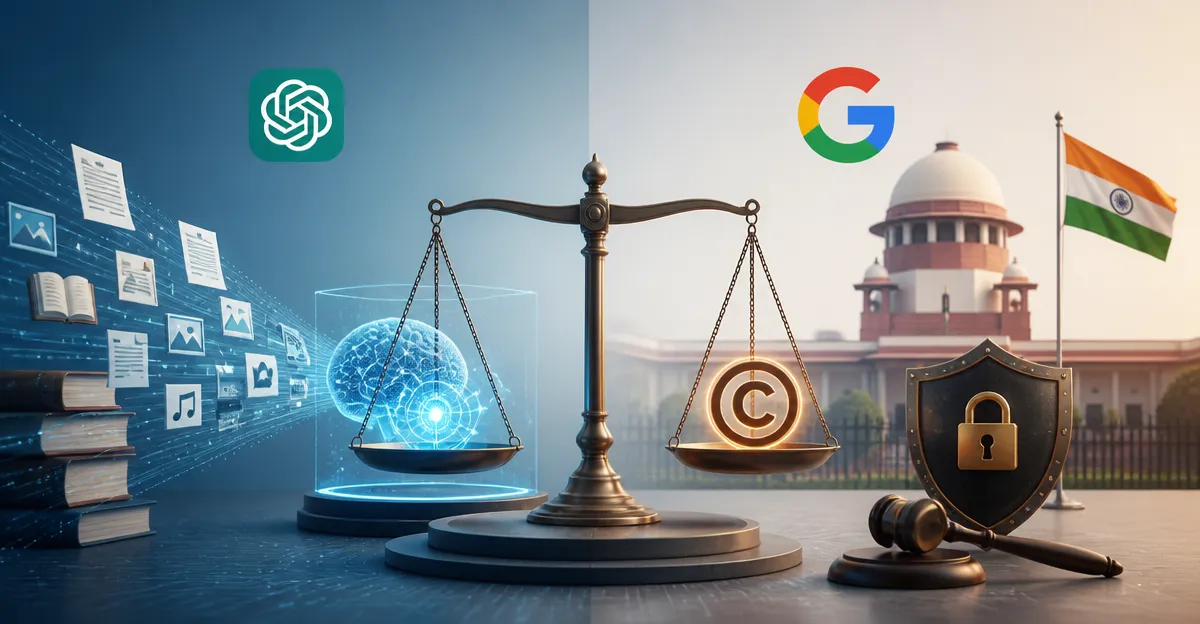
July 28, 2026, (Inside AI) — A Delhi High Court judge ruled on July 24 that OpenAI’s use of copyrighted material to train ChatGPT is prima facie protected under India’s fair dealing provision, in a closely watched interim order that could reshape the global AI copyright debate.
The 135-page judgment by Justice Amit Bansal in the suit filed by news agency ANI found that training AI models serves the public interest, and that existing law need not be frozen in the technological conditions of its enactment.
The ruling invokes public interest in three ways: treating fair dealing as an internal balance of copyright law, not a grudging exception; considering the social benefits of trained AI as relevant to fairness; and holding that an injunction would harm Indian users and domestic AI development.
One of the judgment’s most striking passages interprets “research” under Section 52 of the Indian Copyright Act, 1957. The court observed that if human teachers are replaced by an “AI bot” or “robot,” it would be “regressive” to deny statutory protection merely because instructions come from a machine. This approach, termed “updating construction,” insists the law remain faithful to its purpose without being frozen in time.
The decision arrives amid a policy exercise by the Department for Promotion of Industry and Internal Trade (DPIIT), which in December 2025 released a working paper proposing a mandatory blanket licence and remuneration right for AI training. The court’s reasoning materially alters that premise by suggesting that no payment or consent is necessarily required when training is private, for research, and without substantial market prejudice.
Yet the judgment leaves key questions open: it does not address all classes of works, pirated datasets, memorisation, substantively similar outputs, or proven loss of licensing markets. India now faces two competing visions: one where fair dealing permits AI training under existing law, and another where a statutory licence and payment mechanism provide lasting certainty.
The ruling’s influence is amplified by the peculiar nature of Indian IP litigation, where interim orders often become de facto jurisprudence. The Supreme Court noted in 2009’s Bajaj Auto Ltd vs TVS Motor Company Ltd that final decisions should be the focus, yet interim rulings continue to shape law. A senior practitioner recently told the writer that excluding interim judgments from a patent law commentary would leave little to discuss.
The court’s reasoning aligns with a growing body of research exploring fair use and AI training. A 2023 paper by Sag and Budiardjo argued that training generative AI on copyrighted works is generally transformative and non-expressive, while a UK Intellectual Property Office consultation highlighted the tension between rights holders and AI developers. The Delhi High Court’s emphasis on public interest echoes these debates, but its application of Indian law’s specific fair dealing framework adds a new dimension.
For now, the decision is an interim order, formally governing parties only until trial. But its reasoning will likely echo in appeal, at trial, and in policy rooms, as India decides which vision will shape its copyright future.