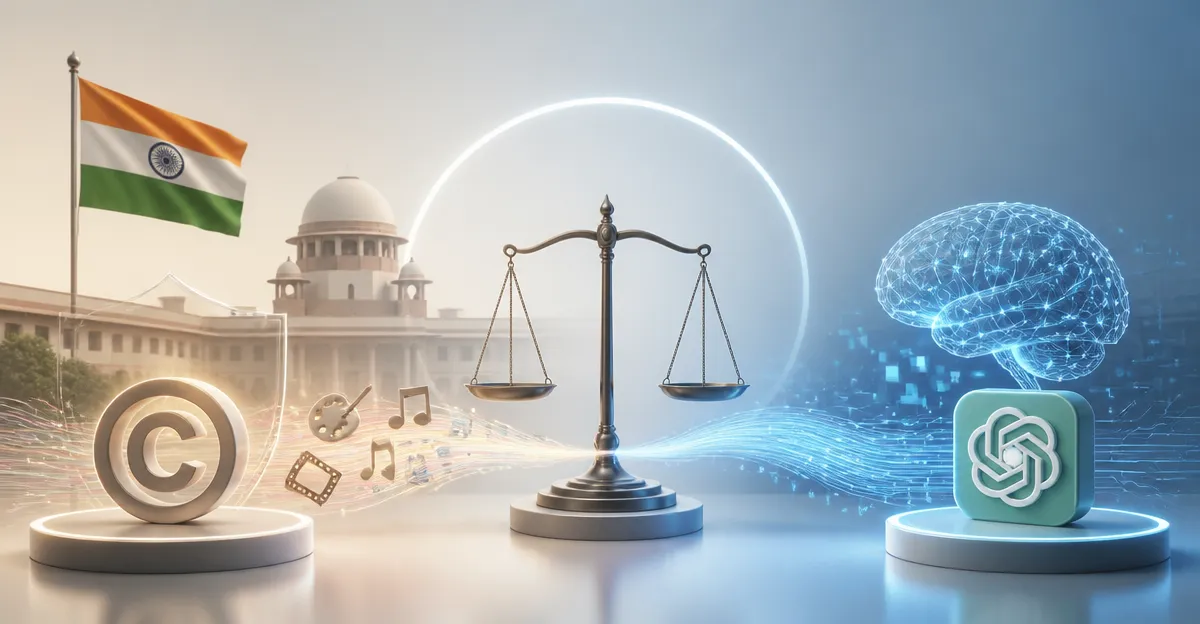
July 29, 2026, (Inside AI) — The Delhi High Court has rejected a bid to confine copyright’s research exception to human-only activity, ruling that machine-mediated analysis qualifies for the same legal protection in a pivotal AI training case.
The decision in ANI v. OpenAI arrives as regulators worldwide scramble to reconcile copyright law with the data ingestion demands of foundation models. The court’s reasoning offers a departure from licensing-first proposals now circulating in India’s policy circles, grounding its analysis in technological neutrality and the dynamic interplay between AI and creative industries.
Machine Research Is Still Research
OpenAI argued that its training process constituted non-infringing research under Indian copyright law. ANI countered that the exception only covers activities performed by humans. The court dismissed that distinction.
The judgment notes that machines increasingly perform tasks once exclusive to humans, including research. Denying protection simply because an activity is machine-mediated would risk stymying societal progress when those technologies operate at the behest of, and for the benefit of, humans.
This reasoning invokes technological neutrality, a principle holding that legal status should not shift merely because technology changes the means of an action. In the AI context, it means research, analysis, and learning do not lose their lawful character when humans are assisted by machines. Otherwise, every technological advance could turn laws meant to encourage creativity and learning into barriers for innovation.
The court’s framing aligns with a growing body of scholarship examining how copyright’s fundamental purposes intersect with machine learning. A recent paper on fair learning argues that training AI models on copyrighted data can be transformative when the purpose is extracting unprotectable patterns rather than expressive content.
Creators and Coders Are Not Enemies
The court also acknowledged deepening ties between the technology and copyright sectors. Evidence shows AI is already augmenting creative work: 83% of creators now use AI tools, according to an Adobe study. A 2025 London School of Economics report finds AI use has sparked dynamism across creative sub-sectors, with tailored tools often built by start-ups.
This Cambrian explosion of innovation lies at the heart of copyright law’s purpose. The court’s recognition challenges the zero-sum framing that pits rightsholders against developers.
Earlier this year, a committee under the Department for Promotion of Industry and Internal Trade (DPIIT) proposed a licensing regime requiring AI developers to compensate rightsholders for training data. The court’s approach suggests a different starting point: first ask whether the use is infringing at all, rather than presuming a compensable claim.
A licensing mandate could raise development costs, with the burden falling heaviest on start-ups and smaller developers. As AI tools embed deeper into creative workflows, increasing cost and uncertainty around their development can also harm creators and creative businesses.
The DPIIT panel must now decide whether to preserve conditions where both creative production and technological innovation can flourish. Treating their interests as antagonistic risks producing the very outcome copyright law is designed to avoid: protecting one form of creativity by constraining the emergence of another.
The ruling’s emphasis on technological neutrality may influence other jurisdictions grappling with similar questions, including ongoing litigation in the United States and European Union. For India, the decision sets a benchmark for how courts can interpret existing law without resorting to blanket licensing schemes that could chill AI development.