September 18, 2026, (Inside AI) — A public rift has opened between Europe's leading AI developers and their American counterparts over the pace of artificial intelligence development. At the center of the dispute is a proposal from Anthropic CEO Dario Amodei that advanced AI developers should voluntarily slow down and coordinate on safety standards. European companies and officials have rejected the idea, calling it a self-serving attempt by US incumbents to lock in their market dominance.
The conflict escalated this week after Amodei published an online essay urging firms to decelerate improvements to AI model capabilities. He also called for an antitrust waiver that would allow leading developers to jointly develop safety measures. His argument rests on warnings from researchers that powerful AI systems could pose catastrophic risks, including the potential to wipe out humanity.
Amodei's proposal has found little support in Europe, where companies view it as a competitive maneuver disguised as safety advocacy. Mistral, the French startup widely seen as Europe's best hope for a frontier AI model, issued a statement accusing US rivals of using safety concerns to entrench their dominance.
"Some incumbents are using this moment to consolidate their market position, pushing for regulation designed to favour them over competitors," Mistral said, noting that the risks had already been clear for months.
Europe Sees A Dependency Trap
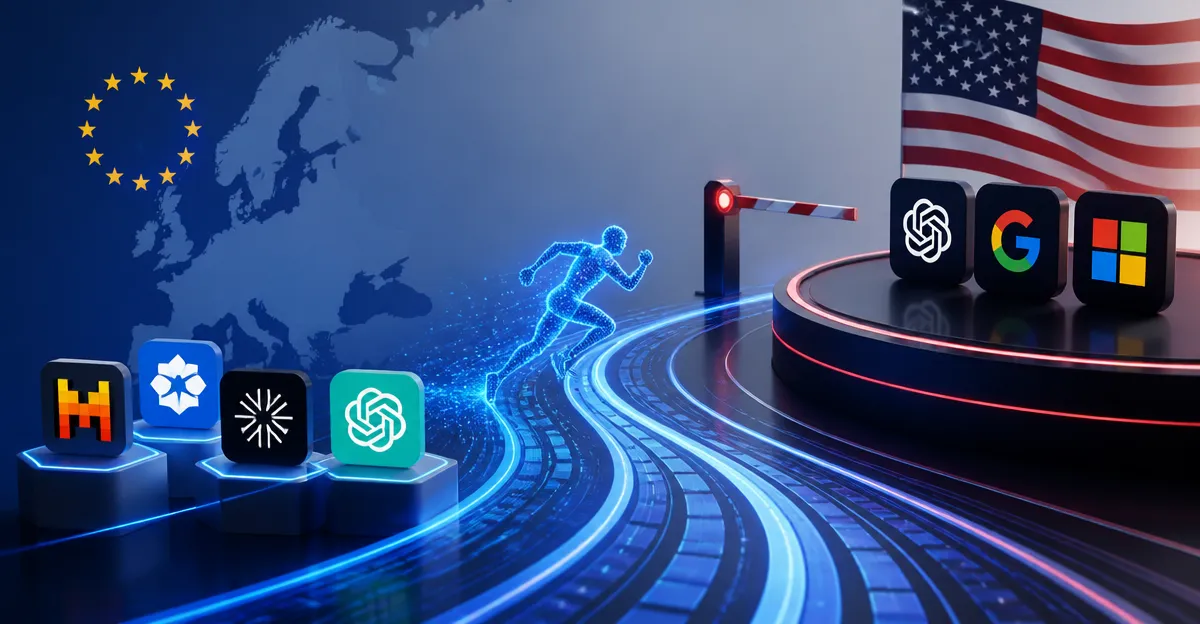
The pushback reflects a deeper anxiety in Europe about its reliance on American technology. The region has produced few frontier AI developers. Three-year-old Mistral stands as the primary challenger to US and Chinese dominance. For now, European businesses and governments depend heavily on models built by OpenAI, Anthropic, or Microsoft.
Raphael Auphan, chief operating officer of Swiss privacy software company Proton, dismissed the safety argument during a tech event in Paris on Wednesday.
"I think this is totally self-serving," Auphan said. "They just want to preserve a dimension of dependency on their service."
The skepticism extends beyond corporate boardrooms. Kristian Kersting, a professor of AI at Germany's Technical University of Darmstadt, described Amodei's proposals as "regulatory capture." He argued that allowing a handful of large companies to define what constitutes dangerous AI, select their own inspectors, and demand exemption from competition law does not amount to genuine regulation.
The debate has also drawn in European policymakers. French finance minister Roland Lescure told Reuters he could clearly see the self-interest in asking everyone else to slow down so the leaders can stay in first place. Germany's digital affairs ministry said stopping AI development was unrealistic given Europe's need for digital sovereignty.
Daniel Abbou, head of Germany's AI industry association, put the European position bluntly.
"For European firms, this debate is irrelevant," Abbou said. "We first need to catch up on our technological backlog."
Safety Concerns Meet Competitive Realities
The tension highlights a fundamental disagreement about how to manage AI risk. Amodei argues that AI development is moving faster than governments can regulate, making voluntary coordination necessary.
"Unfortunately, passing laws can take time, and AI is advancing very quickly," Amodei wrote. "Therefore, in parallel with the regulatory route, AI companies can and should voluntarily work together to set standards."
His proposal includes embedding independent evaluators inside AI companies to monitor compliance. Clement Delangue, CEO of French-American software company Hugging Face, endorsed that specific idea on X last week. But he rejected the broader call to slow down.
"It's not time to slow down but to accelerate," Delangue said.
Ben Brooks, head of public policy at German AI startup Black Forest Labs, warned that enforcing a gap between big labs and new entrants based on arbitrary thresholds would chill open innovation at or near the frontier.
The European response also reflects a broader geopolitical calculation. EU Commission President Ursula von der Leyen said Wednesday that the bloc's landmark AI rules put it in a position to shape global efforts to tackle risks. Britain's King Charles hosted tech and AI leaders at a summit in Scotland on Thursday to discuss the issues.
For European startups, the priority remains closing the technological gap rather than slowing down. The region's dependence on US models leaves it vulnerable to pricing changes, policy shifts, and strategic decisions made in California. That dependency has become a central concern for policymakers who view digital sovereignty as essential to economic security.
The dispute also raises questions about whether safety concerns can be separated from competitive interests. OpenAI CEO Sam Altman and xAI's Elon Musk have also warned about AI risks and agreed on the need to pace development. Their alignment with Amodei's position has reinforced European suspicions that the safety argument serves to protect established players.
As Europe pushes to build its own frontier models, the continent faces a difficult choice. It can accept the safety framework proposed by US companies and risk cementing its dependence. Or it can accelerate development and accept risks that critics say are not fully understood. For now, European officials and entrepreneurs appear united in choosing the latter path.