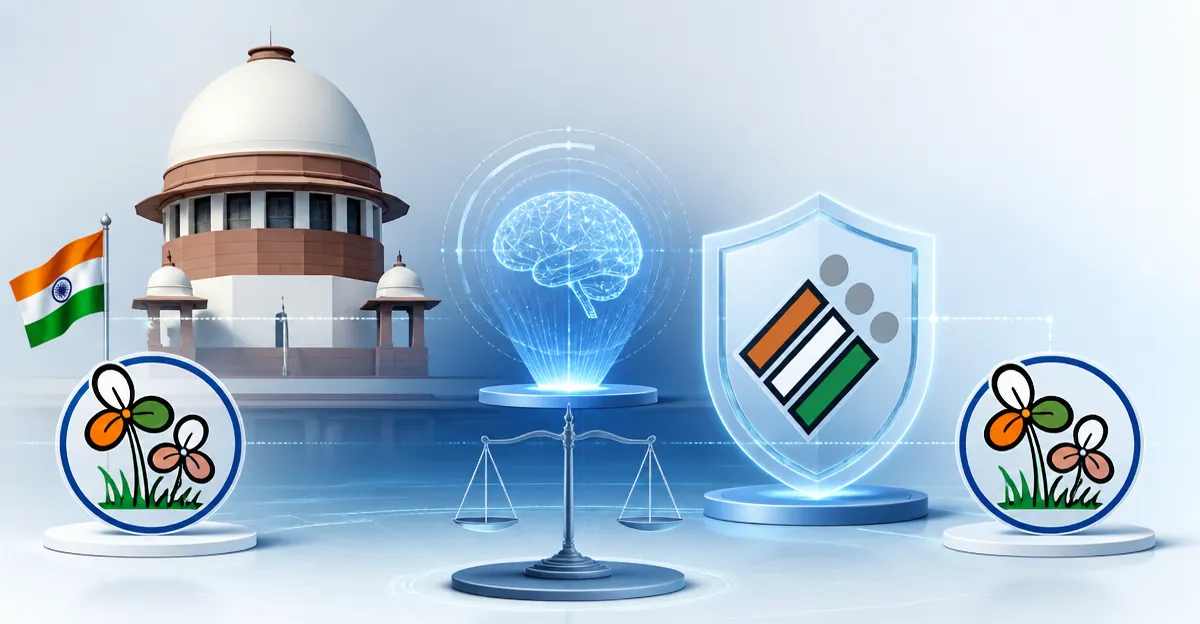
September 28, 2026, (Inside AI) — The Supreme Court of India on Monday directed the Election Commission of India to resolve the internal dispute within the Trinamool Congress over the party's name and symbol within three months, suggesting the use of artificial intelligence and machine learning tools to accelerate the process. The bench, led by Chief Justice of India Surya Kant and comprising Justice Joymalya Bagchi and Justice V Mohana, is hearing a challenge by former West Bengal Chief Minister Mamata Banerjee against the poll panel's interim order freezing the party's name and its flowers and grass symbol.
The court's recommendation to deploy AI in a political symbol dispute marks a notable moment for technology in Indian electoral governance. The Election Commission had requested six months to adjudicate the matter, but the bench deemed three months sufficient. Justice Bagchi remarked, "Use AI and machine-learning devices... it will expedite the case... reading documents, etc." The suggestion underscores a growing recognition that manual processing of massive legal filings can no longer keep pace with the volume of evidence in factional disputes.
Senior Advocate DS Naidu, representing the Election Commission, acknowledged the potential but flagged practical hurdles. "To some extent, they may help, though not to the fullest extent. I will tell you the practical problem we have faced. Rival parties, party cadres, members and everybody vouch for whichever group they support and then file affidavits. They come in lakhs. Whatever time the court fixes, let it run from the date the process of filing affidavits is completed." His comments highlight a critical bottleneck: even with AI-assisted document review, the sheer volume of sworn statements from rival factions could overwhelm any system.
The dispute stems from a split within the Trinamool Congress after the party lost power in West Bengal following this year's Assembly election. Rebel MPs have joined the Nationalist Citizen Party of India and aligned with the NDA, while the rebel faction in the Assembly, led by Arup Roy, now calls itself the Democratic Trinamool Congress. The Banerjee-led group is identified as the Mamata All India Trinamool Congress. The Election Commission's interim order froze the original name and symbol pending a final decision, prompting Banerjee's legal challenge.
Read: Akhilesh vs Yogi: AI video war shapes 2027 UP polls
Senior Advocate Kalyan Banerjee, appearing for the Mamata Banerjee faction, told the court that their side has responded to the poll panel's notice, but the rival faction has not. The bench then issued a structured timeline: "We grant four weeks to the contesting respondents and the petitioner to place on record additional documents, affidavits and counter-affidavits, etc. Let pleadings be completed in all respects within four weeks. The Election Commission of India shall take three months thereafter to decide the symbol issue." When the poll panel's counsel insisted six months would be needed and that three months would be "very difficult," the bench responded, "If some extreme exigency arises, come before us."
The Supreme Court's AI suggestion is not entirely novel. Election authorities globally have experimented with machine learning for voter roll deduplication and fraud detection. In India, the Election Commission has previously used AI for electoral roll management, but its application to symbol disputes remains untested. Legal experts note that AI could help cluster and analyze lakhs of affidavits, identify patterns of support, and flag inconsistencies. However, they caution that such tools cannot replace judicial discretion or verify the authenticity of sworn statements.
The case also raises questions about the admissibility and weight of AI-generated analysis in quasi-judicial proceedings. The Election Commission, as a constitutional body, must follow principles of natural justice. If it adopts AI tools, it will need to establish protocols for transparency and auditability. The court's observation, while advisory, could push the poll panel to pilot AI-assisted review in this high-stakes dispute.
Read: As AI Accelerates, Governments Are Increasingly Left Behind
For now, the Trinamool Congress remains a party divided, with two factions claiming the same legacy. The court's deadline of three months for the Election Commission to decide the symbol issue adds pressure to an already complex political and legal battle. Whether AI can truly expedite the resolution, or merely add another layer of complexity, remains to be seen. The next hearing is expected after the four-week pleadings period, when the court will assess progress and potentially revisit the AI suggestion.