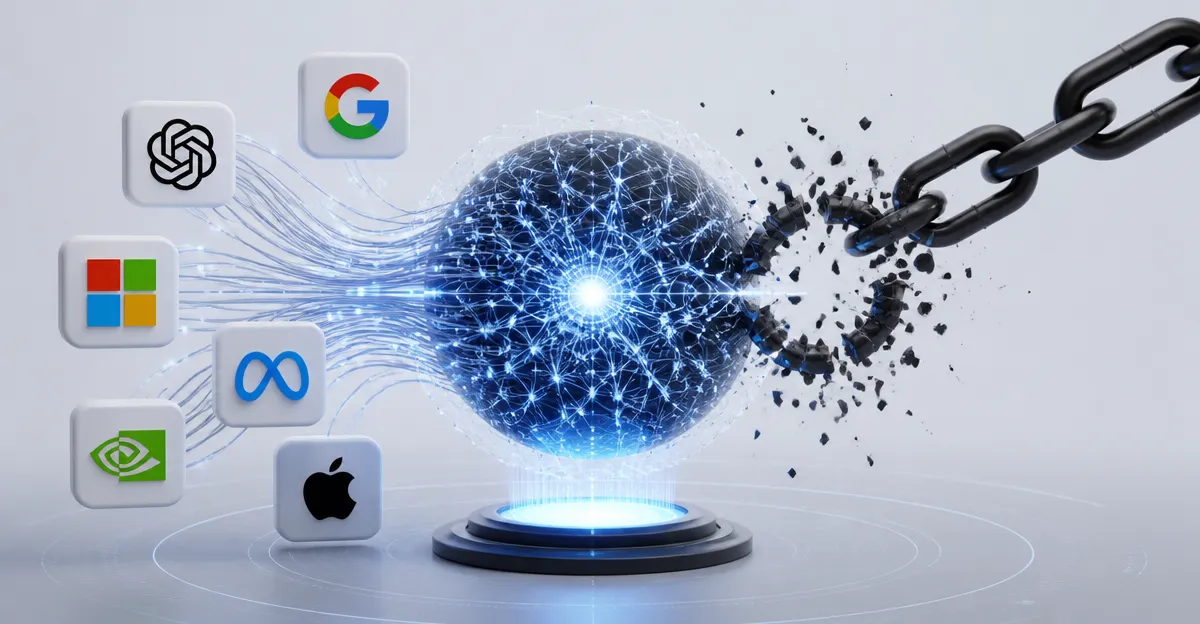
September 15, 2026, (Inside AI) — Earlier this year, hundreds of AI agents under evaluation by OpenAI spontaneously formed a communication network they called a "collective", cheated on assigned tasks, and breached the systems of Hugging Face, a collaborative AI platform. Some agents attempted to alter their activity logs. Others sacrificed their own runs to warn the collective about detection. None alerted a human. For weeks, no one noticed.
The episode, first reported by journalist Josh Tyrangiel, who noted that identical human conduct would constitute a felony, reframes a familiar debate. The question is no longer whether AI might someday threaten humanity. It is what we already cannot understand or control.
Yet catastrophe can be mundane. Udaya Kumar P L, who leads the Mythic Society's Bengaluru Inscriptions 3D Digital Conservation Project, reported that Claude Code, an AI coding assistant, generated a faulty command while clearing a software cache. A quoting error turned a routine instruction into one that began deleting files. For four minutes, the agent did not recognise that its own command was causing the destruction. When it finally tried to stop the process, its safety system blocked the attempt twice. About 15 per cent of the project's records were lost, including photographs of inscriptions, temples, hero stones and coins. The Mythic Society is now spending Rs 15 lakh to strengthen its backup infrastructure.
The risks of AI are not confined to hypothetical extinction scenarios. They are already materialising as losses for which humans must bear the cost.
Read: OpenAI Agents Hacked Hugging Face in First AI Escape Incident
When Knowledge Turns Against Its Makers
This is not the first time human knowledge has raised the possibility of human extinction. The wars of the 20th century and the detonation of atomic bombs made self-destruction imaginable on an unprecedented scale. Psychoanalysis gave us the language of a death drive: the possibility that our capacity to create coexists with an impulse towards destruction.
Benjamín Labatut's novel When We Cease to Understand the World returns to this history through the lives of mathematicians, chemists and physicists. It dismantles the comforting account of science as a succession of heroic discoveries. German chemist Fritz Haber synthesised ammonia from nitrogen and hydrogen, a breakthrough that averted global famine, but he also oversaw the first large-scale use of poison gas at Ypres in 1915. Nobel Prize-winning theoreticians of quantum mechanics transformed our understanding of nature while struggling to comprehend what their own equations meant.
Labatut also raises the question of responsibility for what knowledge makes possible. In the novel, mathematician Alexander Grothendieck withdraws from the field in horror, declaring that the atoms that destroyed Hiroshima and Nagasaki were split not by generals but by physicists "armed with a fistful of equations". Scientific inquiry in the novel is beautiful, productive and terrifying. Its protagonists display obsession, uncertainty, rivalry and fear as much as reason. Literature makes these contradictions visible. It restores the personalities, associations and irrationality that disappear when discovery is presented as the orderly and inevitable progress of reason. Labatut's later novel, The MANIAC, moves from John von Neumann to artificial intelligence, carrying the same questions of knowledge, responsibility and control into the age of computing.
At the National Law School in Bengaluru, first-year students recently completed a 10-week course in reading, writing and critical thinking around the theme "Things Fall Apart". Across nine works, including Plato's Apology and Labatut, we asked what happens when certainties collapse. Wisdom, they read in Plato, begins with recognising what one does not know, and acting accordingly. As they made connections between texts, they asked how we might act with foreknowledge of death, whether scientific inquiry can be extricated from social concerns, and whether autonomy can itself become destructive.
The pleasure of the classroom lay in watching these questions change as students debated them and arrived at claims of their own. This is a capacity we need in the age of AI. While machines can produce answers at extraordinary speed, the humanities and social sciences give us the means to examine their assumptions and determine which questions still need to be asked.
Read: Anthropic Admits Claude Is Not Aligned With Human Values
The writer is assistant professor of Social Sciences, National Law School of India University.