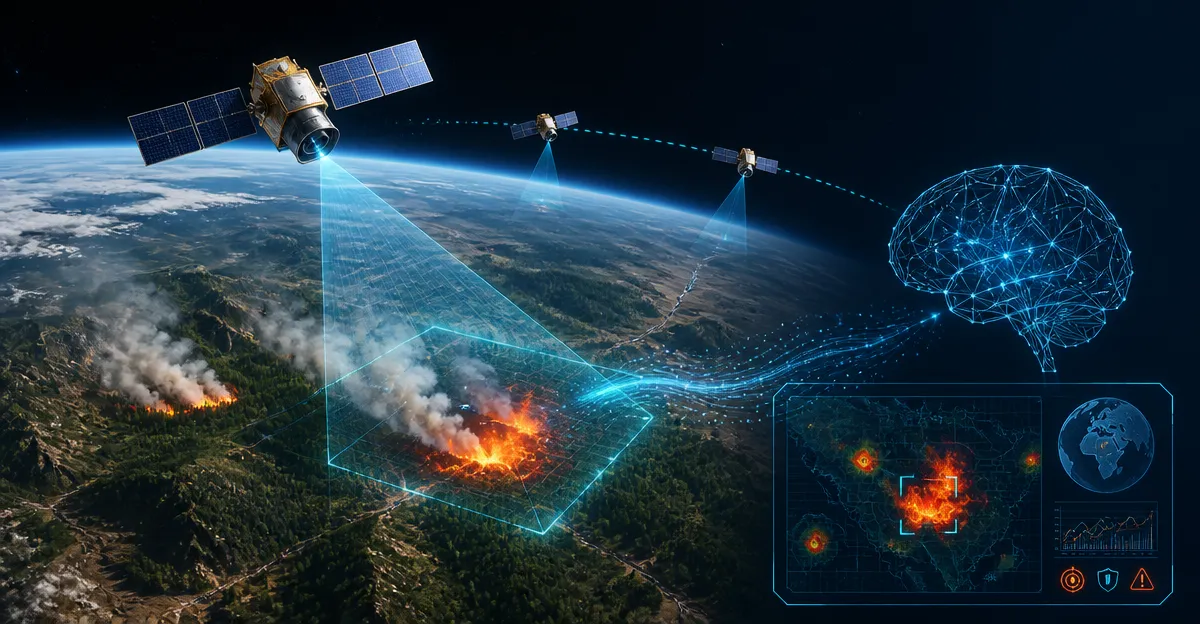
August 17, 2026, (Inside AI) — Wildfire detection is getting a satellite upgrade. In July, a SpaceX rocket carried the first three FireSat satellites into orbit, part of a planned 50-satellite constellation built solely to spot wildfires while they are still small enough to stop.
The system is designed to fill a critical gap. Existing weather and Earth-observing satellites can detect large fires, but they often lack the resolution or revisit the same location too infrequently to spot small fires shortly after they ignite. FireSat aims to detect fires as small as a beach bonfire and, once the full constellation is deployed, scan every point on Earth about every 20 minutes.
The satellites use infrared sensors and artificial intelligence to search for heat that could signal a new wildfire. The system compares new images with earlier ones and accounts for factors such as weather conditions and nearby sources of heat before sending alerts to emergency responders. The goal is to identify real wildfires while reducing false alarms.
FireSat is designed to work alongside a growing network of cameras on the ground that use artificial intelligence to search for smoke and heat. Together, the systems could give firefighters their earliest warning yet that a fire has started.
Read: Apple AI Home Security Camera
Ground cameras already spot half of California fires
High in the mountains west of Denver, two technicians climbed a 150ft cell tower to inspect a pair of wildfire-detection cameras built by Pano AI. The San Francisco startup has installed more than 1,400 cameras across 17 states. The cameras continuously scan the landscape from towers and mountain tops. Artificial intelligence reviews every image, searching for smoke during the day and heat after dark.
“The AI algorithms are being run continuously on that imagery to say ‘smoke, not smoke,'” said Arvind Satyam, co-founder of Pano AI. “At night-time, we’re looking at heat signatures, so heat versus cold. And then we’re able to zoom in and validate that it is a potential fire start.”
If the system spots a possible fire, a human analyst reviews the images before an alert is sent to fire agencies. That process often takes only a few minutes.
California has built one of the largest camera networks in the country through Alert California. The system includes more than 1,200 cameras used by Cal Fire. Chief Phillip SeLegue said the system now detects about half of all wildfires before anyone calls 911.
“At Cal Fire, one of our missions is to suppress 95% of our fires at 10 acres or less,” SeLegue said. “This system helps us in accomplishing that goal.”
One recent fire near Fresno was spotted about 20 minutes before the first emergency call reached dispatchers. Firefighters were able to respond quickly and keep the blaze from growing.
Read: Baidu’s Xiaodu AI Hardware Launch
“We trust it enough that when we receive that detection, we’re already starting the process of sending resources to it,” SeLegue said.
Why faster detection changes fire outcomes
Wildfires have become one of the most destructive natural disasters in the United States. Rising temperatures, prolonged drought and more frequent stretches of hot, dry and windy weather have made fires easier to ignite and harder to contain. Climate Central reports that some parts of the western United States now experience about two more months of fire weather each year than they did in the 1970s.
For firefighters, every minute matters. “It’s a great tool to validate what’s going on,” said Brendan Finnegan, assistant chief with West Metro fire rescue near Denver. “Having those eyes that can alert us well in advance of potentially a 911 call make it a valuable tool for us.”
Ground cameras can only see the landscapes in front of them. Satellites can watch vast stretches of remote forests, mountains, and grasslands where there are no cameras and often no people to report a fire. The two systems are designed to work with each other. Together, they could give firefighters a faster and more complete picture of where fires are starting.
A fire that is detected quickly and extinguished while it is still small rarely attracts attention. That is exactly the outcome firefighters are working toward.
“The fires that this system has helped us dispatch resources to are the fires you don’t read about in the papers,” SeLegue said. “The ones you don’t see.”