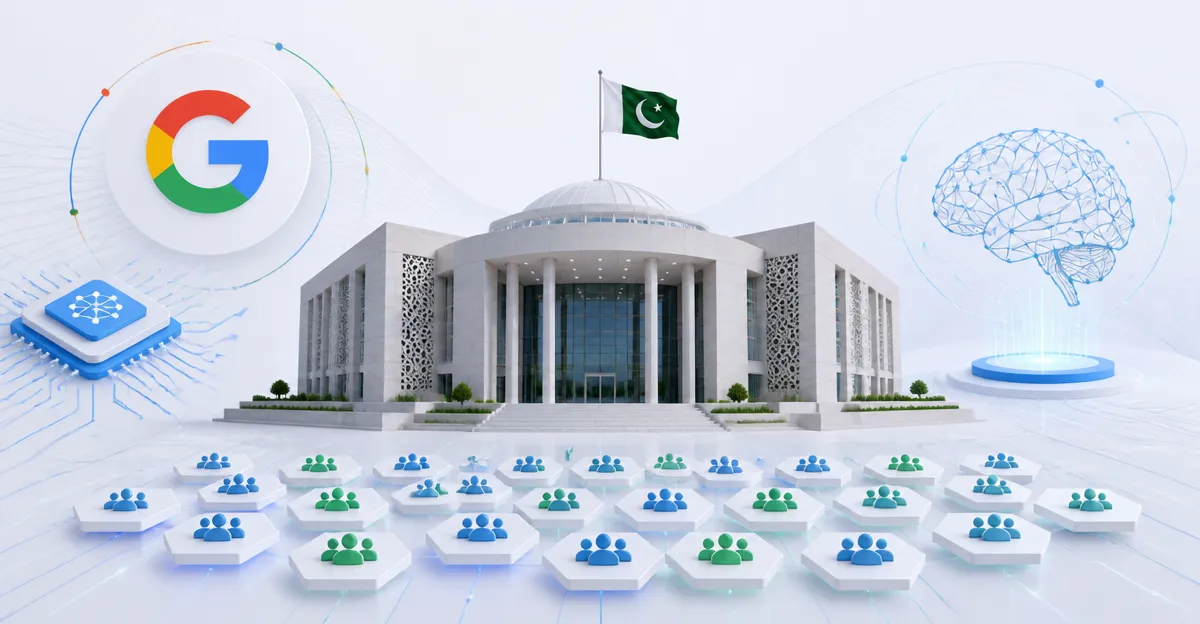
August 10, 2026, (Inside AI) — More than 80 developer teams gathered at the National Incubation Centre (NIC) Islamabad on August 8–9 for the AI Seekho Builders Day Hackathon 2026, converting raw ideas into working AI prototypes in roughly 36 hours using Google’s AI toolchain. The event, organized by Google Developer Group (GDG) Islamabad in collaboration with NIC Islamabad and Mobilink Bank, marked a significant shift in Pakistan’s developer ecosystem from learning AI to actively shipping functional products.
Participants competed across four tracks aligned with national priorities: Sehat ki Azaadi (health freedom), Kifayat ki Raah (economic efficiency), Ilm ki Roshni (education), and Sabz Pakistan (green sustainability). Teams built prototypes using Google AI Studio, Gemini APIs, Google Antigravity, and Android Studio’s prompt-to-app tools, receiving mentorship from experienced technologists. On the second day, judges shortlisted 12 finalists from the initial pool, with Team MONAD securing first place, CTRL X CTRL V earning second, and SAFEER E MOHALLA claiming third.
The hackathon’s intensity and output reflect a maturing ecosystem where community-driven events yield deployable AI solutions, not just slide decks. This progression echoes a global pattern where hackathons increasingly serve as launchpads for viable startups, but Pakistan’s context—marked by rapid mobile adoption and a young, tech-savvy workforce—amplifies the stakes. The AI Seekho movement, which aims to convert learners into builders, has gained momentum as Google’s Community Manager for South Asia Pacific, Umar Nazir, highlighted Pakistan’s creative potential for turning AI capabilities into tangible products.
From Prototypes to Production: The Governance Gap
Komul Khan, Chief Information Technology Officer at Mobilink Bank, cautioned that responsible AI adoption requires strong data foundations and inclusive digital ecosystems. She emphasized that rushing products to market without governance frameworks risks undermining trust and scalability. Her session underscored a tension often absent in hackathon euphoria: the gap between rapid prototyping and production-grade deployment, particularly in regulated sectors like finance and healthcare.
This warning aligns with industry research showing that over 60% of AI proofs of concept never reach production, often due to data quality issues and lack of operational guardrails. For the winning teams, the challenge now shifts from building under time pressure to navigating regulatory landscapes, securing funding, and iterating based on real-world feedback. Syed Ahmed Masood, Project Coordinator at NIC Islamabad, encouraged participants to continue developing their products beyond the hackathon, hinting at incubation support through NIC’s network.
Tooling Democratization Meets Local Talent
Tehreem Rasul, Technical Lead at RedBuffer and Google Developer Expert in AI, demonstrated how Google AI Studio enables rapid prototyping from problem statement to functional product. Her session illustrated a broader industry trend: the democratization of AI development through low-code and prompt-based tools, which lowers barriers for non-traditional programmers. However, critics argue that such tools can obscure underlying model limitations, leading to brittle solutions if not paired with robust engineering practices.
The judging panel, which included Zeeshan Mazhar (Chief Digital Financial Services, Mobilink Bank), Hufsa Munawar (Senior App Growth Manager, Google), and Abdul Rauf (Associate Director of AI and People Platforms, S&P Global), evaluated prototypes on technical merit and real-world applicability. Their diverse expertise—spanning finance, growth, and enterprise AI—suggests a deliberate push to bridge builder creativity with market viability.
The event, held just days before Pakistan’s Independence Day, was supported by TechJuice as Digital Media Partner, HUM News as Media Partner, GrowLytics as Sponsor, and Bookkaru as Ticketing Partner. While the hackathon showcased impressive speed, the true test will be whether these prototypes evolve into sustainable ventures that address Pakistan’s pressing challenges in health, economy, education, and sustainability.