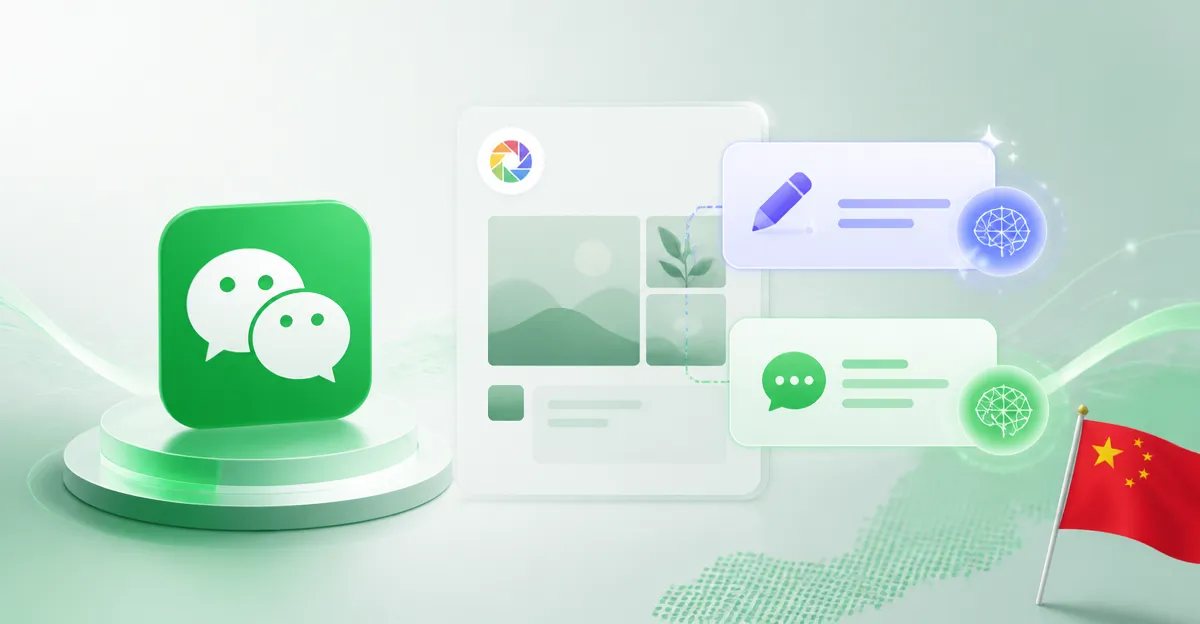
August 10, 2026, (Inside AI) — WeChat is quietly testing two AI features in its Moments social feed: AI-assisted writing and AI-generated comments. Screenshots from a limited gray test reveal an “AI Writing” button in the Moments publishing interface that helps users generate post copy. The features tap into WeChat’s Xiaowei AI assistant, according to TechNode reporting.
The experiment marks Tencent’s latest push to embed generative AI into its 1.3-billion-user super app. Moments, WeChat’s answer to a social news feed, is central to daily user engagement. By offering AI-crafted posts and comments, Tencent aims to lower the effort of sharing, potentially boosting activity in an era of stagnant social media growth.
No public timeline exists for a wider launch. A WeChat representative confirmed the test is confined to a small user group, with no immediate plans for expansion. The cautious approach mirrors Tencent’s broader strategy: iterate behind closed doors before scaling features that could reshape user behavior.
AI whispers into the social graph
The “AI Writing” button appears directly in the post composer. Users can presumably input a prompt or topic, and Xiaowei generates text for a Moments update. The AI-generated comments feature is less documented but likely suggests replies to friends’ posts, accelerating conversational loops.
Read: LinkedIn Adds AI Slop Reporting
This integration raises questions about authenticity. Moments thrives on personal updates and intimate sharing. If AI-generated content floods the feed, trust could erode. Tencent must balance utility with the risk of diluting genuine connection, a challenge Meta faced when testing AI chatbots on Facebook and Instagram.
Xiaowei, WeChat’s voice assistant, has historically handled tasks like setting reminders or answering queries. Linking it to social content generation signals a major upgrade, possibly powered by Tencent’s Hunyuan large language model. The company has been aggressively embedding Hunyuan across its ecosystem, from cloud services to gaming.
Competitors are watching closely. ByteDance’s Douyin (TikTok’s Chinese sister app) already offers AI video editing tools. WeChat’s move into text-based social AI could pressure rivals to follow suit, igniting an AI arms race in China’s social media landscape.
Gray tests and regulatory shadows
WeChat’s gray-test methodology is notorious for prolonged incubation. Features can simmer for months before a full rollout, if they survive at all. The AI writing tool must navigate China’s strict content moderation rules, which require platforms to police AI-generated material for misinformation or sensitive topics.
In 2023, China mandated that AI-generated content be clearly labeled. WeChat would need to implement visible markers, potentially affecting user adoption. The test screenshots do not show any labeling, suggesting the feature is still in early compliance review.
Tencent’s AI ambitions extend beyond social media. The company recently launched an enterprise AI platform and invested heavily in autonomous driving. Yet Moments remains a cultural cornerstone; any misstep could spark backlash. User feedback from the gray test will determine whether AI becomes a permanent fixture in China’s digital town square.
Read: Reddit Expands AI Moderation Rules
For now, the experiment underscores a pivotal shift: AI is moving from backend optimization to front-and-center social interaction. Whether users embrace ghostwritten moments or reject them as inauthentic will shape the next chapter of social media evolution.