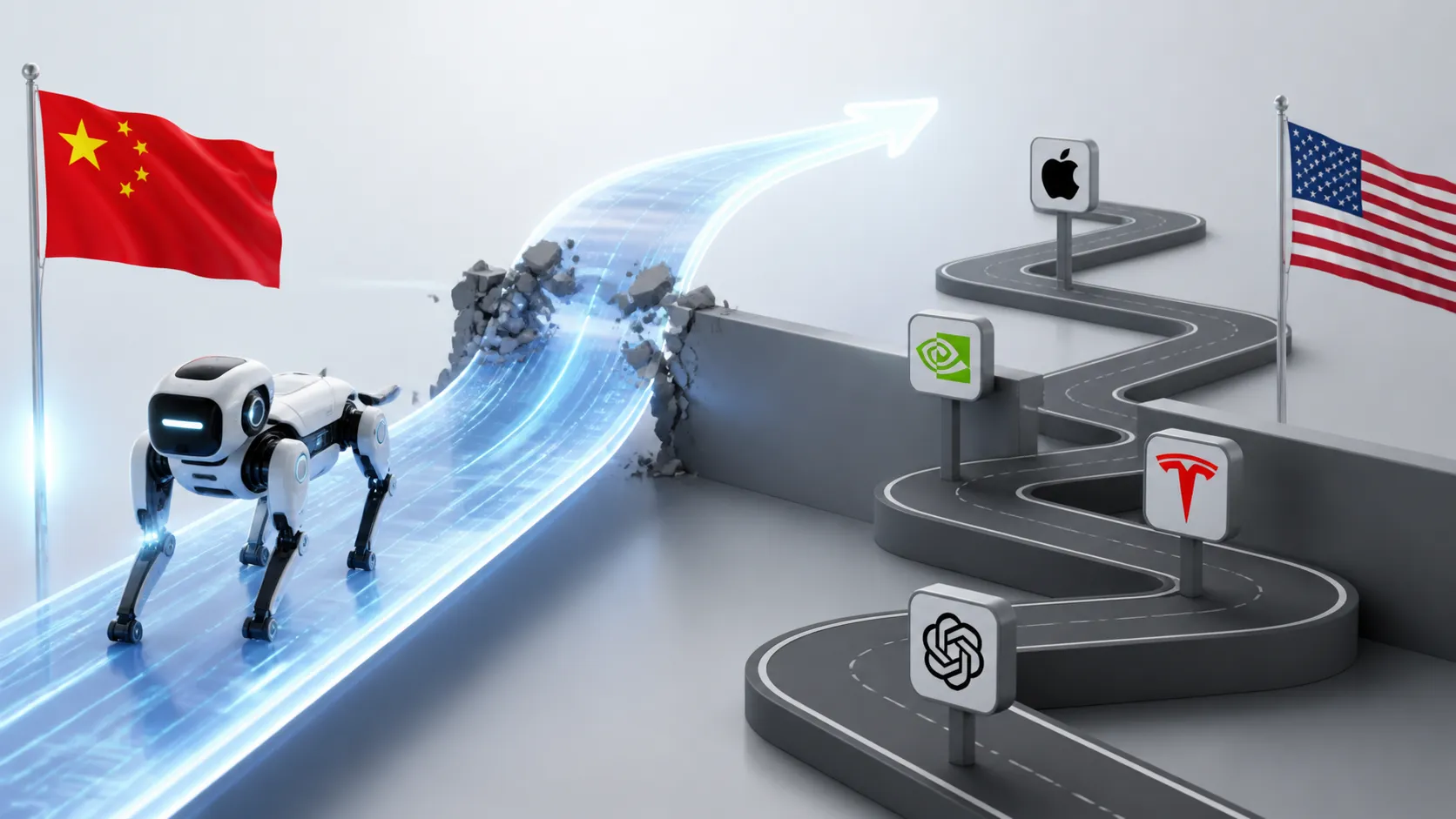
June 25, 2026, (Inside AI) — Shanghai-based start-up Fysics AI has unveiled Fysiverse, a physics-based world model that embeds real-world physical laws directly into its architecture. The launch marks a deliberate break from the data-driven paradigms championed by US leaders like OpenAI and Meta Platforms.
Fysics AI, founded by former Nvidia senior manager Zhang Lihua, announced the model on its WeChat account. The company claims Fysiverse can eliminate common failures like physical illusions and reasoning breakdowns in non-standard scenarios.
World models simulate environments to train robots and autonomous vehicles. The sector currently splits into three main approaches. Fysics AI’s method directly encodes physics equations, contrasting with black-box systems like Meta’s V-JEPA that learn rules from video data without explicit physics knowledge.
China’s Physics-First Gambit
Fysics AI’s launch signals a strategic divergence from US road maps. American firms largely pursue scaling laws—feeding ever-larger datasets into neural networks. Fysics AI instead hard-codes conservation laws, fluid dynamics, and rigid-body mechanics into the model’s inference engine.
Read: AI Founders Who Rejected Bezos-Backed Prometheus Unveil Physics Model
Zhang’s team argues that data-driven models inevitably produce “hallucinations” in edge cases. A Fysics AI engineer, speaking anonymously, said the model “doesn’t guess physics—it obeys it.” This could prove critical for safety in robotics and autonomous driving.
Yet the approach has trade-offs. Hard-coded physics limits adaptability to novel scenarios not covered by the equations. Meta’s V-JEPA, by contrast, can learn from raw video without human-labeled physics. The debate mirrors the classic AI tension between symbolic reasoning and statistical learning.
Industry Ripples and Unanswered Questions
Fysics AI has not disclosed training data, compute requirements, or benchmark comparisons. Independent verification remains absent. The announcement comes as China pushes for self-sufficiency in foundational AI, with government funds pouring into physical AI start-ups.
US firms have also explored hybrid models. OpenAI’s Sora generates video with some physics understanding but still fails on basic causality. Nvidia’s Omniverse platform uses physics engines for simulation, though not as a pure world model. Fysics AI’s pure-physics paradigm could influence the next wave of sim-to-real transfer research.
Zhang previously led simulation projects at Nvidia, giving her team deep insight into the limitations of purely data-driven graphics. The start-up’s backers include Chinese state-linked venture funds, though exact funding rounds remain private.
Read: VeloAlpha’s FusionAlpha Uses AI to Crack Fusion Energy’s Software Bottleneck
For now, Fysiverse exists as a proprietary model with no public API. The company plans to offer it first to Chinese robotics and autonomous driving firms, a market projected to reach $45 billion by 2030. Whether physics-first models can scale remains the critical question.