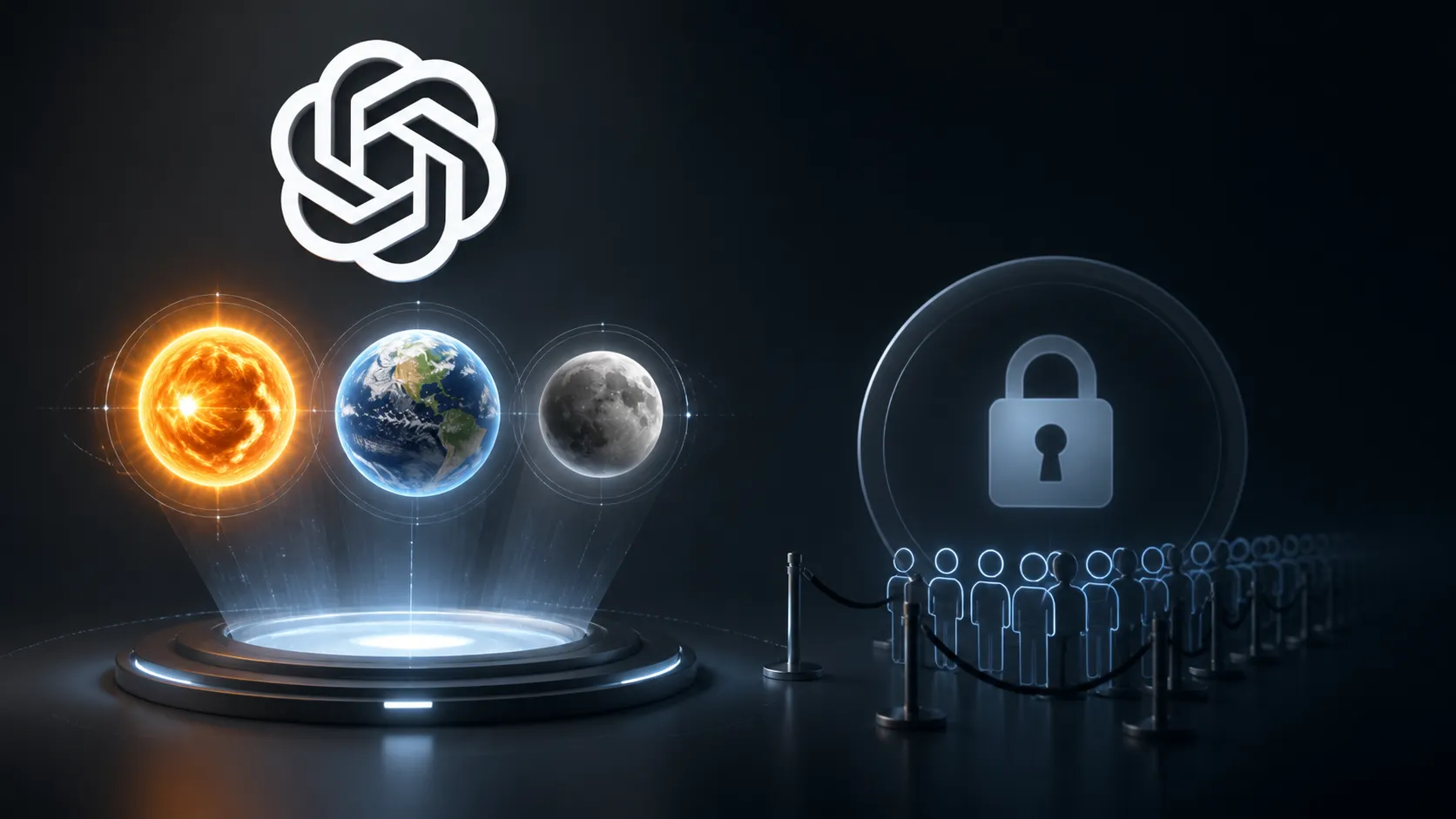
June 28, 2026, (Inside AI) — OpenAI has introduced its GPT-5.6 model family—Sol, Terra, and Luna—but almost no one can use them. The U.S. government has requested an indefinite delay on public access, limiting availability to a small set of pre-approved customers.
The three models represent a tiered offering: Sol is the flagship, Terra is a balanced mid-tier option, and Luna emphasizes speed and affordability. Sol excels on benchmarks for cybersecurity, biology, and agentic tasks. It includes a “layered safeguard stack” to prevent misuse, such as cyberattacks.
OpenAI disclosed the restriction in a blog post on Friday, June 26. Only customers vetted by the U.S. government gain access. The company is working with the Trump administration to expand access gradually, including to international partners, starting next week. The approval criteria remain opaque; OpenAI executives said they submit a list to the government and receive feedback.
A Regulatory Precedent Stirs Industry Debate
OpenAI is the second frontier AI lab, after Anthropic, forced to limit model availability at the government’s behest. This raises concerns about an uncertain regulatory environment and the extent of government power over AI releases. Experts question whether such interventions could stifle innovation or concentrate control.
OpenAI expressed frustration. The company stated:
“We don’t believe this kind of government access process should become the long-term default. It keeps the best tools from users, developers, enterprises, cyber defenders, and global partners who need them. We are taking this short-term step because we believe it is the strongest path to broader availability in the coming weeks, while we work with the Administration to develop the cyber Executive Order framework and a repeatable process for future model releases.”
CEO Sam Altman called the process “not optimal” and added:
“We want to be a reliable, dependable partner that works with all stakeholders, and we also want to live by our mission of benefiting all of humanity. I believe the government shares most of our goals, and that they are overall doing a good job in a very difficult situation.”
Anthropic’s Claude Mythos 5 faced similar restrictions. The parallel actions signal a new era of government involvement in frontier AI deployment. Critics argue that delaying public access could hinder defensive cybersecurity efforts and slow beneficial applications.
Technical Muscle and Safety Architecture
GPT-5.6 Sol features two reasoning modes: a ‘max’ effort mode and an ‘ultra’ mode that coordinates sub-agents for complex tasks. OpenAI claims Sol slightly outperforms Claude Mythos 5 on coding workflows and matches Mythos Preview while using only a third of the output tokens.
Safety mechanisms are built directly into the model’s behavior, not layered as external filters. Training focused on resisting jailbreaking and adversarial attacks, with an intentional bias toward defensive cybersecurity. This contrasts with Anthropic’s Claude Fable 5, which uses classifiers to detect high-risk topics and reroute requests to an older model.
Benchmark results highlight Sol’s strengths in agentic capabilities, biology, and cybersecurity. The ‘ultra’ mode demonstrates coordinated problem-solving that mimics multi-agent systems. Pricing, when generally available, will be tiered: Sol costs $5 per million input tokens and $30 per million output tokens; Terra is half that; Luna costs $1 and $6, respectively. Improved prompt caching aims to reduce costs for repeated queries.
If restrictions lift, access will come through ChatGPT, Codex, and the OpenAI API for paid subscribers. The naming scheme—Sol (Sun), Terra (Earth), Luna (Moon)—hints at a cosmic hierarchy of capabilities. For now, the models remain in a government-controlled limbo, leaving the AI community waiting for broader availability.