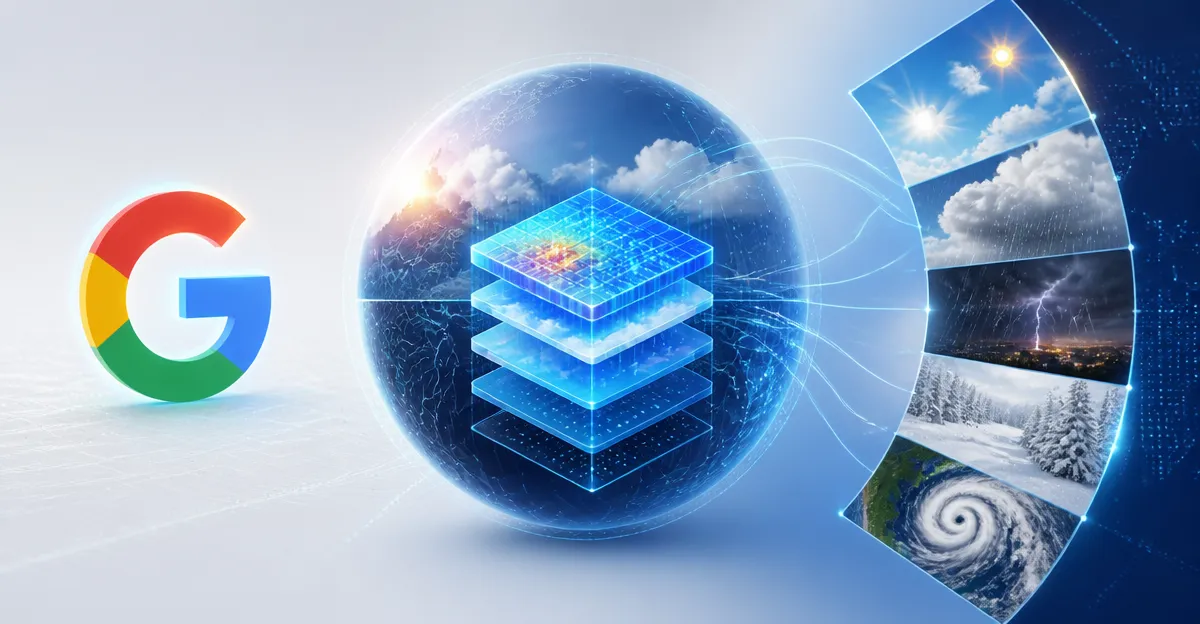
September 5, 2026, (Inside AI) — Google has released WeatherNext 3, a global weather model that trains directly on live satellite data instead of traditional physics simulations. The model, unveiled by Google DeepMind and Google Research on September 3, now powers weather features in Search, Gemini, Maps, and Google Cloud.
WeatherNext 3 generates a new forecast every hour using the latest geostationary satellite observations. It visualizes temperature and moisture at five-kilometer resolution, roughly five times sharper than WeatherNext 2. This marks a structural shift in how weather AI is trained and deployed.
Most AI weather models learn from numerical weather prediction data, which carries a six-hour lag. That delay introduces biases for fast-changing variables such as rain and surface temperature. By ingesting satellite data directly, WeatherNext 3 removes the lag and improves timeliness.
The model shows especially strong gains for precipitation. It trains on high-quality data from NASA satellites and radar-based reanalysis. Medium-range forecasts show accuracy improvements of up to 60% against certain baselines. Users planning a day or more ahead will see up to 50% more accurate precipitation forecasts.
WeatherNext 3 also introduces variables tailored for renewable energy. It forecasts wind speeds at turbine height for precise energy output. It predicts cloud cover and solar radiation for solar farms. These additions address a growing need for reliable weather data in clean energy planning.
Satellite-First Training Breaks the Physics Bottleneck
Traditional numerical weather prediction relies on physics simulations that run on supercomputers. Those simulations produce initial conditions that AI models then learn from. The six-hour delay between simulation and observation creates a mismatch for rapidly evolving weather systems.
WeatherNext 3 bypasses that bottleneck by learning directly from geostationary satellites. These satellites provide continuous observations of clouds, moisture, and temperature across the globe. The model updates hourly, ensuring forecasts reflect the most recent atmospheric state.
This approach also reduces computational cost. High-resolution forecasting historically required immense supercomputing resources. By training on sparse weather station data and satellite imagery, WeatherNext 3 delivers localized forecasts without the same infrastructure burden.
Developers and researchers can access the underlying data through Google Cloud, BigQuery, and Earth Engine. This opens the model to third-party applications in agriculture, logistics, and disaster response.
Underserved Regions Gain High-Fidelity Forecasts
Much of Asia, Africa, and Latin America has lacked high-resolution forecasting due to supercomputing costs. WeatherNext 3 accounts for topography and sparse station data, bringing high-fidelity forecasts to billions of people previously overlooked.
Accurate, localized rainfall prediction remains a persistent challenge across South Asia. The model improves forecasts precisely where they have been least reliable, which could aid disaster preparedness. However, Google stressed that official warnings should still come from national meteorological agencies.
The model’s hourly updates and five-kilometer resolution represent a significant leap over previous versions. WeatherNext 3’s ability to train on live satellite data may influence how other AI weather models are developed. The shift from physics-based to observation-based training could become a new standard.
Google has not disclosed the full training dataset or model architecture. Independent verification of the accuracy claims is not yet available. The company’s emphasis on renewable energy variables suggests a strategic focus on commercial applications beyond consumer weather apps.