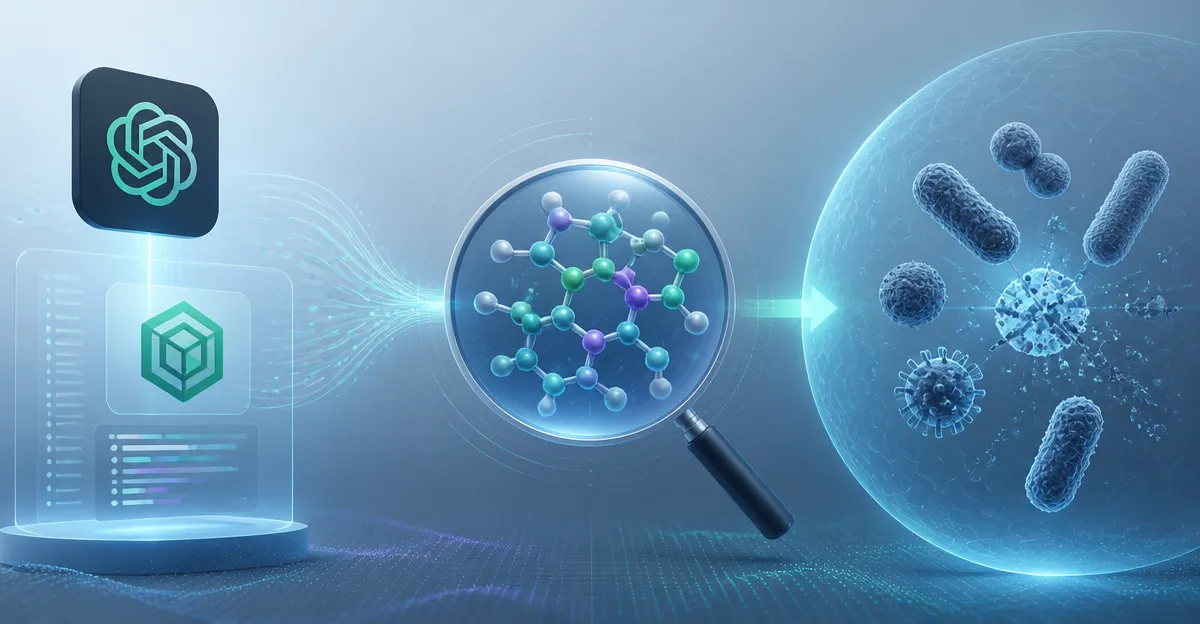
September 10, 2026, (Inside AI) — A University of Pennsylvania lab is using ChatGPT and Codex to search extinct and living genomes for molecules that could kill drug-resistant microbes. The team, led by bioengineer César de la Fuente, has cut the initial search for antimicrobial candidates from years to hours.
Drug-resistant infections are already a leading killer. About five million deaths in 2021 were linked to bacterial antimicrobial resistance, a toll projected to roughly double by 2050. Yet no new class of antibiotics has reached patients in 50 years.
De la Fuente argues the field has stalled because most development tweaks existing drugs or familiar chemical classes. His lab starts from a different premise: biology is information. DNA nucleotides and protein amino acids form an alphabet that machine learning can read.
"The nucleotides that make up DNA, and the amino acids that make up proteins and peptides are sort of like an alphabet," said de la Fuente, Presidential Associate Professor at the University of Pennsylvania. "Thinking about biology as information enabled us to develop methods that can begin to decipher the organizing principles of life that gave rise to a functional molecule."
The lab trains deep-learning models to recognize patterns in biological sequences. These models scan massive genome and protein datasets for potential antimicrobials. The approach shrinks a process that once took years into hours of computation.
AI as a Multilingual Lab Partner, Not a Replacement
Alongside its own models, the lab uses ChatGPT and Codex to brainstorm hypotheses, write and refine code, process datasets, and connect ideas across disciplines. Biologists who lack programming depth can build tools. Programmers who know less biology can tackle biological problems.
ChatGPT also lets lab members work in their native languages. That lowers barriers and speeds workflows. De la Fuente uses it as a brainstorming partner, feeding it good and bad ideas from a team that thinks differently about the same problems.
"Our ChatGPT workspace is receiving input from all these different people that think differently about the problems that we're trying to tackle," said de la Fuente. "Obviously you have to always double-check for accuracy."
The lab is highly transdisciplinary, with members from biology, chemistry, computer science, and engineering. That mix is deliberate. De la Fuente believes breakthroughs hide at the edges between fields where few people go.
The Long Road From Candidate to Drug
Finding a promising molecule is only the first step. Scientists must confirm it kills the target microbe, determine the effective dose, and test how it affects human cells. Chemists may then optimize it for potency, safety, or stability.
Further tests assess toxicity, resistance development, and how the candidate moves through the body. Teams must also find a reliable manufacturing method. Candidates that clear these hurdles still face regulatory review and clinical trials.
De la Fuente insists AI and laboratory biology must advance together. "Ground-truth experiments are essential to validate AI predictions," he said. "This will be critical in the life sciences in the years to come if we are to continue scratching the surface of our understanding of biology, which is the most complex thing out there."
He frames the work as part of a longer scientific tradition. "We have always relied on tools and machines to understand the world around us," said de la Fuente. "The telescope illuminated the cosmos, and the microscope revealed the world of the invisible. That is what our work is all about."
The lab's approach has drawn attention beyond academia. Earlier work from the group identified antimicrobial peptides in extinct organisms, including Neanderthals and woolly mammoths. That research, published in 2023, showed how mining ancient genomes could surface molecules modern medicine has never seen.
Still, the path from a computational hit to an approved drug remains long and expensive. Most candidates fail. But de la Fuente's bet is that AI can make the search faster, broader, and more creative than traditional screening methods allow.