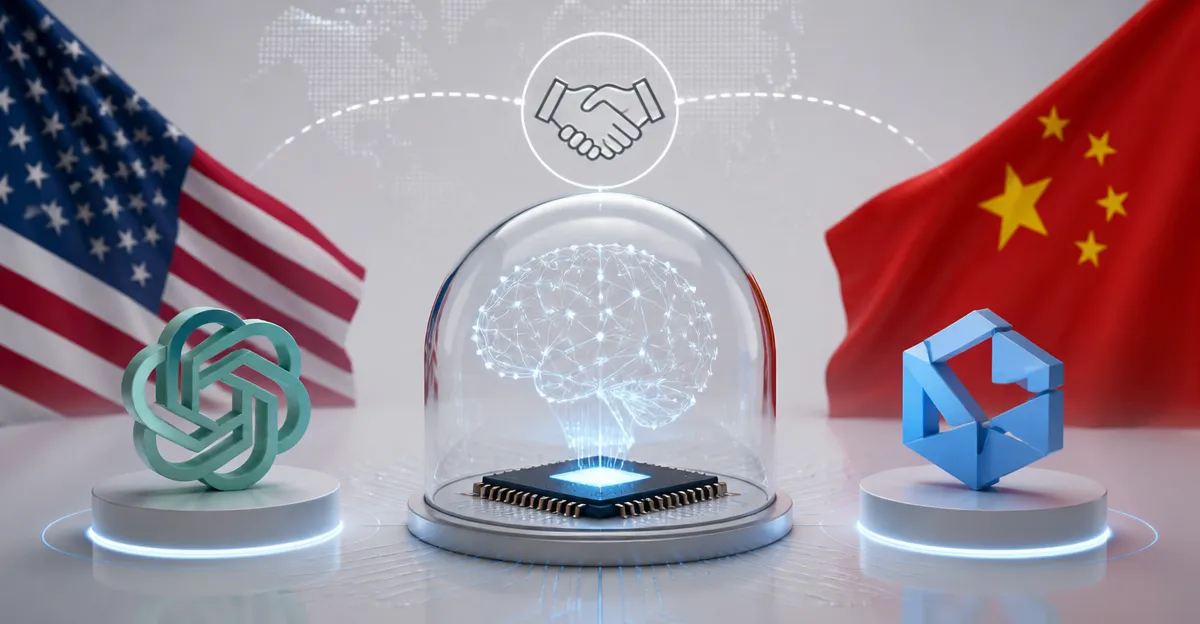
September 24, 2026, (Inside AI) — US President Donald Trump said he will discuss artificial intelligence with Chinese President Xi Jinping during their meeting on Thursday, but indicated he wants to maintain the current status quo on AI regulation.
In a social media post, Trump wrote that "Super Intelligence (SI)" would be a "big topic of discussion," using his preferred term for artificial intelligence. He added that he wants to "leave it exactly where it is" and claimed that is also China's position.
"A big day with President Xi of China. Super Intelligence (SI) will be a big topic of discussion, but I want to leave it exactly where it is," Trump wrote. "That is China's position also. Our guardrail is the DOJ!"
The president's reference to the Department of Justice as the primary guardrail signals a continued reliance on existing enforcement mechanisms rather than new legislative or regulatory frameworks for AI. This stance comes as the European Union implements its AI Act and other nations advance their own governance models.
Trump's comments follow his statement last week that the United States already has guardrails in place to regulate and prosecute AI companies. That remark appeared to downplay concerns raised by industry leaders about the potential misuse of artificial intelligence harming people.
The meeting between Trump and Xi is expected to cover a range of bilateral issues, with AI now added to the agenda. The two leaders have previously discussed technology competition, but this marks a direct focus on artificial intelligence at the presidential level.
China has its own approach to AI regulation, including rules on algorithmic recommendations and generative AI services. The Chinese government has emphasized the importance of AI safety and security, though specific enforcement details remain less transparent than in Western jurisdictions.
The president's use of the term "Super Intelligence" rather than the more common "artificial intelligence" is notable. Superintelligence typically refers to a hypothetical AI that surpasses human intelligence across all domains, a concept more often discussed in theoretical and safety research circles than in policy statements.
Industry observers have noted that the lack of new regulatory proposals from the Trump administration contrasts with the rapid advancement of AI capabilities. Major AI labs continue to release more powerful models, and concerns about misinformation, bias, and economic disruption persist.
The Department of Justice has taken some enforcement actions related to AI, including cases involving fraud and antitrust. However, these actions are not specifically designed for AI regulation and may not address broader societal impacts.
Trump's statement that both leaders want to leave things "exactly where they are" suggests a mutual interest in avoiding new restrictions that could slow AI development. This could be seen as a boost for AI companies in both countries, which have argued that heavy regulation could hinder innovation.
However, critics argue that without clear rules, risks to consumers and democratic processes will grow. They point to deepfakes, algorithmic manipulation, and autonomous weapons as areas needing urgent oversight.
The meeting between Trump and Xi will be closely watched for any concrete agreements or joint statements on AI. Given the president's comments, significant new initiatives appear unlikely. Instead, the focus may remain on maintaining current policies and enforcement through existing agencies.
As AI continues to evolve, the balance between innovation and safety will remain a contentious issue. The outcome of this high-level discussion may set the tone for how both nations approach AI governance in the coming years.