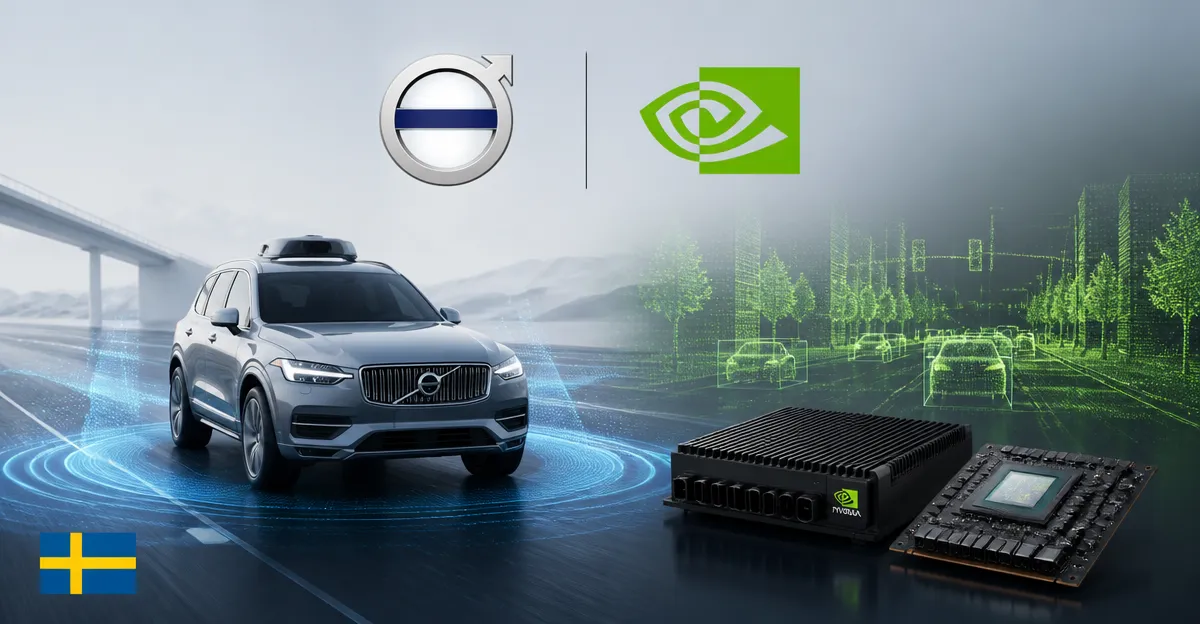
October 16, 2026, (Inside AI) — Volvo Cars and NVIDIA on Wednesday announced an expansion of their partnership to develop automated driving technology that aims to let cars drive "from door to door," covering highways, urban streets, and parking. The collaboration, which began in 2017, will combine Volvo's vehicle safety systems with NVIDIA's AI and accelerated computing platforms.
The two companies did not disclose specific chip models or detailed technical specifications, but they confirmed the use of NVIDIA's Hyperion sensor and compute architecture, Halos OS, and the Alpamayo Stack driving software. Volvo plans to debut the technology in an unnamed next-generation car, part of what the automaker calls its "largest-ever product push." No launch date was provided.
The announcement signals a step toward "eyes-off and mind-off" driving features, where drivers would not need to watch the road or stay mentally engaged in certain conditions. The companies described a gradual rollout of these capabilities, though they did not specify a timeline or the conditions under which the features would be available.
Volvo CEO Håkan Samuelsson said the company has stood "synonymous with car safety for almost 100 years." He added that combining this legacy with NVIDIA's AI "brings safety knowledge and AI technology together." NVIDIA CEO Jensen Huang said that "accelerated computing has transformed the car into an intelligent machine that can understand the world around it."
Read: Samsung's $80B Quarterly Profit Surpasses Nvidia, But Valuation Lags
The partnership builds on previous work. Volvo already uses NVIDIA's DRIVE Orin chip in its EX90 electric SUV, which delivers over 250 TOPS of computing power. The automaker plans to integrate the more powerful DRIVE Thor chip into future models. DRIVE Thor uses NVIDIA's Blackwell GPU architecture and delivers up to 1,000 TOPS.
Volvo sold over 710,000 cars in 2025, with 46% of them electrified. The company employs about 42,600 people and targets net-zero greenhouse gas emissions by 2040.
NVIDIA's Auto Ambitions Meet Volvo's Safety Legacy
NVIDIA has been steadily expanding its automotive footprint. The company's DRIVE platform now powers vehicles from Mercedes-Benz, Jaguar Land Rover, and BYD, among others. The Hyperion architecture, announced earlier this year, is designed to support level 3 and level 4 autonomous driving. Halos OS provides a safety-certified operating system, while the Alpamayo Stack handles perception, planning, and control.
Volvo's safety record is well-documented. The company introduced the three-point seatbelt in 1959 and has since pioneered numerous safety innovations. Its EX90, launched in 2023, was the first Volvo to feature lidar and NVIDIA's DRIVE Orin. The automaker has also committed to becoming fully electric by 2030, though it recently adjusted that target to allow for hybrids.
Industry analysts note that the partnership's success will depend on regulatory approval and public acceptance of eyes-off driving. Several automakers, including Tesla and Mercedes-Benz, have faced scrutiny over their advanced driver-assistance systems. Volvo's emphasis on safety could give it an edge, but the company has not yet demonstrated the technology in real-world conditions.
This deal also highlights NVIDIA's growing role in the automotive supply chain. The company's automotive revenue reached $1.1 billion in its fiscal 2026 second quarter, up 37% year-over-year. As automakers race to integrate AI, NVIDIA's chips and software are becoming a standard. For Volvo, the partnership is a bet that NVIDIA's accelerated computing can help it leapfrog competitors in the race to autonomy.
Read: Nvidia-backed Firmus scraps $5bn Australian IPO
Volvo and NVIDIA did not say when the first car with the new technology will hit the road. The companies also declined to comment on whether the system will require regulatory exemptions. Volvo's next-generation models are expected to be built on the SPA2 platform, which supports over-the-air updates and advanced computing. The automaker has not confirmed which model will debut the technology.