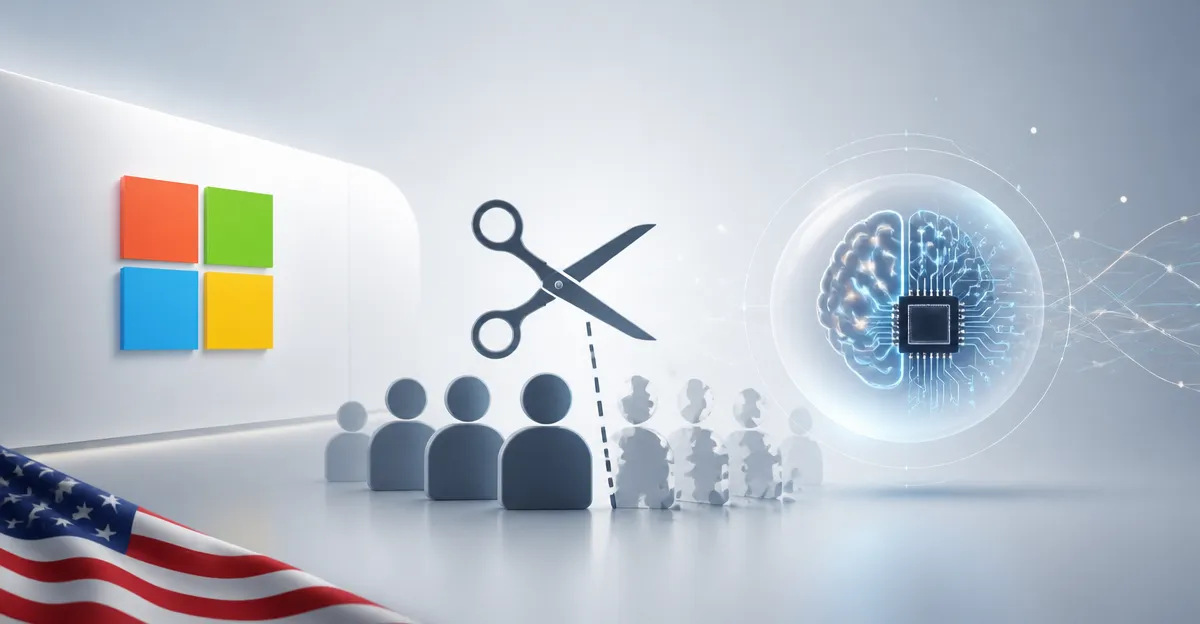
October 30, 2026, (Inside AI) — Microsoft has offered a voluntary exit package to roughly 60,000 employees, about a quarter of its global workforce, across the United States, Canada, the United Kingdom and India. The offer, announced on October 26, follows a narrower voluntary retirement programme launched in April that targeted long-serving U.S. staff. Unlike that earlier round, the new Voluntary Exit Offer carries no age or tenure requirement and extends up to vice president level. Microsoft expects only 3 to 5 percent of employees to accept.
The timing invites a simple narrative: AI is replacing workers, and Microsoft is clearing the decks. That reading is not supported by the evidence. A July 2026 policy brief from the Stanford Institute for Economic Policy Research found that AI's effect on overall employment is likely to be small for now. Since 2022, unemployment among the most AI-exposed U.S. workers and the least AI-exposed workers has risen at roughly the same rate. The layoff story is really a restructuring story, and the restructuring is really a financing story.
Why The Exit Door Is Cheaper Than The Axe
Microsoft is not alone in needing cash. Tech companies are pouring billions into AI data centres, chips and power contracts. Some of the job cuts being labelled as AI-driven are more directly tied to funding that infrastructure build-out, or to correcting the over-hiring of the pandemic years. A voluntary programme lets a company reduce headcount without the public spectacle of a mass layoff. It also moves the decision from the employer to the employee, which changes how the event is recorded and how it is perceived.
Read: AI Spending Fears Trigger Global Stock Selloff, Bond Rally
The two Microsoft offers are not comparable. The April programme was limited to U.S. employees whose age and years of service added up to 70 or more, effectively targeting people near the end of their careers. It came with up to 39 weeks of pay and up to five years of health cover. About 8,600 employees were offered it, and roughly 30 percent accepted. The October offer is broader in reach but thinner in terms: it provides Microsoft's standard severance package, which scales with years of service.
That structure creates a quiet inequity. Older, longer-tenured staff have the largest financial incentive to leave. Younger and newer employees have the least, and staying exposes them to future layoffs with no guaranteed cushion. The voluntary label does not remove the risk. It redistributes it.
The deeper shift here is in corporate strategy, not technology. Voluntary exits give employers a way to shrink without triggering the backlash that has greeted recent layoff announcements. They also produce a cleaner public record, since each departure can be logged as a personal choice. If this model spreads, the labour market data that policymakers rely on will show fewer layoffs even as headcount falls. That is a measurement problem with real consequences for how AI's impact on work is understood and governed.
There is some evidence that AI may be reducing hiring of young graduates, and that signal deserves attention. But a hiring slowdown among entry-level roles is not the same as mass replacement of existing workers. The Stanford findings suggest the aggregate effect remains modest. The consensus forming among labour economists is that AI is changing the composition of work faster than the total quantity of it.
India has an opening to measure this better than most. Since 2025, the Periodic Labour Force Survey has published monthly estimates of employment and unemployment, giving the country a strong base. Adding questions on how and why people leave jobs would sharpen the picture. Large employers could be asked to report departures by type, so voluntary exits can be separated from layoffs. New York already asks employers whether automation played a part in their layoffs, a model that could travel.
Read: A reality check on AI boom: Eight risks to look out for
Expect more voluntary programmes across the sector. They are cheaper politically than layoffs and easier to defend to investors. But each exit recorded as a personal choice makes the labour market harder to read. Companies are experimenting with restructuring faster than statisticians can track it, and the gap between what is happening and what is being counted is where the real story sits.