November 8, 2026, (Inside AI) — Abu Dhabi's state oil giant ADNOC signed a deal this week with G42 and OpenAI to deploy advanced AI across its energy operations, a move that signals the industry's pivot toward "physical AI" as the next major monetization frontier. The agreement, announced at the ADIPEC conference in Abu Dhabi on November 2, aims to improve operational efficiency and solve complex engineering challenges in the oil sector. It marks one of the most concrete examples yet of AI moving beyond digital chatbots and code assistants into the physical world of sensors, robots, and industrial machinery.
The push comes as renewed unease over AI spending weighs on the technology sector. Investors have grown impatient with the lack of tangible returns from generative AI tools. Physical AI, which combines AI models with sensors, actuators, and control systems, offers a path to revenue by automating tasks in factories, energy grids, and logistics. Nvidia CEO Jensen Huang has been the most vocal proponent, predicting in a January 2026 podcast that the world will eventually have "a billion robots" and a new global economy around building and maintaining them. "The ChatGPT moment for robotics is here," Huang said, a claim that is now being tested by real-world deployments.
Why Industrial Giants Are Betting on Atoms, Not Bits
The ADNOC deal is not isolated. Shell has implemented a predictive maintenance system with California-based C3.ai, monitoring more than 13,000 pieces of equipment to prevent failures and cut emergency repair costs. Rival BP now applies AI to analyze real-time drilling data, claiming it has cut evaluation times from months to days, lowered exploration and drilling costs by 7%, and reduced non-productive time by nearly 8%. Chevron uses AI-driven seismic interpretation and its in-house genAI tool ApEX to improve subsurface imaging and increase exploration success rates. Meanwhile, Taiwanese electronics manufacturer Foxconn has deployed a "scalable AI-powered robotic workforce" that uses digital twin simulations to prune deployment times by nearly 50%, improve cycle times by 20-30%, and lower error rates by 25%.
These deployments share a common thread: they require real-world data, not just internet-scraped text. "Synthetic data alone is not useful. The environment where the deployment would happen plays a vital role in the training of the robots," a senior executive with a logistics-linked robotics company said, speaking on condition of anonymity. This data challenge explains why physical AI is harder to scale than digital AI, but also why it creates stickier, more defensible revenue streams.
Read: AustralianSuper AI Strategy
OpenAI CEO Sam Altman, speaking at the ADIPEC signing, framed the partnership as a reversal of historical roles. "For a long time, the AI industry has talked about what it needs from the energy industry. And now I think we can repay the favour," Altman said. He added that AI's potential extends beyond workplace productivity to accelerating scientific discoveries and solving problems that have historically proved difficult for researchers.
The monetization pressure is real. "I think they are thrashing around for revenue ideas. You can't vibe code a phone. It is a deep ecosystem. Others such as Amazon have tried," a US-based technology analyst told Inside AI, speaking on condition of anonymity. The analyst noted that Anthropic is performing better on the B2B side, distributing more widely through cloud service providers, while OpenAI was hobbled by its contract with Microsoft, which is reportedly coming to an end soon.
My own analysis: The physical AI narrative serves a dual purpose for the industry. It addresses the monetization crisis by tying AI to hard assets and operational savings, but it also shifts the competitive landscape. Nvidia, which dominates AI training chips, stands to benefit enormously from a robotics boom. Yet the real winners may be industrial incumbents like ADNOC, Shell, and Foxconn, who own the data and the deployment environments. If physical AI delivers even half of the projected $1 trillion in economic value by 2040, as McKinsey partner Ani Kelkar estimates, the balance of power in AI could tilt away from pure software companies toward those who control physical infrastructure.
Kelkar, based in McKinsey's Greater Boston office, said the value will come not from worker replacement but from innovation. "That will happen not through worker replacement and productivity but through our ability to innovate what products we make, how we make them, and what tasks humans perform versus which ones are automated, elevating the nature of work for humans to more problem-solving and to sort of a catcher role, rather than just relying on our physical dexterity," he said.
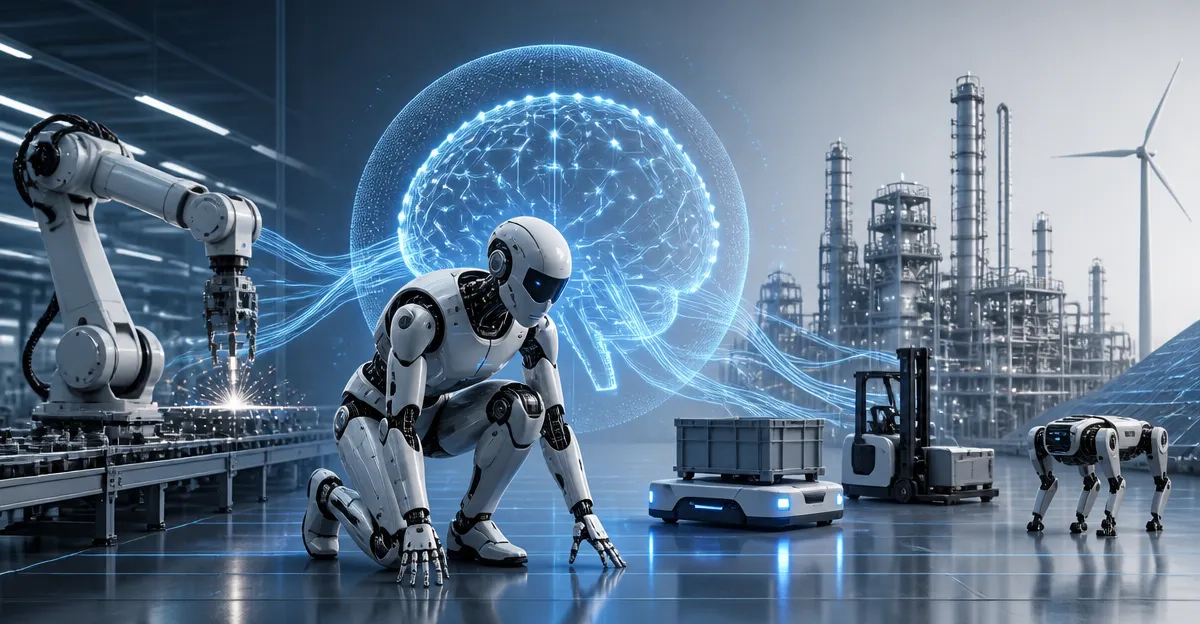
The technical foundations are still maturing. Physical AI requires multimodal inputs such as images, videos, text, speech, and sensor data, converted into actions that machines can execute. Large language models provide a kind of "common sense" about the world, but pairing them with reinforcement learning in hybrid architectures remains complex. According to IBM Think's Cole Stryker, physical AI "goes far beyond individual robots to entire AI-powered factories, energy-efficient smart grids or fleets of automated vehicles."
Read: Blackstone AI Fundraising
For now, the ADNOC deal and similar industrial partnerships represent a bet that the next wave of AI value will be measured in barrels of oil, welding seams, and drilling precision, not just in tokens and prompts. Whether that bet pays off will depend on how quickly physical AI can overcome its data and deployment hurdles. The industry's ability to monetize AI may hinge on it.

Shamil has a low tolerance for AI that only works in controlled demos. He covers agentic systems and generative AI with the skepticism of someone who has seen too many “revolutionary” tools quietly disappear six months after launch.