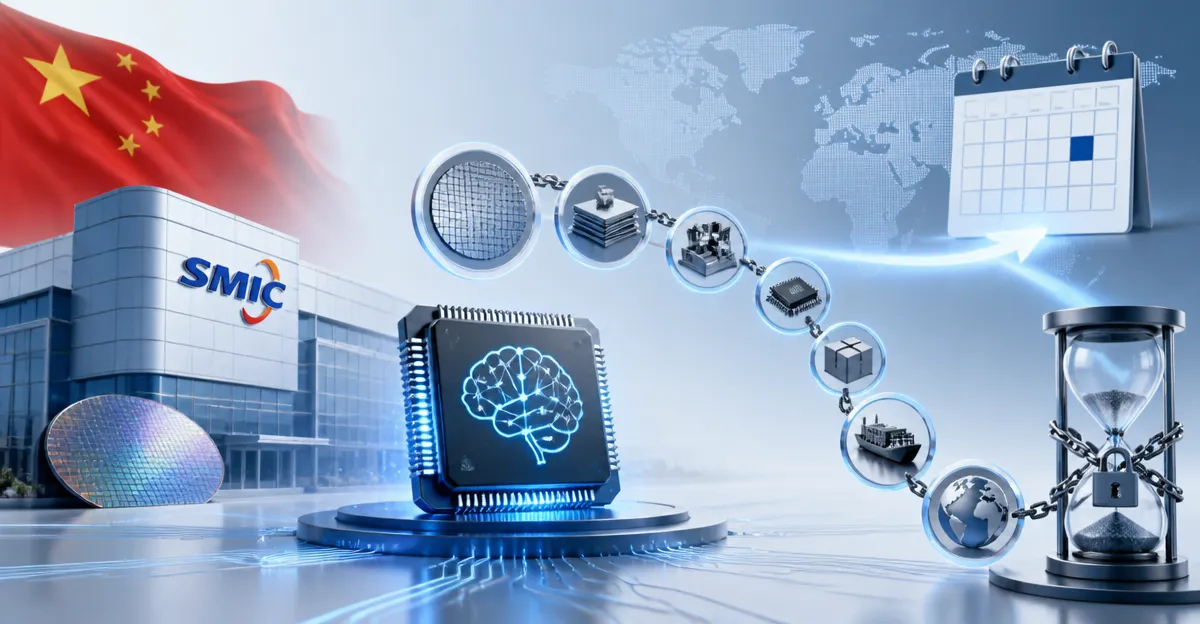
November 13, 2026, (Inside AI) — China's largest contract chipmaker, Semiconductor Manufacturing International Corp (SMIC), warned that the global AI chip supply chain will remain tight through 2027, signaling that demand for advanced semiconductors continues to outpace production capacity.
The disclosure came during SMIC's earnings call on Friday, when Co-CEO Zhao Haijun addressed investor concerns about a potential AI bubble. Zhao said the artificial intelligence industry remains in its early stages and that demand for AI chips is still strong.
"The AI industry is still in its early stages and demand remains strong," Zhao said, according to sources familiar with the call.
The supply chain constraint matters because SMIC is China's primary foundry for mature-node chips, which are essential for AI inference, power management, and edge devices. While SMIC does not produce the most advanced AI training chips, its role in the broader semiconductor ecosystem gives its outlook weight. The company's comments suggest that even the less glamorous segments of the AI hardware stack are feeling the pinch.
Industry analysts have been debating whether the AI market is overheating after a year of record capital expenditures on data centers and GPUs. SMIC's assessment adds a data point to the "no bubble" camp, but it also highlights a structural problem: the supply chain cannot keep up with demand.
Why the Bottleneck Persists
The tightness in AI chip supply stems from several factors. Advanced packaging capacity, such as chip-on-wafer-on-substrate (CoWoS) technology, remains limited. Most of that capacity is controlled by TSMC, which has been expanding but still faces long lead times. Memory bandwidth is another constraint. High-bandwidth memory (HBM) production is dominated by a few players, and AI accelerators require massive amounts of it.
SMIC's own capacity is largely focused on mature nodes, but the company has been investing in advanced packaging and specialty processes. Zhao's comments imply that even these less advanced parts of the chain are strained.
The geopolitical dimension complicates matters further. U.S. export controls have restricted China's access to advanced chipmaking equipment, forcing SMIC and its peers to develop domestic alternatives. That has slowed China's ability to expand capacity at the leading edge, but it has also spurred investment in mature-node and packaging technologies.
SMIC's warning echoes similar statements from other industry players. In recent months, executives at ASML and Applied Materials have noted that demand for chipmaking equipment remains strong, with backlogs extending into 2027. The consensus is that the AI buildout is not a short-term fad but a multi-year investment cycle.
Yet skeptics point to signs of froth. Some AI startups have struggled to monetize their products, and venture funding has cooled from its 2024 peak. Nvidia's data center revenue growth has decelerated, though it remains robust. The question is whether the current demand is sustainable or driven by a few hyperscalers stockpiling hardware.
SMIC's Zhao did not directly address these concerns, but his statement that the industry is "still in its early stages" suggests he believes the runway is long. That view is shared by many in the industry, who argue that AI adoption in enterprises is only beginning.
For SMIC, the tight supply chain presents both opportunity and risk. On one hand, it can command higher prices and prioritize higher-margin orders. On the other, it limits the company's ability to grow revenue if it cannot secure enough equipment and materials. The company has been investing heavily in new fabs, but those take years to come online.
SMIC's warning also has implications for the broader Chinese tech sector. If AI chip supply remains tight, Chinese AI companies may face higher costs and longer lead times, potentially slowing their competitiveness against U.S. rivals. The Chinese government has been pushing for self-sufficiency in semiconductors, but progress is slow.
Investors will be watching SMIC's capital expenditure plans for 2027. The company has not yet disclosed its budget, but analysts expect it to increase spending on advanced packaging and mature-node capacity. The tight supply chain through 2027 means that any new capacity will be absorbed quickly.
For now, SMIC's message is clear: the AI chip shortage is not going away anytime soon. Companies that depend on semiconductors should plan for continued constraints.

If a research paper dropped this week, Mahesh has already read it. He covers AI tools and vibe coding for builders who need to know what is worth their time and what is not.