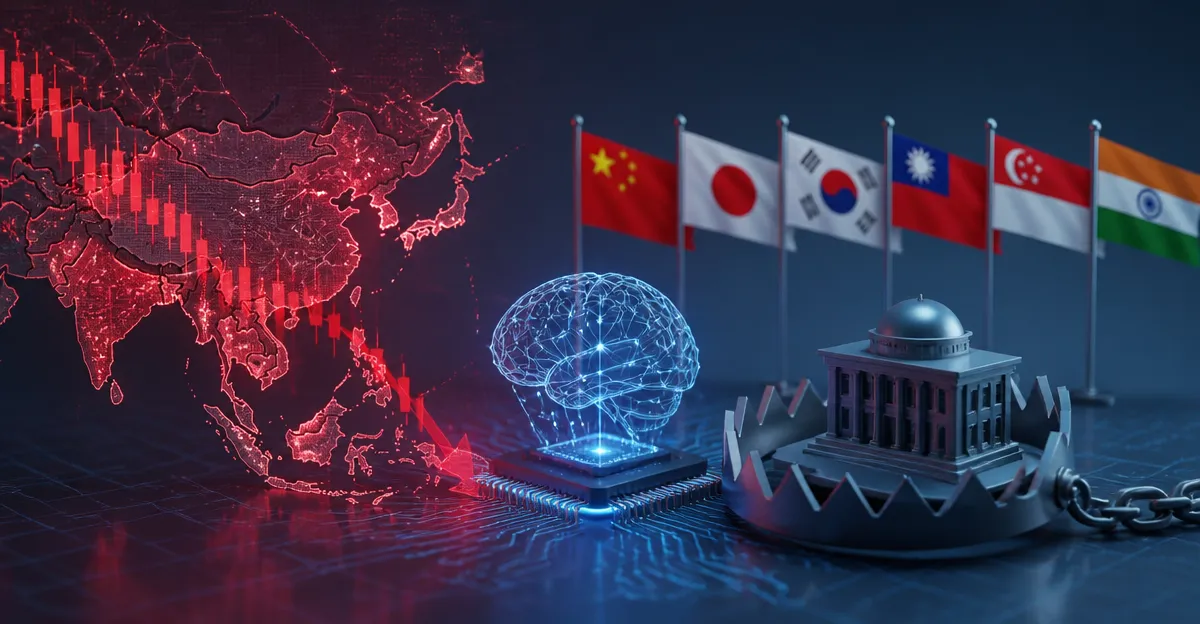
November 23, 2026, (Inside AI) — A deepening selloff in technology and semiconductor stocks is testing the conviction of the global AI trade, with markets from Taipei to Seoul and New York on track for steep monthly losses. Investors are now openly questioning whether the enormous sums of mostly borrowed money spent on data centers will generate returns fast enough to repay lenders or justify elevated equity valuations.
The anxiety has been compounded by the departure of Nvidia's influential chief executive Jensen Huang, an intensifying US-China technology dispute, and the prospect of greater regulatory scrutiny over the data center buildout following the Democrats' sweeping midterm victory. US futures rebounded on Monday after last week's rout, but selling pressure persisted in Asia, where trading was thinned by a holiday in Japan.
The scale of the decline has drawn the attention of policymakers in South Korea and Taiwan, the region's AI bellwethers. South Korea's finance minister on Monday reiterated plans to stabilize the market if necessary. Taiwan's financial regulator ordered a tightening of short-selling rules, while stock exchanges in China announced support measures including eased requirements for margin financing.
Goldman Sachs' Tony Pasquariello framed the shift in stark terms: "The market has shown its hand regarding its dependency on the AI story. After nearly four years of uninterrupted advancement, during which time the AI theme was rocket fuel for the market and, thus, the wealth effect, we've entered a far more complicated period."
The next key catalyst will be Wednesday's release of the US personal consumption expenditures price index, a key inflation gauge that could signal how much further the Federal Reserve may need to raise rates. Expectations of a 25-basis-point Fed hike next month have kept the dollar near a 19-month high, with the global equity rout lending the greenback an additional safe-haven bid.
Why Borrowed Billions Now Face A Reckoning
The current stress differs from earlier AI-driven pullbacks because it centers on the financing structure of the buildout itself. Much of the capital expenditure on data centers has been funded through debt, meaning the investment case now depends on near-term cash flows rather than long-range projections. When equity prices fall, collateral values weaken and lenders tighten terms, a dynamic that can accelerate a downturn independently of underlying demand for AI services.
The policy response in Asia underscores how central AI-linked chipmakers have become to national economic stability. South Korea's finance ministry and Taiwan's financial regulator are effectively treating semiconductor equities as systemic assets. That posture carries its own risk: market interventions can mask price signals and delay the necessary repricing of risk.
The political dimension adds another layer. The Democrats' midterm victory raises the probability of hearings and disclosure requirements around data center energy use, land acquisition, and debt issuance. Even the threat of scrutiny can chill capital deployment, particularly for projects with long permitting timelines.
Separately, MSCI CEO Henry Fernandez conveyed a willingness to consider alternatives to a two-step downgrade of Indonesia's stock-market status in recent talks with President Prabowo Subianto, according to sources familiar with the discussion.
Key developments that could influence markets on Monday include flash manufacturing and services PMI data for France, Germany, the euro zone, and the UK, along with remarks from New York Fed President John Williams.

Shamil has a low tolerance for AI that only works in controlled demos. He covers agentic systems and generative AI with the skepticism of someone who has seen too many “revolutionary” tools quietly disappear six months after launch.