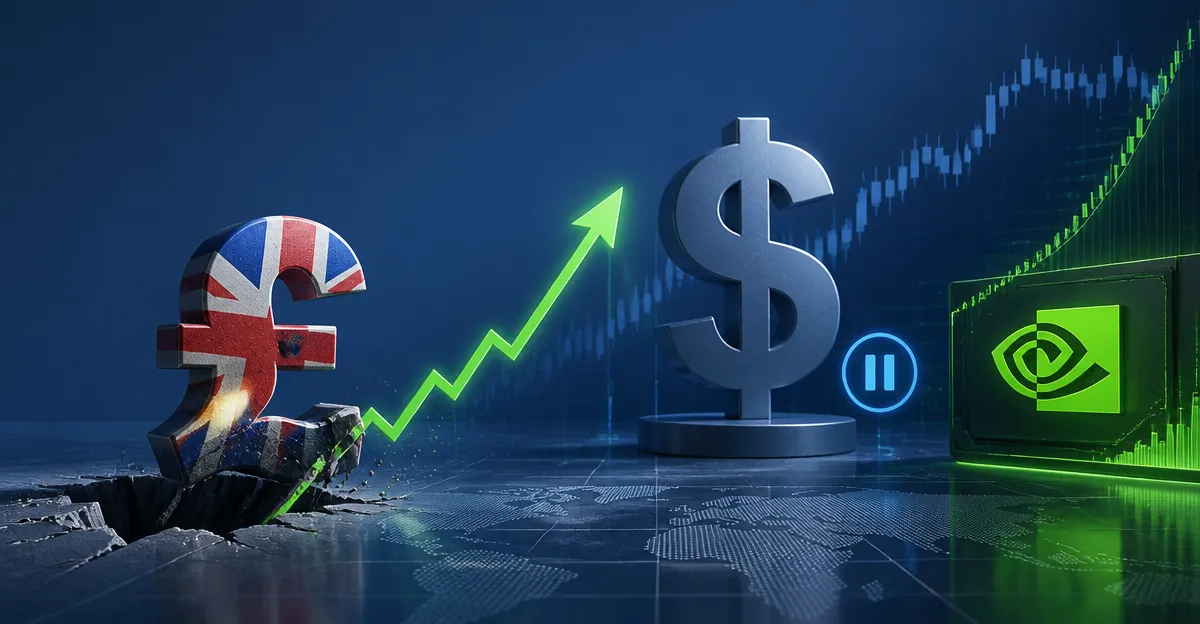
November 24, 2026, (Inside AI) — The British pound climbed above $1.30 on Tuesday, snapping a two-week losing streak, as currency markets paused to reassess the dollar's recent surge. That surge was fueled by renewed confidence in artificial intelligence as a driver of U.S. economic growth.
Sterling rose 0.3% to $1.307 in London trading, recovering from Monday's low of $1.3011, its weakest level since April 2025. Against the euro, the pound slipped slightly, with the single currency edging up 0.1% to 83.73 pence.
The dollar's pullback follows a sharp rally triggered by Jensen Huang's reinstatement as CEO of Nvidia, the chipmaker at the center of the AI trade. Nvidia shares jumped roughly a third on Monday, lifting global technology stocks and reinforcing the view that sustained capital spending on AI infrastructure could give the U.S. economy a durable advantage.
That narrative has reshaped interest rate expectations. Traders now price a quarter-point hike from the Federal Reserve in December, with U.S. rates peaking near 4.5% by mid-2027. The Bank of England, which raised rates earlier this month, is expected to reach only 4.75% over the same period. In theory, a narrower rate gap should support the pound. In practice, growth differentials tell a different story.
Read: Nvidia Reinstates Jensen Huang After 11-Day Exile, Shares Jump 32%
The U.K. economy expanded at an annualized 1.9% in the third quarter, its fastest pace since late 2024. The U.S. economy grew at 3.4% over the same period. That gap helps explain why the dollar has remained resilient despite the pound's modest rebound.
The AI investment boom is now a macro variable. Capital expenditure on data centers, chips, and power infrastructure has become a measurable contributor to U.S. GDP. This dynamic gives the Federal Reserve room to keep rates higher for longer without choking growth. For currency traders, AI sentiment has become a leading indicator for the dollar.
PCE Data Looms as Sterling Tests $1.30
The next catalyst arrives Wednesday with the release of the personal consumption expenditures (PCE) index, the Fed's preferred inflation gauge. A hot reading could push the pound below the psychologically important $1.30 level. A softer print might allow consolidation.
"The pair is now testing $1.30. Wednesday's PCE price index could trigger a break lower if it comes in hot. If it undershoots, we see a case for consolidation around this psychologically important level, with easing energy prices reinforcing the dovish reading," said Antonio Ruggiero, strategist at Convera.
The pound's path also depends on how global markets digest the AI-driven dollar narrative. If investors continue to treat U.S. tech leadership as a proxy for economic outperformance, the dollar may stay bid even as rate differentials narrow. That would leave sterling vulnerable despite the Bank of England's tightening cycle.
Read: Wall St Futures Dip as Chip Stocks Cool After Nvidia-Fueled Rally
For now, the currency market is caught between two forces: a resurgent AI investment thesis that favors the dollar, and a modest technical rebound that has lifted the pound off its lows. Wednesday's inflation data will likely determine which force prevails in the near term.

Shamil has a low tolerance for AI that only works in controlled demos. He covers agentic systems and generative AI with the skepticism of someone who has seen too many “revolutionary” tools quietly disappear six months after launch.