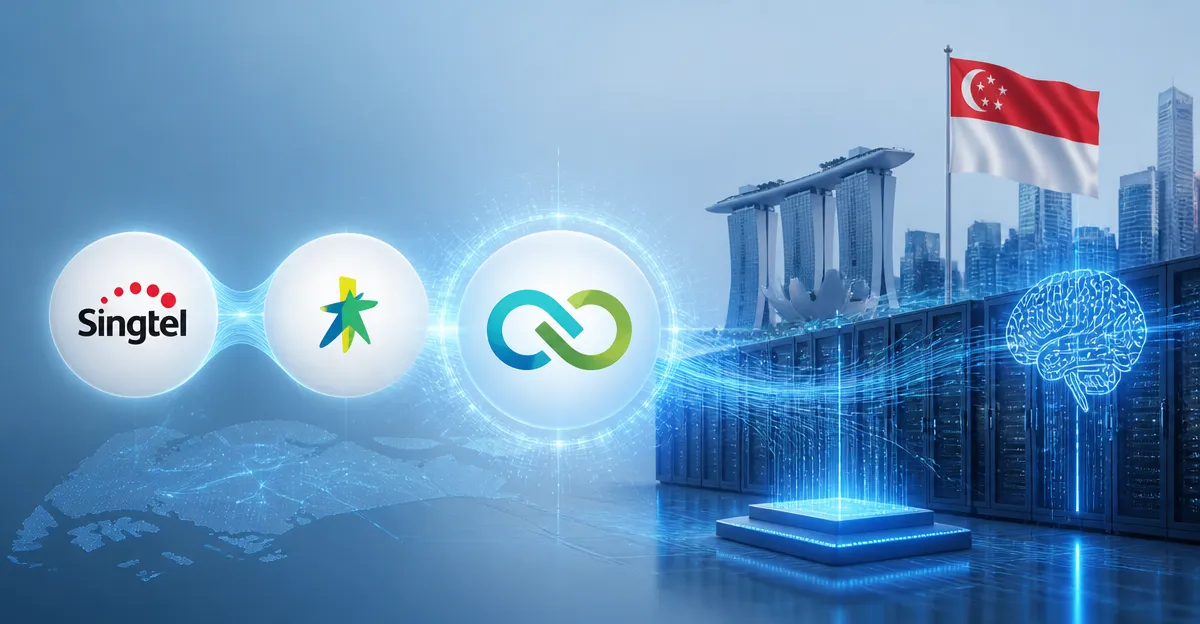
November 25, 2026, (Inside AI) — A merger between two of Singapore's most prominent telecommunications operators has brought the city-state's aggressive push into artificial intelligence infrastructure into sharp focus, even as industry players confront mounting uncertainty over demand, regulation, and return on investment. The deal, confirmed this week, creates a combined entity with the scale to compete for AI data center contracts and cloud services that are rapidly becoming the backbone of the region's digital economy.
The merger underscores how telecom operators are repositioning themselves as AI infrastructure providers, betting that their existing networks, land banks, and power agreements can be converted into profitable AI factories. Singapore, which has positioned itself as a neutral digital hub for Southeast Asia, faces pressure to keep pace with larger neighbors like Malaysia and Indonesia that are courting hyperscalers with cheaper land and energy.
Details of the transaction remain limited, but sources familiar with the matter say the combined operator will control a substantial share of Singapore's submarine cable landings and terrestrial fiber, assets that are increasingly valuable for AI training clusters that require low-latency connections to global cloud platforms. The merger also consolidates spectrum holdings, giving the new entity more capacity to support edge AI applications.
Yet the deal arrives at a moment of genuine uncertainty. Global AI infrastructure spending has shown signs of cooling after two years of breakneck growth, with several hyperscalers revising capital expenditure plans downward for 2027. Power constraints in Singapore, which has limited renewable energy options and relies heavily on natural gas, further complicate the picture. The government has imposed strict efficiency requirements on new data centers, forcing operators to innovate on cooling and workload management.
Read: SMIC: AI Chip Supply Chain to Stay Tight Through 2027
Industry analysts see the merger as a defensive move as much as an offensive one. By combining forces, the two operators can spread the risk of building AI-ready facilities that may take years to fill. They also gain bargaining power with equipment vendors and can share the cost of upgrading networks for AI inference at the edge.
The move fits a broader pattern of telecom consolidation across Asia. In recent years, operators in Japan, South Korea, and Australia have merged or formed joint ventures to pool resources for 5G and AI infrastructure. Singapore's small domestic market makes scale essential for competing with regional giants.
However, the merger also raises questions about competition. Consumer groups have warned that reduced choice in the telecom market could lead to higher prices, though the combined entity will still face competition from mobile virtual network operators and foreign entrants. The Infocomm Media Development Authority (IMDA) is expected to review the deal for antitrust implications.
For AI companies, the merger could mean better access to integrated network and compute services. Several AI startups in Singapore have complained about the difficulty of securing reliable, low-latency connectivity for distributed training. A single operator with end-to-end control over fiber, 5G, and data centers could simplify procurement.
But the uncertainty cuts both ways. If AI demand slows, the merged operator could be left with excess capacity and debt from the consolidation. The global AI market has shown volatility, with valuations of AI chip companies swinging sharply on earnings news. Telecom operators are not immune to these cycles.
Singapore's government has made AI a pillar of its Smart Nation agenda, committing billions to research and infrastructure. The merger aligns with that vision, but it also concentrates risk in a single player. How regulators balance the desire for national champions against the need for competitive markets will shape the outcome.
The deal is expected to close in the second half of 2027, subject to regulatory approval. Both operators have declined to comment on specific terms. For now, the merger stands as a test case for how small, digitally advanced economies can build AI infrastructure without the scale of larger nations.

If a research paper dropped this week, Mahesh has already read it. He covers AI tools and vibe coding for builders who need to know what is worth their time and what is not.