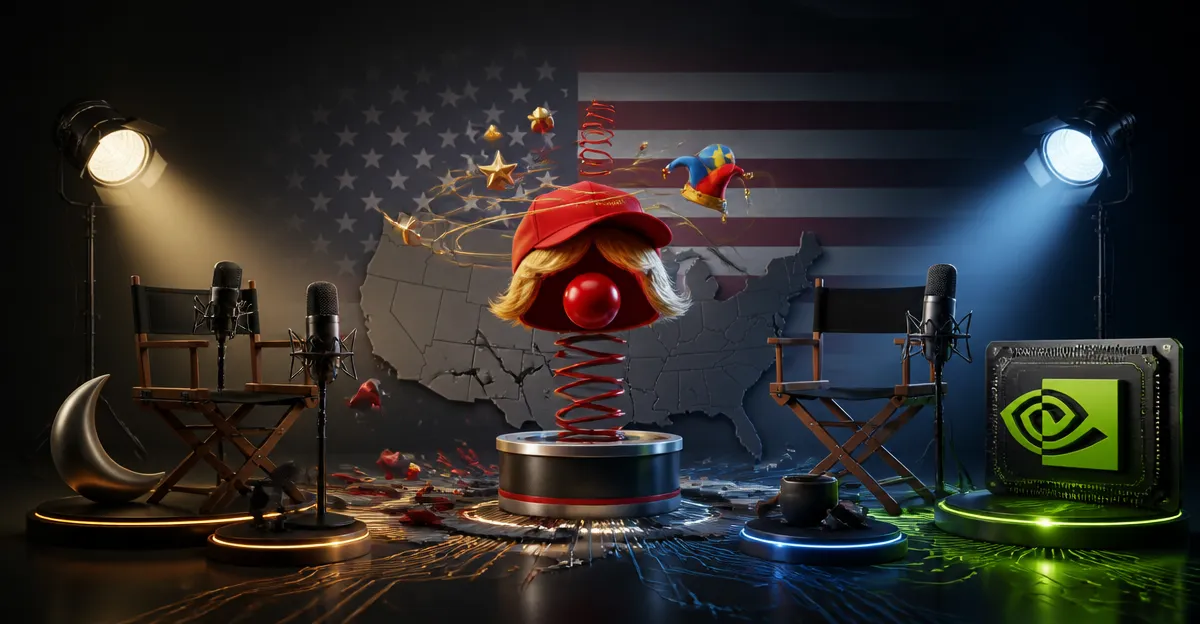
November 26, 2026, (Inside AI) — Late-night hosts Jimmy Kimmel and Seth Meyers used their Monday monologues to mock Donald Trump over his reported intervention in Nvidia's leadership crisis, questioning why the President pushed to reinstate CEO Jensen Huang after the company's board removed him over alleged affairs, including one involving a suspected Chinese spy.
The controversy centers on Huang's return to the $1 trillion chipmaker just two weeks after his ouster. Trump reportedly contacted Nvidia's board directly, pressing for Huang's reinstatement. The board complied, and Trump publicly celebrated the decision on Truth Social, calling it the "correct and proper decision" and dismissing national security concerns.
The episode has drawn scrutiny because Nvidia sits at the center of the global AI industry. Its processors power advanced AI systems, and the company faces intense U.S. export restrictions on chip sales to China. Huang's reinstatement, following Trump's reported intervention, raises questions about the relationship between political power and tech leadership, as well as the role of financial interests in Washington.
Kimmel opened his monologue by framing Huang's return as an unlikely comeback story. "Who doesn't love a good comeback story?" he asked, noting the CEO's brief spell away from the company.
The comedian then turned sarcastic: "All this guy did was cheat on his wife with two employees and a Chinese spy. Who hasn't done that?"
Kimmel also highlighted Trump's estimated $62 million in Nvidia stock holdings and Huang's reported $25 million contribution toward Trump's proposed White House ballroom. "There's nothing unusual about a president who owns a huge amount of stock in a company putting his little carrot thumb on the scale in a way that immediately boosts that company's stock price," Kimmel quipped.
He concluded with a bleak assessment of the moment: "What a profoundly stupid time to be alive."
Meyers focused on the contradiction between Trump's tough rhetoric on China and his defense of Huang. He pointed to the allegations involving a suspected Chinese spy and questions over whether Nvidia had allowed China access to advanced chips.
Recalling Trump's account of asking Huang whether he knew the woman was a spy, Meyers joked: "Yeah, that's how spying works! They don't wear shirts that say 'ask me about being a spy.'"
Meyers also questioned why a President who positions himself as a defender against China would dismiss concerns involving a major technology company and its chief executive. He cited reports about Trump's Nvidia investments and business connections involving companies associated with his son, Donald Trump Jr., suggesting financial interests might explain the support.
The comedian widened his criticism to the tech industry's relationship with political power. "Tech oligarchs consider us expendable," Meyers said. "We can be replaced by AI. But the second they lose a job or face consequences for their actions, Trump will swoop in and save them."
The late-night mockery underscores a broader tension: Nvidia's dominance in AI hardware makes its leadership stable a matter of national interest. Washington's chip export controls have already placed the company under a microscope. Trump's intervention, and the board's rapid reversal, have intensified debate over whether political connections now trump corporate governance and national security protocols.
Neither the White House nor Nvidia has issued further comment on the comedians' remarks. The board has maintained it has "every confidence" in Huang's leadership.

Sofia spent years studying how machines parse human language before pivoting to cover the systems now rewriting it. She reads technical papers the way others read news and looking for what the numbers are actually saying beneath the headlines.