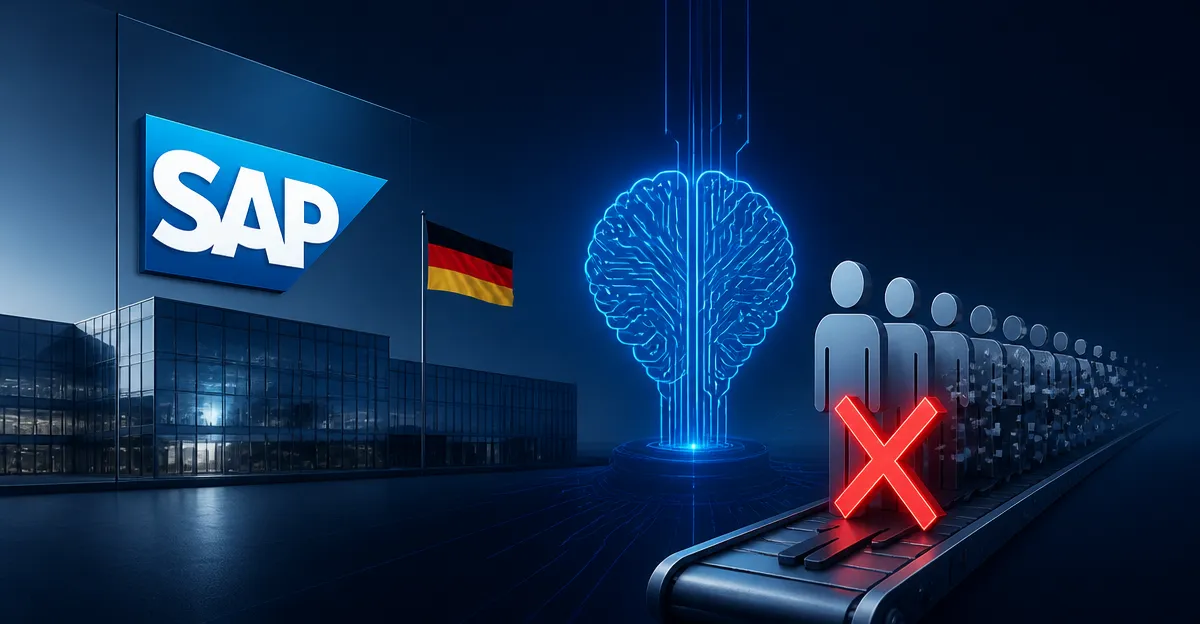
November 27, 2026, (Inside AI) — SAP, Europe's most valuable technology company, is weighing a restructuring that could eliminate at least 10,000 jobs, according to people familiar with the matter. The figure represents roughly 9% of the German software giant's global workforce. The plan is tied to a broader shift toward artificial intelligence across its product lines and internal operations.
SAP declined to comment on the report. The exact number of cuts remains fluid and could change after negotiations with labor representatives. The company employs about 108,000 people worldwide, so the proposed reduction would rank among the largest single workforce actions in European tech this decade.
The news lands at a delicate moment for enterprise software. SAP's core business, selling ERP and back-office suites to large organizations, faces pressure from AI-native competitors and from customers who increasingly ask why they pay per-seat licenses when automation can handle routine tasks. CEO Christian Klein has spent two years repositioning SAP around Joule, its embedded AI assistant, and around Business AI offerings sold as add-ons. A leaner headcount aligns with that strategy: fewer support and administrative roles, more engineering focused on model integration and data governance.
Why Europe's Software Champion Is Rethinking Headcount
The timing is not accidental. SAP's cloud backlog has grown, but operating margins have lagged US peers like Salesforce and Microsoft. Investors have rewarded companies that cut costs while pitching AI as a growth lever. SAP's stock has underperformed the Nasdaq over the past 12 months, and activist pressure has mounted quietly in Frankfurt and Walldorf, where the company is headquartered.
Read: AI Stocks Slide as Infrastructure Buildout Costs Spook Investors
The restructuring also reflects a structural reality: AI does not eliminate the need for software, but it changes who builds and maintains it. Tasks like report generation, ticket triage, and configuration work that once required armies of consultants and support staff now fall to automated agents. SAP's services ecosystem, which includes partners like Accenture and Infosys, could feel the ripple. If SAP reduces internal headcount, partners that rely on SAP implementation work may face similar pressure.
This is not SAP's first major restructuring. In 2024, the company announced an 8,000-role program focused on voluntary severance and internal reskilling. That effort was framed as a transformation, not a retreat. The current discussion, by contrast, appears larger and more directly tied to AI substitution rather than role reallocation. Labor representatives at SAP's German sites, where works councils hold significant influence, will scrutinize any plan that touches guaranteed employment arrangements.
“SAP declined to comment.” The company's silence is standard for unconfirmed personnel matters, but it leaves open questions about timing, geography, and whether the cuts will fall disproportionately on Germany, where SAP employs roughly 25,000 people. German labor law makes large-scale dismissals slow and expensive, so any final figure will likely emerge only after months of negotiation.
The broader industry context matters. IBM has publicly discussed replacing certain back-office roles with AI. Salesforce froze hiring in some divisions while expanding AI sales. Workday and ServiceNow have made similar moves. SAP's action, if confirmed, would be the clearest signal yet that Europe's flagship software firm sees AI as a headcount lever, not just a product feature.
Analysts will watch two numbers closely: the final job-cut figure and SAP's cloud gross margin. A reduction of 10,000 roles could save the company an estimated €1.5 billion to €2 billion annually, depending on severance costs and role mix. That savings would give SAP room to invest in AI infrastructure and acquisitions without compressing margins further.
For customers, the immediate impact is likely minimal. SAP's support contracts and product roadmaps remain intact. But over time, a smaller SAP may lean more heavily on partners and on automated support channels. Enterprises that rely on customized SAP environments should expect slower human response times and more self-service tools.
Read: AI Adoption Falls Among Pakistani Businesses to 22%
The report remains unconfirmed by SAP, and the final scope could shrink or expand. What is clear is that the conversation inside Walldorf has shifted. AI is no longer just a feature to sell. It is now a rationale for reshaping the company itself.

Shamil has a low tolerance for AI that only works in controlled demos. He covers agentic systems and generative AI with the skepticism of someone who has seen too many “revolutionary” tools quietly disappear six months after launch.