November 28, 2026, (Inside AI) — OpenAI is quietly building a version of ChatGPT that can operate an Android phone more like a system-level assistant, according to strings found in version 1.2026.328 of the Android app. The code, first surfaced by Android teardown specialists, points to contacts lookup, call management, SMS reading and sending, media playback control, and screen awareness. None of these features are live, and OpenAI has not confirmed them. But the scope of the permissions suggests a deliberate push beyond voice chat and into the core functions of the device.
The discovery matters because Android has long allowed third-party apps to become the default digital assistant. Google's own Assistant and Gemini use that slot to reach contacts, messages, and on-screen context. ChatGPT currently holds the assistant role on some devices but remains boxed into voice conversations and text replies. The new strings imply OpenAI wants to close that gap, turning ChatGPT into a true system agent rather than a chat window that happens to respond to a wake word.
Permissions Point To A Phone-Wide Assistant
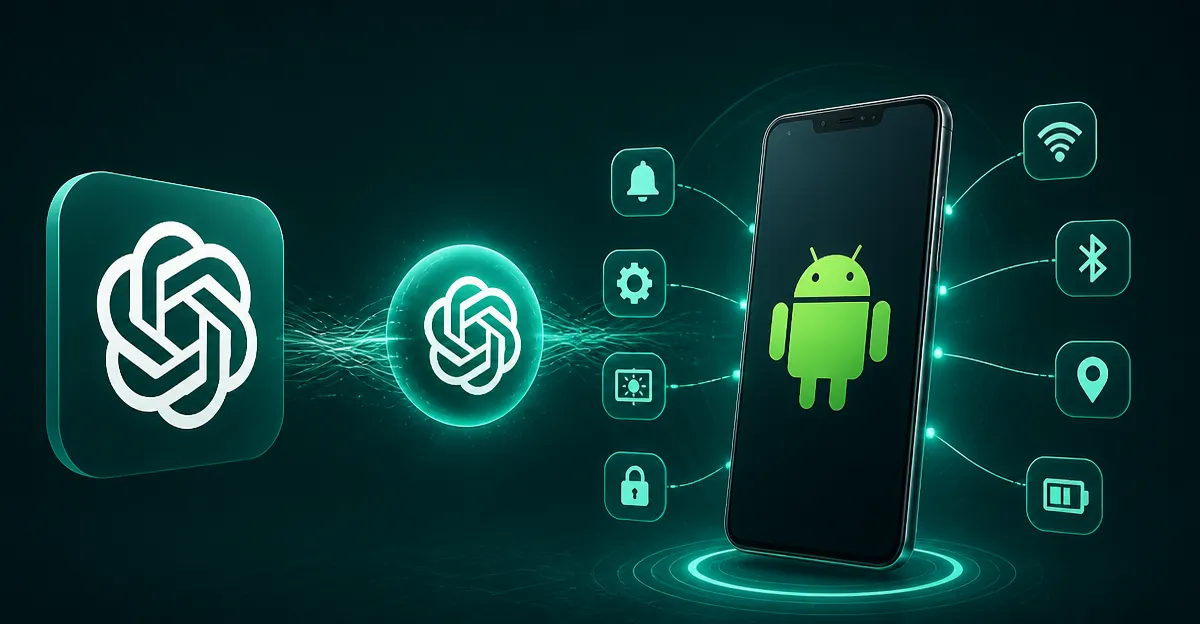
The strings describe a feature set that maps closely to Android's privileged APIs. ChatGPT could look up contacts, read recent call logs, and place calls on request. It could read and send text messages. Users would have to grant each permission explicitly, a consent model that mirrors how Android handles sensitive data access. Media control appears narrower: the assistant could pause, resume, or skip tracks through notification access, but it would not open music apps or start new songs. It would only steer a playback session that already exists.
Screen awareness is the more consequential addition. A new toggle labeled "Use screen and app data" suggests users could share what is currently displayed with ChatGPT. The assistant would then re-check the screen whenever a follow-up question arrives, giving it a form of visual context that goes beyond a single screenshot. That capability is the difference between an assistant that answers questions and one that acts on what the user is looking at.
Read: Tencent WorkBuddy Remote Control
Two configuration flags, "allowedWhileLocked" and "useDotAsAssistant", hint at a separate product line. The first suggests a feature called Dot card could operate while the phone is locked. The second suggests users might set a Dot as the device's default digital assistant. OpenAI has been developing Dots, which are designed to perform tasks without requiring users to keep the app open. If Dots can run while locked and occupy the assistant slot, OpenAI would have a persistent agent on the device, not just an app.
The timing is notable. Android's assistant framework has been open to third parties for years, but few companies have built a credible alternative to Google's own stack. Microsoft's Cortana retreated from the role. Samsung's Bixby remains device-bound. OpenAI's advantage is a model that already handles natural language well. Its challenge is trust: contacts, calls, and messages are the most sensitive data on a phone, and a single misstep would invite regulatory scrutiny. The permission prompts will need to be clear, and the assistant will need to fail safely when it lacks access.
OpenAI has not announced a release timeline, and it is unclear which capabilities will survive to the final version. Teardowns often surface features that are shelved or reshaped before launch. The strings alone do not prove that OpenAI will ship any of this. But they do show the direction of travel: ChatGPT is being prepared to do more than talk. It is being prepared to act.
For Android users, the practical question is whether a more capable ChatGPT would replace Google's assistant or sit alongside it. The default assistant slot allows only one app at a time. If OpenAI pursues that slot through Dots, the choice becomes a fork in the platform experience. Google has spent years tying Assistant to its services. OpenAI would have to earn the same trust without the same system-level integration. The strings suggest it is trying.

Shamil has a low tolerance for AI that only works in controlled demos. He covers agentic systems and generative AI with the skepticism of someone who has seen too many “revolutionary” tools quietly disappear six months after launch.