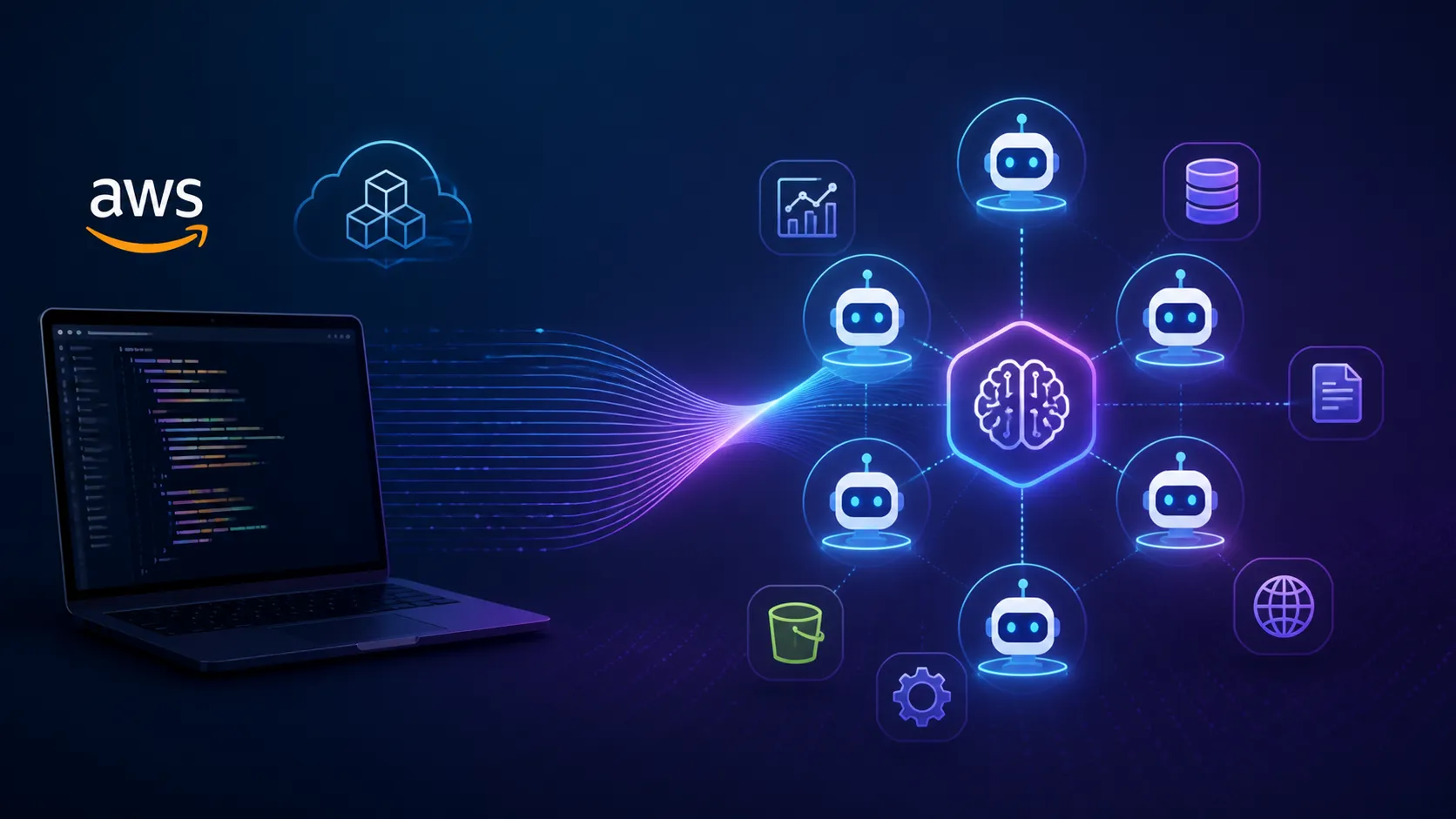
June 26, 2026, (Inside AI) — Amazon Web Services’ 10,000 AIdeas Competition drew thousands of developers from over 115 countries between December 2025 and April 2026, challenging them to build AI applications using Kiro, the company’s agentic development environment. The contest required participants to operate within the AWS Free Tier, eliminating upfront costs and lowering barriers to entry. Global winners Shambhavi Sharma and Om Singh built tools for Parkinson’s screening and scientific claim verification, respectively, showcasing what AWS vice president Jeff Barr called “exceptional quality” in production-ready software.
The event signals a fundamental shift in how software gets built. Developers are no longer writing code line by line. Instead, they orchestrate AI agents that reason, plan, and execute. Barr, who serves as AWS chief evangelist, told indianexpress.com that the competition was a natural extension of the company’s core mission to make powerful technology accessible to every developer, from a dorm room to a global enterprise.
From Syntax to Strategy: The Agentic Pivot
Barr observed that the most successful participants behaved less like traditional coders and more like problem-solvers who define specifications and let Kiro handle implementation. “They weren’t just experimenting with prompts; they were developing structured, reliable, and deployable software.” This spec-driven approach, he said, allows developers to focus on understanding users and solving domain-specific challenges rather than wrestling with syntax.
The competition’s entries spanned healthcare, sustainability, education, and daily life. Sharma’s NeuroVoice platform detects early Parkinson’s indicators by extracting 26 acoustic features from voice notes sent via WhatsApp or a native app. It layers in facial analysis, motor assessments, and sleep tracking to build a longitudinal biomarker picture. “The science was there. The gap was that nobody had made it accessible,” Sharma said.
Read: Loop Engineering: Why AI Agents May Soon Make Prompting Obsolete
Om Singh’s ASET engine validates scientific claims against a corpus of over 1.2 million peer-reviewed papers across 8 domains. It breaks assertions into components and delivers evidence-backed analysis. “We were not aiming to build something very big but rather solve a small problem that everyone is facing today,” Singh noted. ASET is designed as an embeddable engine, not a standalone platform.
Barr stressed that technical skill alone did not determine winners. Participants had to identify opportunities, articulate ideas, and market their solutions. “They needed strong communication and marketing abilities, not just to build something amazing, but to explain it clearly and effectively to the world.” He described the top performers as “broad problem-solvers” who blended engineering with storytelling.
Trust, Tools, and the Indian Developer Surge
Barr acknowledged lingering skepticism about AI-generated code but argued that hands-on experience rapidly converts doubters. He recounted a personal example: a validator tool languished on his task list for a year until Kiro built it from a single prompt. “It parsed the document, identified each section, determined appropriate rules, and produced a clean programme. It’s exactly the kind of moment, where a genuine task is resolved with minimal effort, that converts sceptics into advocates.”
He contrasted this with the landscape three years ago, when AI coding tools often produced uncompilable output that required line-by-line review. Now, he said, confidence is rising as models improve. Developers are moving from writing every line to orchestrating intelligent agents, a shift that frees them to concentrate on architecture and business outcomes.
India’s developer community played a prominent role in the competition. Barr highlighted their deep technical talent, culture of experimentation, and focus on real-world problems at scale. “The AIdeas competition made clear that India’s developer community isn’t just technically strong but also deeply engaged with some of the most pressing issues today across industries.”
Read: How Tool Calling Transforms AI Agents from Text Generators to Action Takers
The judging panel reviewed each entry through blog posts and videos submitted by participants. Barr noted that the breadth of skills on display—from ideation to deployment—underscored a broader industry transition. As agentic development environments mature, the role of the developer is being redefined around orchestration, domain expertise, and communication, rather than manual coding.