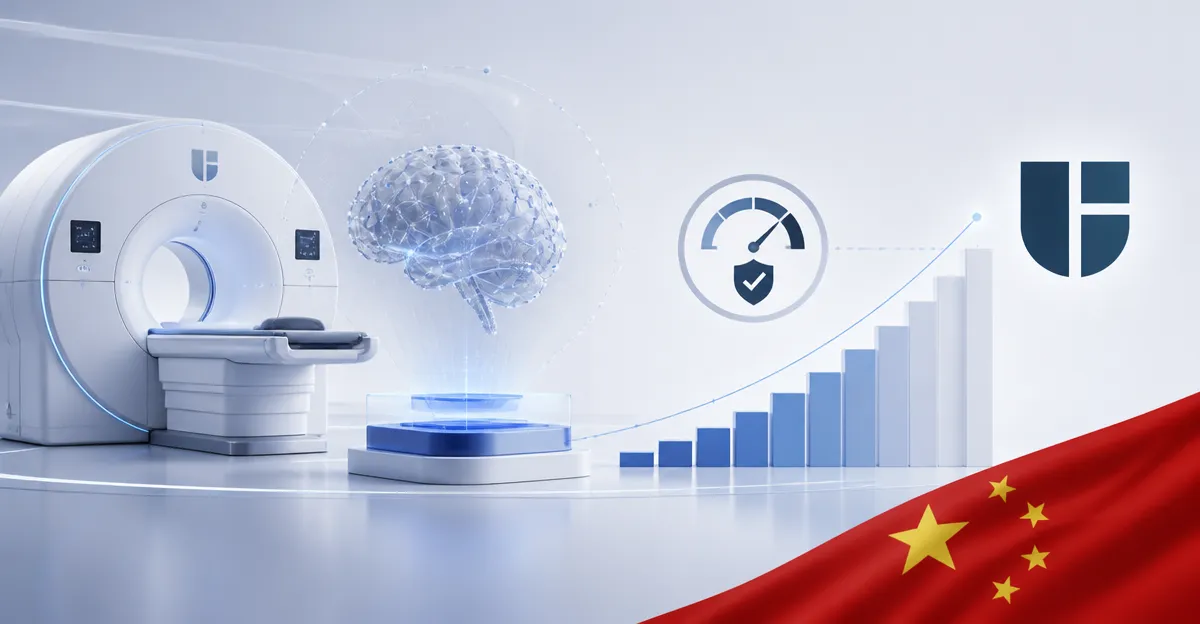
July 20, 2026, (Inside AI) — United Imaging Intelligence, the AI subsidiary of Chinese medical technology giant Shanghai United Imaging Healthcare, is deliberately slowing its AI deployment, resisting a national push for rapid adoption. Co-CEO Zhou Xiang told Reuters at the World Artificial Intelligence Conference in Shanghai that the company will not force extreme AI usage metrics on employees.
Zhou’s stance puts him at odds with a growing number of Chinese firms that now track employee AI token consumption as a measure of digital transformation. He revealed that internal software engineers and architects had warned him about the technology’s immaturity and potential side effects.
This caution is rare in China’s current AI landscape, where President Xi Jinping used the same conference to champion the country as a leader in a new global AI order, emphasizing open-source development. Yet in healthcare, Zhou argued, the calculus is different.
“In healthcare, in medicine, the first mover advantage is not as drastic as other fields,” Zhou said, highlighting the sector’s unique risk profile where errors can directly harm patients.
Read: Medical Trainees Risk ‘Never-Skilling’ by Relying on AI Before Building Clinical Judgment
The parent company, Shanghai United Imaging Healthcare, competes globally with GE HealthCare, Siemens Healthineers, and Philips in medical imaging and scanning equipment. Its AI unit focuses on integrating intelligent features into diagnostic hardware and software, where reliability trumps speed.
Zhou’s comments come amid a broader industry debate over AI readiness in high-stakes domains. While China’s government urges swift adoption across key sectors, medical AI developers worldwide face stringent regulatory hurdles. The U.S. Food and Drug Administration, for instance, has authorized over 1,000 AI-enabled medical devices, but most are locked—meaning their algorithms cannot learn from new data without reapproval—precisely because of safety concerns.
United Imaging’s conservative approach mirrors a growing recognition that large language models, despite their fluency, are prone to hallucinations and unpredictable outputs. In radiology, for example, an AI misdiagnosis could lead to unnecessary procedures or missed conditions. Zhou’s engineers are not alone: a 2025 study in Nature Medicine found that 6 out of 10 AI tools for medical imaging showed performance drops when tested on real-world data from different hospitals.
“Some companies said … if you don’t use this much token, you must not be transforming into the new age. We are not that extreme,” Zhou stated, pushing back against a culture of AI maximalism that has swept through Chinese industry.
This tension between innovation velocity and patient safety is not new. The history of medical AI is littered with cautionary tales, such as IBM Watson Health, which overpromised and underdelivered in oncology, partly due to training on synthetic rather than real patient data. United Imaging appears determined not to repeat those mistakes.
Zhou did not disclose specific AI tools under development but implied that any rollout would be gradual and tightly controlled. The company’s stance could influence other Chinese medical device makers, as Beijing balances its AI ambitions with the practicalities of healthcare delivery.
Read: Can an AI-Powered Scribe Curb Physician Burnout?
Meanwhile, competitors are not standing still. Siemens Healthineers recently expanded its AI-Rad Companion platform, and GE HealthCare has been acquiring AI startups to embed intelligence across its imaging portfolio. Yet even these Western giants emphasize “augmented intelligence” rather than full autonomy, suggesting that Zhou’s caution has global resonance.
For United Imaging, the message is clear: in medicine, being first is less important than being right. As China races to dominate AI, this subsidiary is choosing to walk, not run.