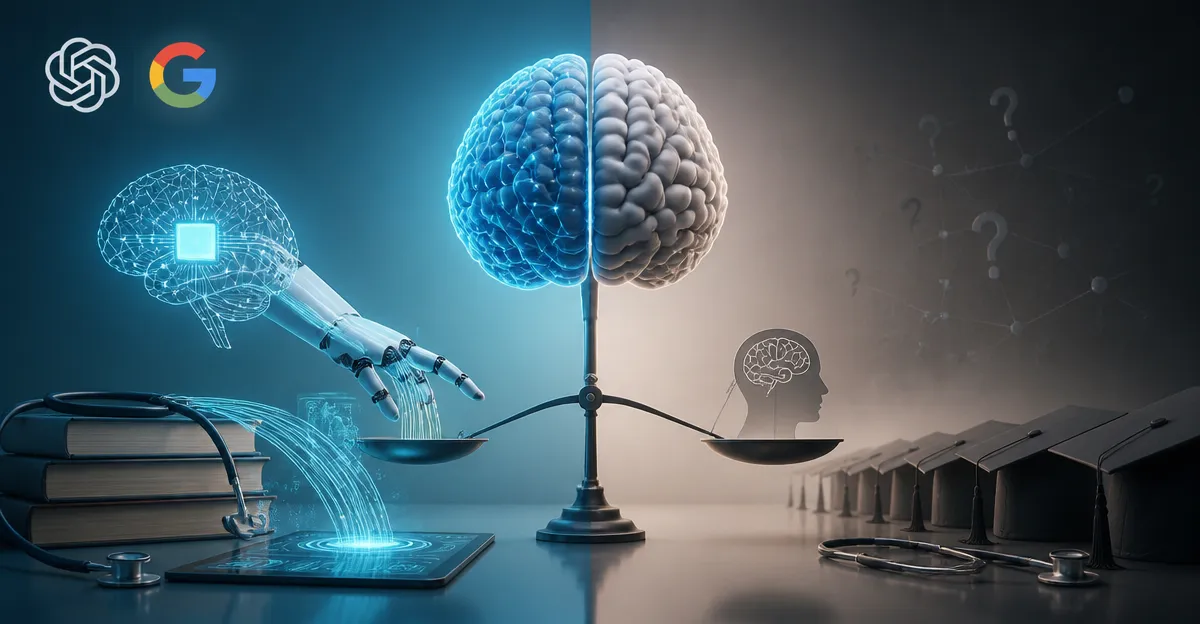
August 10, 2026, (Inside AI) — Medical trainees who lean on AI chatbots before building their own diagnostic skills risk a dangerous “never-skilling” that could erode the foundation of clinical judgment, warn researchers Simar Bajaj and Joseph Sakran in a new analysis.
The warning comes as tools like OpenEvidence, an AI chatbot used by roughly two-thirds of U.S. doctors, gain traction among medical students and residents. These trainees are using the tool at a formative stage, asking about puzzling symptoms or drug interactions and getting polished answers in seconds, often without the struggle that builds deep reasoning.
“The danger is not just deskilling but never-skilling,” Bajaj and Sakran write. “Although a doctor who has forgotten how to reason is recoverable, one who never learned how may not be.”
The core issue is that medical training is an apprenticeship where failure and uncertainty shape clinical intuition. Trainees once learned by building differential diagnoses from scratch, sometimes painfully discovering gaps. Now, AI can conceal those gaps, letting a trainee appear prepared while bypassing the cognitive struggle that forges lasting skills.
Read: Redesign Mentoring for the AI Era: Closing the Judgment Gap
A recent study in Nature Medicine found that AI tools pulling from the latest literature, like OpenEvidence, can be less reliable than they seem and sometimes less accurate than general-purpose chatbots. This misplaced trust compounds the risk when trainees’ foundational knowledge is still forming.
“With unchecked use among trainees, we risk creating supervisors of reasoning before we create reasoners,” the authors state.
Many trainees sense the trap but feel caught in an arms race. If peers use AI to sound more prepared, opting out feels like a disadvantage. The solution, Bajaj and Sakran argue, must be structural: medical schools and residency programs should mandate a “reason first, consult AI second” approach.
In practice, a resident admitting a patient overnight might write a brief pre-AI assessment after the history and physical exam. On rounds, when new data shifts the case, the attending could pause the team to ask how the diagnosis changes before anyone consults AI. This deliberate friction echoes “desirable difficulties” from learning science, which slow performance now but boost long-term retention.
Aviation offers a precedent. The Federal Aviation Administration advises pilots to periodically disengage autopilot and hand-fly to preserve manual skills. Medicine needs similar discipline, with trainees required to work through no-AI cases and be assessed on unaided reasoning to detect drift.
Training should also teach interrogation of AI. Programs could run simulated cases with subtly flawed AI assessments, then debrief when trainees trusted or questioned the tool. Mixing in perfectly accurate outputs would build disciplined judgment, not reflexive skepticism.
Read: Why Some Junior Employees Thrive with AI While Others Fall Behind
AI’s speed and reach can benefit patients, but the authors stress that doctors must stand apart from the machine long enough to know when it is wrong. A trainee who has seen pneumonia that looks like heart failure develops bedside judgment that no chatbot can replicate. That is what training must preserve.