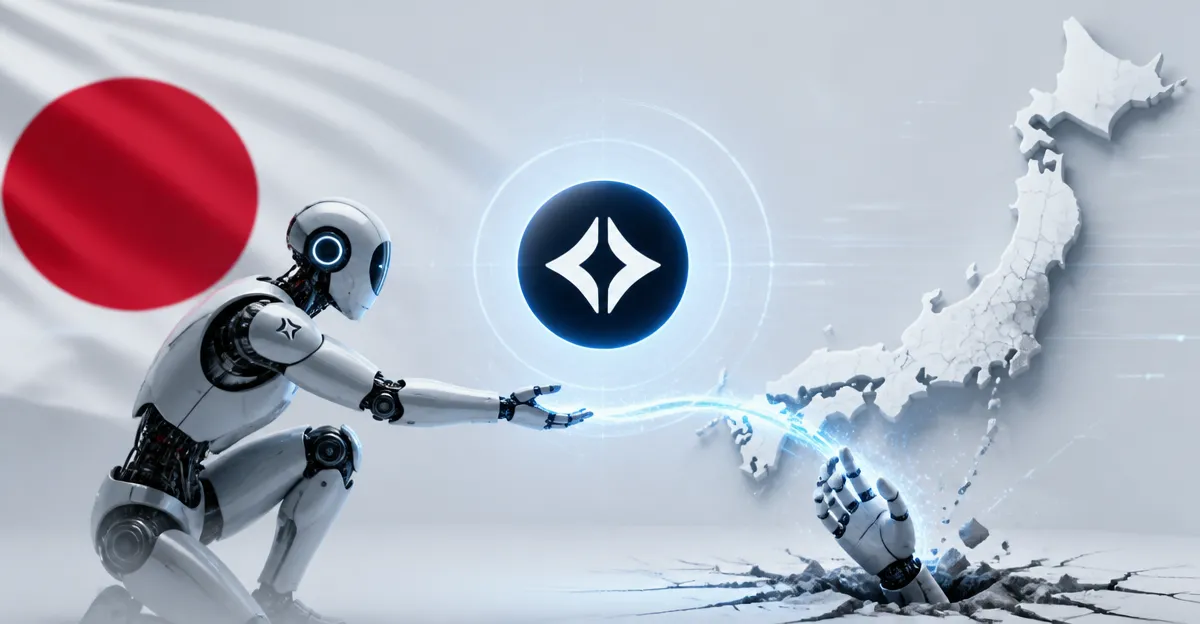
July 22, 2026, (Inside AI) — Japan has launched a state-backed company called Noetra to build a foundational model for physical AI and robots, a move its CEO describes as the nation's "last chance" to secure technological self-reliance.
The venture, formally announced today in Tokyo, is backed by over 380 billion yen ($2.33 billion) in first-year government funding and a consortium of 44 corporate partners including SoftBank, Honda, and Sony. It plans to procure 27,500 Nvidia Rubin chips and break ground on AI infrastructure in April 2027, with operations targeted for June 2028.
"We've been able to bring together people who have been working on AI in Japan," said Hironobu Tamba, Noetra's CEO and a SoftBank executive, in an interview. "Honestly, I think this may be our last chance."
The urgency reflects Japan's precarious position between the U.S. and China in the global AI race. While Japan leads in industrial robotics, it has lagged in foundational AI models and domestic compute capacity. Noetra aims to offer companies a secure, sovereign platform for managing sensitive data—a contrast to foreign-controlled cloud services.
Prime Minister Sanae Takaichi's administration is simultaneously backing chip foundry venture Rapidus to produce cutting-edge semiconductors. The government's broader ambition is to deploy 10 million AI-enabled robots by 2040 across manufacturing, shipbuilding, and nursing.
The project mirrors global trends in sovereign AI infrastructure, but its scale is exceptional. For context, the 380 billion yen initial outlay rivals the $2.6 billion Japan allocated for its post-5G fund in 2020, signaling a sharp prioritization of physical AI. Unlike pure software models, physical AI requires integrating perception, planning, and control in real-world environments—a domain where Japan's robotics expertise could provide an edge.
Yet challenges loom. Nvidia's Rubin architecture, expected in 2026, is unproven at this scale. Japan's energy grid, already strained, must support massive compute clusters. And talent shortages persist despite Tamba's claim of uniting domestic AI researchers. A 2025 government report noted Japan produces only 2,800 AI PhDs annually, compared to 35,000 in China.
The Geopolitical Calculus Behind Noetra's Sprint
Noetra's launch cannot be separated from escalating tech nationalism. The U.S. CHIPS Act and China's $47 billion Big Fund III have weaponized semiconductor supply chains. Japan, reliant on TSMC and Samsung for advanced logic chips, sees Rapidus and Noetra as hedges against potential blockade.
The consortium structure—spanning automakers, electronics giants, and telecom—suggests a deliberate effort to avoid past failures. Japan's Fifth Generation Computer Systems project in the 1980s collapsed partly due to siloed corporate interests. By embedding SoftBank's capital, Honda's manufacturing data, and Sony's sensor IP, Noetra may circumvent those pitfalls.
Still, skepticism persists. "Japan has a history of grand AI projects that underdeliver," said Dr. Yuko Harayama, former executive director at RIKEN, in a 2025 policy paper. "Success depends on sustained funding beyond political cycles and genuine data sharing among rivals."
Noetra's focus on "safe" and "reliable" models also hints at alignment with emerging AI regulations. Japan's 2025 AI Governance Framework emphasizes human-centric robotics, potentially giving Noetra a regulatory moat if it can certify compliance early.
The Robotics Supply Chain Reset
The 10 million robot target by 2040 is ambitious but not fantastical. Japan currently has about 630,000 industrial robots installed, per the International Federation of Robotics. Scaling to 10 million requires a 15x increase in 14 years—a compound annual growth rate of roughly 22%. Noetra's model could accelerate deployment by standardizing robot brains, much like Android unified smartphones.
However, physical AI introduces unique safety and liability questions. A foundational model that controls nursing robots, for instance, must handle edge cases like patient falls without cloud latency. Noetra's edge-computing approach, implied by the Nvidia Rubin procurement, may address this, but details remain scarce.
The project also underscores Japan's demographic crisis. With a shrinking workforce, robots are not optional. The health ministry projects a shortage of 570,000 caregivers by 2040. Noetra's success could redefine eldercare globally, but failure would leave Japan dependent on U.S. or Chinese AI platforms—a scenario Tamba's "last chance" warning seeks to avert.
Construction delays, chip export restrictions, or corporate infighting could derail the timeline. Yet the sheer scale of investment and political will suggests Japan is treating this as a national imperative, not a research experiment. Whether Noetra becomes a blueprint for sovereign AI or a cautionary tale will depend on execution, not ambition.