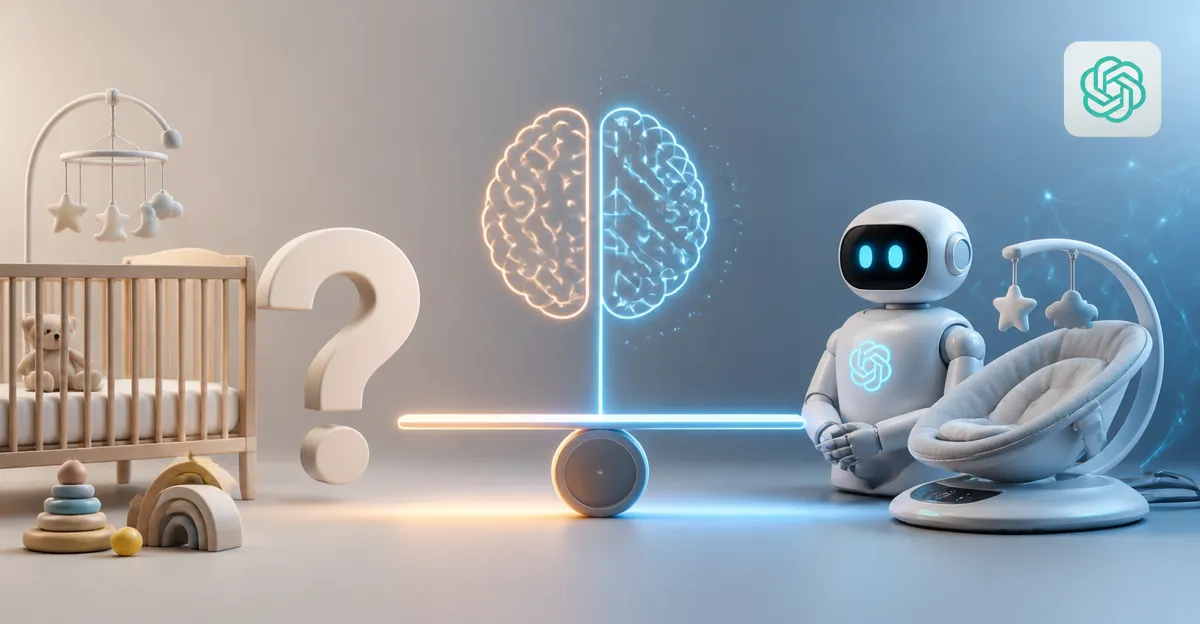
August 8, 2026, (Inside AI) — Parenting has never been cheap, but a new wave of AI-powered baby tech is turning child-rearing into a surveillance-heavy, subscription-based industry. From eye-movement trackers to algorithmically generated bedtime podcasts, companies are pitching tools that promise safer, smarter, and more efficient parenting. The question is whether any of this solves real problems or just monetizes parental anxiety.
OpenAI CEO Sam Altman recently floated the idea of using AI to generate a personalized daily podcast about your child’s life, summarizing upcoming soccer games, birthdays, and news. The pitch implies that a machine can replace morning check-ins and family conversation. But critics argue it solves a problem that does not exist, turning intimate knowledge into “digital mush delivered by a generically cheery voice.”
The market is already crowded with hardware and apps. Nanit sells a $474 camera and monitor kit plus a $100 annual subscription, tracking eye movements, breathing, and “sleep efficiency” to encourage parents to move babies into their own rooms sooner. Its rival Owlet offers a $300 smart sock with a pulse oximeter that straps to an infant’s foot. Meanwhile, the Huckleberry app provides “optimized nap predictions” and a chatbot assistant for $120 per year.
These tools collect biometric data and promise early health alerts. Nanit’s marketing even hints at improved parental sex lives by reclaiming the master bedroom. Yet no device can guarantee a child’s safety, and false alarms or missed predictions could erode trust. The underlying assumption is that constant monitoring equals better care, a claim that remains scientifically thin.
Read: Joanna Stern’s Year Outsourcing Everything to AI: What She Learned
Historically, parenting aids have always been a lucrative market. The $1,700 Snoo crib, which uses motion and sound to soothe infants, is a recent example of high-end gear marketed as essential. Decades of parenting books, classes, and gadgets have turned child-rearing into a sector where fear of inadequacy drives spending. AI adds a new layer: the promise of data-driven certainty in an inherently uncertain journey.
Not everyone is convinced. Writer Dave Schilling, in a recent essay, dismissed these products as unnecessary luxuries for the optimization-obsessed. He wrote:
“None of this is anything people actually need to be parents. Babies need food, toys, diapers and a regular bath. Those all cost money. If I have to choose between saving for my son’s college and a spreadsheet with a bunch of biometric data, I’m skipping the spreadsheet.” Dave Schilling, Writer
He also questioned the value of an AI-generated podcast about one’s own child, asking:
“How entertaining would a podcast ‘that talks about one kid’s soccer game that afternoon, one kid’s upcoming birthday, some news, etc’ actually be? ‘Jimmy needs to work on his dribbling.’ Great. I think he knows already.” Dave Schilling, Writer
Schilling’s broader point is that these devices target a demographic with disposable income and a desire to micromanage every aspect of life, as if technology could shield them from failure, illness, or death. He contrasts this with a time when extended family provided childcare, offering something AI cannot: teaching children about someone besides themselves.
Privacy experts have long warned about the risks of normalizing constant surveillance from infancy. Data collected by these devices could be hacked, shared with third parties, or used to build behavioral profiles before a child can consent. The long-term psychological effects on children raised under algorithmic watch are unknown. Pediatricians generally advise against over-reliance on consumer vital-sign monitors, which are not FDA-approved medical devices and can cause unnecessary anxiety.
Read: State Attorneys General Investigate OpenAI Over Data, Child Safety
Despite the criticism, the market is growing. The global baby monitor market alone is projected to exceed $2 billion by 2030, with AI features becoming a key differentiator. Venture capital continues to flow into parenting tech, betting that stressed, affluent parents will pay for peace of mind, even if that peace is algorithmically constructed.
For now, the choice remains stark: invest in cameras, socks, and subscriptions, or trust the low-tech methods that have worked for millennia. As Schilling put it, he would rather pitch a tent next to a cave of grizzly bears than install an AI camera in his kid’s room. That sentiment may not dent sales, but it captures a growing unease with the quantified nursery.