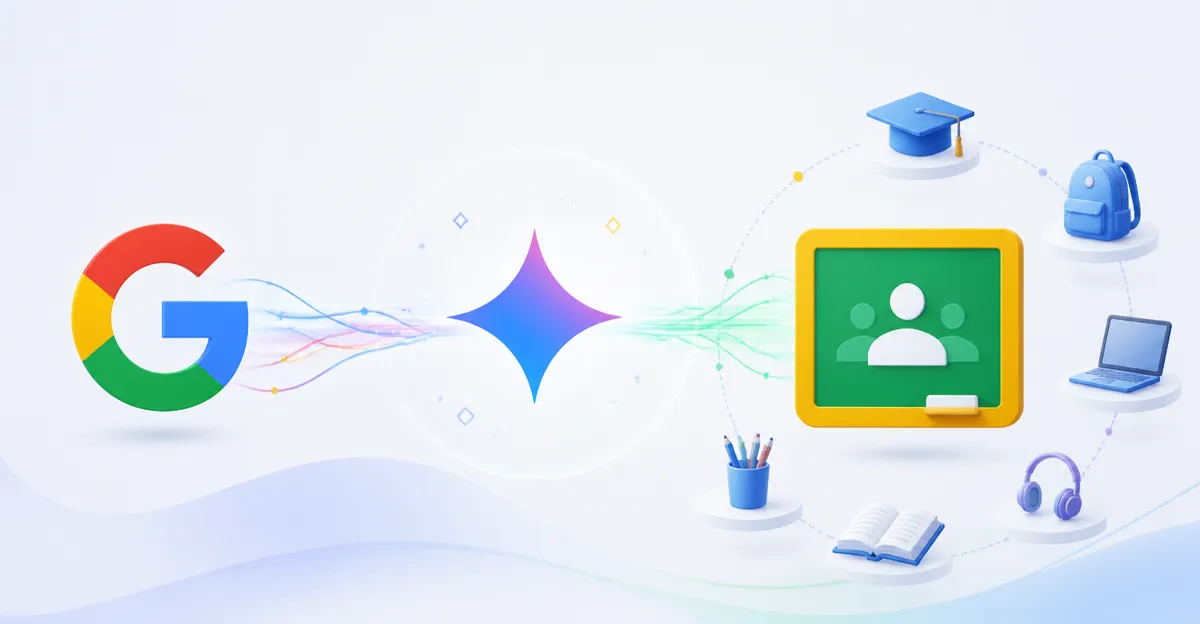
August 15, 2026, (Inside AI) — Google has activated its Gemini chatbot for elementary through high school students using Google Classroom, a move that intensifies competition among technology giants to shape how young learners interact with artificial intelligence.
The change affects Classroom, a learning management system used by more than 150 million students and teachers globally. Previously, Google automatically enabled Gemini in Classroom only for students aged 18 or older. Now, a new Gemini tab allows students of all ages to seek AI help on math problems and writing assignments, generate study guides, quizzes, flashcards, and even produce images.
Google said the new setup enables students to ask the AI about specific course materials and assignments provided by their teachers. The company stressed that the changes affect only schools that allowed student access to its Gemini app or Gemini Notebook, another Google product. School administrators can turn Gemini access on or off for all students, or for specific groups such as lower grades.
Yet some school administrators say Google made so many simultaneous changes to its AI products for schools that it is difficult to track what is enabled or disabled. Derek Moore, chief technology officer for the Palo Alto Unified School District in California, which allows high school students to use Gemini only for specific teacher-approved purposes, captured the frustration.
Read: OpenAI Expands ChatGPT for Teachers to 55 More U.S. School Districts
“We seem to be the last to know,” Derek Moore, chief technology officer, Palo Alto Unified School District
Google’s push to increase student access to its AI tools escalates a long-standing battle among Apple, Google, and Microsoft to capture classrooms and secure students as long-term customers. Newer entrants such as Anthropic and OpenAI have started programs for K-12 teachers, but have not yet made their ChatGPT and Claude chatbots available for student use in US public schools.
The industry’s classroom chatbot drive comes as parents’ groups in New York City, Los Angeles, and elsewhere press schools to halt rollouts of student AI products. These groups argue that AI chatbots can pose risks to children’s safety, privacy, and critical thinking. Some warn that using chatbots to generate flashcards and text summaries may hinder learning.
Opt-Out Defaults Put Schools on the Back Foot
Google’s AI changes highlight a long-standing power dynamic between consumer tech giants and the US public education system. Tech companies regularly turn on new education product features for students, and automatic changes often require school administrators to opt out rather than asking schools to switch them on.
Several district leaders urged tech companies to allow schools to vet significant AI changes first. James O’Hagan, digital equity, innovation and library services director at the Glendale-River Hills School District in Wisconsin, said Google had previously turned on a different AI service, Workspace Intelligence, for school district customers, a change he criticised in a LinkedIn post.
“A school district should not accidentally adopt an AI platform simply because nobody happened to find the right check box six months ago,” James O’Hagan, digital equity, innovation and library services director, Glendale-River Hills School District
“The default should be permission, not adoption,” James O’Hagan
This fall, Google plans to turn on another new setting for students younger than 18 who are logged in to school Google accounts, this time as part of its Search services. Called the Search Personalised Recommendations Control, the setting enables the company’s search system to customise suggestions based on students’ Google account data, including saved activity across Google sites and apps and location data.
Google said the new recommendation setting would be turned on this fall only for schools that enabled its search services. After discovering the notice, O’Hagan said he used Google’s school administrator dashboard to turn off the company’s search services and preempt the new feature for students.
The rollout of Gemini in Classroom reflects a broader trend of AI integration in education, but it also raises questions about consent, data privacy, and the appropriate role of AI in learning. As districts grapple with these changes, the balance between innovation and oversight remains a central tension.