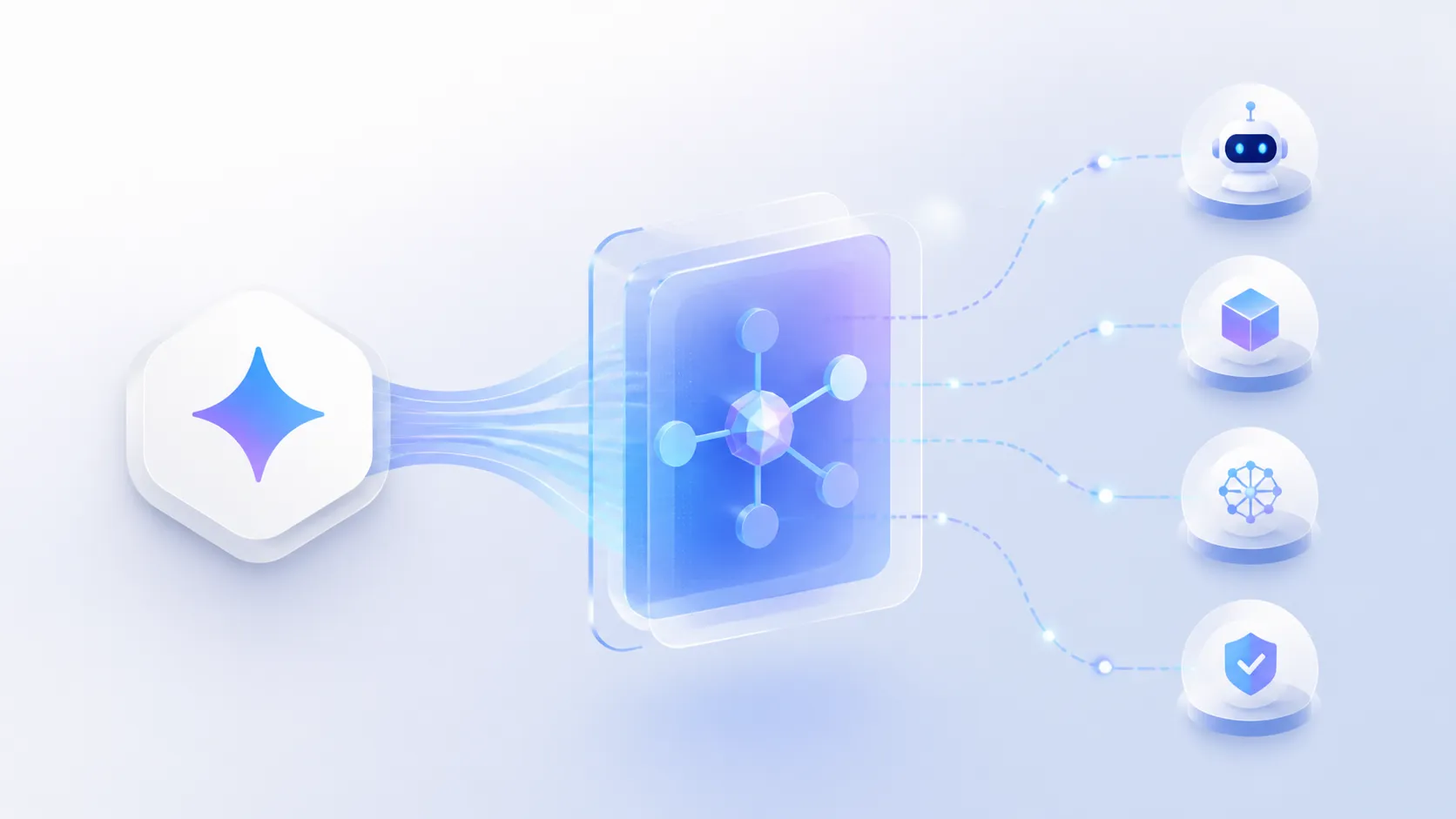
June 23, 2026, (Inside AI) — Google launched the Interactions API, a unified interface for its Gemini models and agents, now the default across AI Studio, the Gemini API, and all documentation. A single call handles inference with a model ID or autonomous tasks with an agent ID. Developers can set background=True for any long-running operation, triggering asynchronous execution on the server.
The API provisions managed agents inside remote Linux sandboxes where they reason, execute code, browse the web, and manage files. The Antigravity agent ships as the default, but teams can define custom agents with specific instructions, skills, and data sources. This shift embeds agentic workflows directly into the primary development surface, not as an add-on.
Google is betting that stateful, long-running tasks will define the next wave of AI applications. The legacy generateContent API remains fully supported and will receive new Gemini models, but frontier capabilities for agents will land exclusively on the Interactions API. A migration guide helps teams transition at their own pace.
Tool calling now mixes built-in functions—Google Search, Google Maps—with custom functions in one request. Tool results can return images alongside text, expanding multimodal grounding. Deep Research upgrades bring two new agent versions optimized for speed or depth, collaborative planning, native charts and infographics, and grounding with images, PDFs, and audio.
Read: Google Brings Gemini Spark to macOS in the US with App Integrations and Real-Time Tracking
Media generation spans image creation with Nano Banana 2 and Google Image Search grounding, music via Lyria 3, and expressive speech through multi-speaker TTS. The schema replaces the old role structure with typed steps—user_input, thought, function_call, model_output—making interaction history more transparent.
Cost controls arrive through Flex and Priority tiers. Flex cuts costs by 50% for latency-tolerant workloads. Error messages now pinpoint the exact field, and paid-tier users can retrieve past interactions with 55-day retention. These details matter for production systems where debugging and audit trails are non-negotiable.
An Agent-First Ecosystem Takes Shape
Google frames the Interactions API as the backbone for an agent-first ecosystem. Most developers already use coding agents like Antigravity to build applications. To keep those agents current, Google released the gemini-interactions-api Skill, which injects best-practice patterns—streaming, function calling, structured output, Deep Research—directly into an agent’s context.
This skill-based approach signals a deeper shift: agents themselves become the primary consumers of API documentation. Instead of reading guides, developers may soon rely on agents that automatically adopt the latest patterns. It raises questions about how quickly legacy codebases can adapt and whether smaller teams can keep pace without dedicated AI ops.
The API’s design choices reflect lessons from the generateContent era. Stateful workflows, long-running tasks, and mixed human-AI interactions demanded a ground-up rethink. By collapsing model inference and agent orchestration into one surface, Google reduces the cognitive load on developers but also ties them more tightly to its ecosystem.
Competing platforms like Anthropic and OpenAI have taken different paths, with tool-use and agent frameworks often layered on top of chat APIs. Google’s all-in-one approach could simplify development but may lock teams into specific patterns that don’t translate easily elsewhere. The migration guide will be a critical test of how smoothly teams can bridge the gap.
Read: Google Launches AI Agent Inside Search Ads in India, Expands Gemini-Powered Tools
Background execution, sandboxed agents, and multimodal tool results push the Gemini platform closer to an operating system for AI tasks. Whether developers embrace that vision depends on real-world latency, cost predictability, and how well the Flex tier performs under load. Early adopters will weigh the 50% cost reduction against the risk of slower response times.
The 55-day interaction retention on paid tiers also hints at future compliance and fine-tuning use cases. As enterprises adopt agentic workflows, audit trails become essential. Google’s move preempts regulatory pressure but may not satisfy sectors with stricter data residency requirements.
For now, the Interactions API resets the baseline for Gemini development. Teams starting new projects will find a cleaner, more capable surface. Those maintaining legacy code can take their time—but the frontier is moving without them.