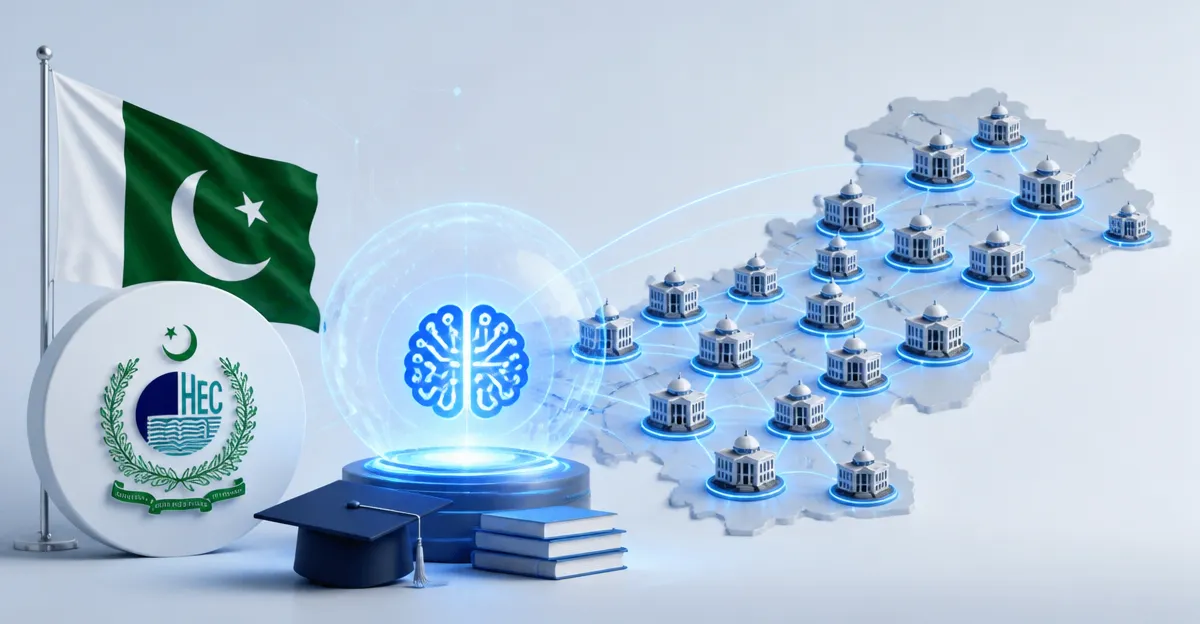
August 26, 2026, (Inside AI) — Pakistan’s higher education regulator will launch a nationwide faculty training drive on artificial intelligence starting August 27, targeting about 100 universities. The four-day programme aims to equip educators with practical AI skills for classrooms, research, and administration.
The initiative, titled “AI Literacy for Faculty Members: Building AI-Ready Institutions,” is organized by the National Academy of Higher Education (NAHE) under the Higher Education Commission (HEC). Sessions run on August 27, 28, 31, and September 1, from 9am to 4pm, simultaneously in smart classrooms across the country.
The training covers integrating AI into curriculum design, teaching, learning, assessment, research, and academic administration. It is open to full-time regular or permanent faculty, with preference for newly inducted teachers. Universities have been asked to nominate suitable faculty members.
Interested faculty can contact mawan@hec.gov.pk or 051-90800823 for details.
This push comes as higher education systems globally scramble to adapt to generative AI tools that can write essays, generate code, and analyze data. Pakistan’s move mirrors similar faculty development efforts in India, where the University Grants Commission has mandated AI literacy modules, and in the United States, where institutions like Arizona State University have partnered with OpenAI to bring ChatGPT into classrooms.
Critics argue that four days may be insufficient to build deep AI competency, especially for faculty in non-technical disciplines. However, the programme’s focus on practical integration rather than theoretical foundations could accelerate adoption. The HEC has not disclosed the curriculum details or the names of trainers, leaving questions about quality and consistency across 100 campuses.
Historical context matters. Pakistan’s higher education sector has faced chronic underfunding and digital infrastructure gaps. A 2023 HEC report noted that only 40% of public universities had reliable high-speed internet. Running simultaneous smart classroom sessions nationwide will test that infrastructure. If successful, this could become a model for other developing countries.
Faculty training is only one piece of the puzzle. Students also need AI literacy, and universities need clear policies on academic integrity. Without guidelines on acceptable AI use, educators may struggle to balance innovation with assessment security. The HEC has not announced any parallel student-focused initiatives, a gap that could undermine the programme’s long-term impact.
For now, the immediate test is participation. Will universities nominate enough faculty, and will those faculty attend all four days? The HEC’s preference for newly inducted teachers suggests a strategy to embed AI skills early in academic careers. But senior faculty, who often control curriculum decisions, may be left out, creating a generational divide in AI adoption.
The programme’s success will likely be measured not by attendance but by observable changes in teaching practices and research output. That will take months, if not years, to assess. In the meantime, the HEC’s initiative signals that Pakistan’s higher education leadership recognizes AI as a strategic priority, not a passing trend.