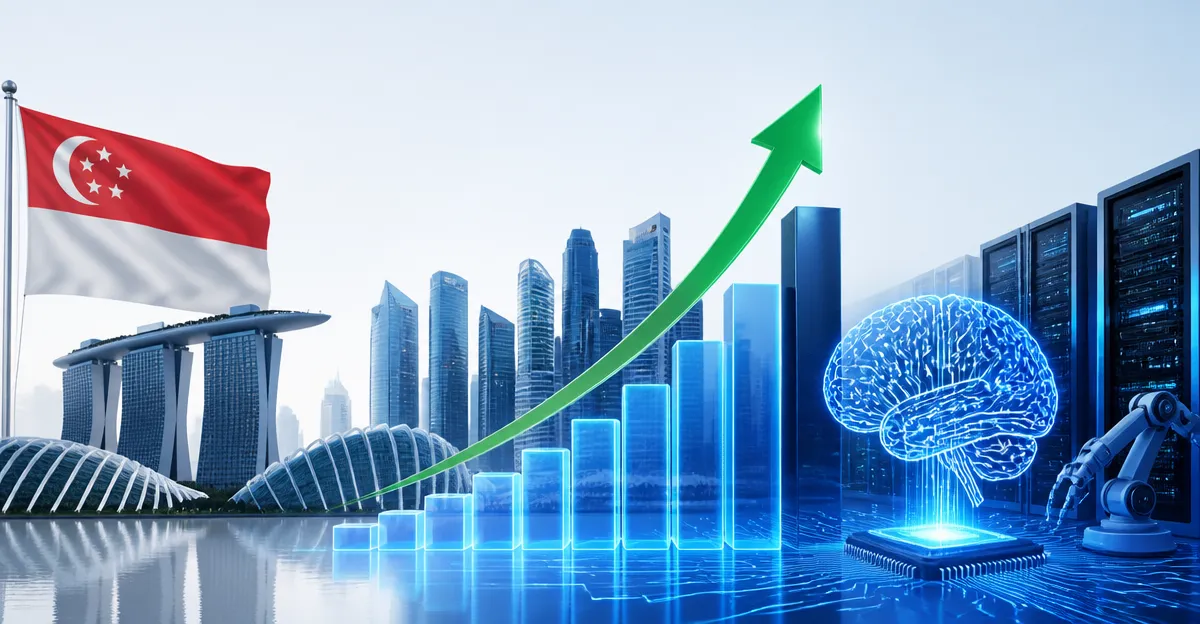
August 11, 2026, (Inside AI) — Singapore’s economy surged 5.9% in the second quarter from a year earlier, topping the official advance estimate of 5.7%, as the global artificial intelligence investment boom supercharged growth. The Trade Ministry also lifted its full-year forecast to 4.5%–5.5%, up sharply from 2.0%–4.0%, citing stronger-than-expected AI-driven demand and less severe fallout from the Middle East conflict.
The upgrade marks a dramatic vote of confidence in the city-state’s position as a critical node in the global AI supply chain. Singapore is a major hub for semiconductor fabrication, cloud infrastructure, and data center operations. It has aggressively courted tech giants with tax incentives and land for hyperscale facilities. Now, those bets appear to be paying off faster than anticipated.
First-half GDP growth reached 6.1%, the ministry said. On a quarter-on-quarter seasonally adjusted basis, the economy expanded 1.4% in the April–June period, versus an advance estimate of 1.1%.
“Against this backdrop, the 2026 outlook for sectors of the Singapore economy that are linked to the AI-driven technology cycle has improved, although that for sectors directly affected by supply disruptions arising from the Middle East conflict remains weak,” the ministry said.
Read: US Economy Likely Grew 2.1% in Q2 on AI Spending, Consumer Rebound
Non-oil domestic exports are now expected to grow 14%–16% this year, a huge leap from the previous 3%–5% forecast, Enterprise Singapore said in a separate statement. “The global economy has remained more resilient than expected, bolstered by the sustained AI-related demand and capex spending,” the agency noted, while flagging downside risks from the Iran war and a new round of U.S. tariffs.
Monetary Policy Tightens as Energy Costs Bite
The Monetary Authority of Singapore unexpectedly tightened policy in late July, citing persistent inflation risks as the Middle East conflict keeps energy costs elevated. It now expects core and headline inflation to average 1.5%–2.5% in 2026, up from 1.0%–2.0% forecast earlier. Annual inflation stood at 1.6% in June, with the central bank warning it will pick up and stay elevated through the first half of next year.
The government has responded with a S$900 million support package for households and businesses, on top of nearly S$1 billion announced in April, to cushion the blow from high energy prices. The central bank has also flagged the sustainability of the AI investment boom as a major risk to the outlook.
Singapore’s reliance on AI-linked exports leaves it exposed to a potential pullback in global tech spending. The boom has been fueled by massive capital expenditure from U.S. hyperscalers, but some analysts warn that AI infrastructure buildout could slow if enterprise adoption lags. The city-state’s trade ministry did not address this risk directly, but the central bank’s caution suggests policymakers are watching closely.
AI Windfall Masks Geopolitical Fault Lines
While the AI surge has lifted headline numbers, the economy remains split. Sectors tied to the technology cycle are booming, but those hit by Middle East supply disruptions are still struggling. The Iran conflict has snarled shipping routes and pushed up freight costs, hurting traditional manufacturing and logistics firms. The new U.S. tariffs add another layer of uncertainty for exporters.
Read: Global AI Boom Fuels Asia Factory Expansion in August
Still, the upgraded forecasts underscore how deeply Singapore has embedded itself in the AI value chain. From advanced chip packaging to subsea cable landing stations, the country has become indispensable. As long as the AI investment cycle holds, Singapore’s economy looks set to outperform. The question is whether that cycle has already peaked.