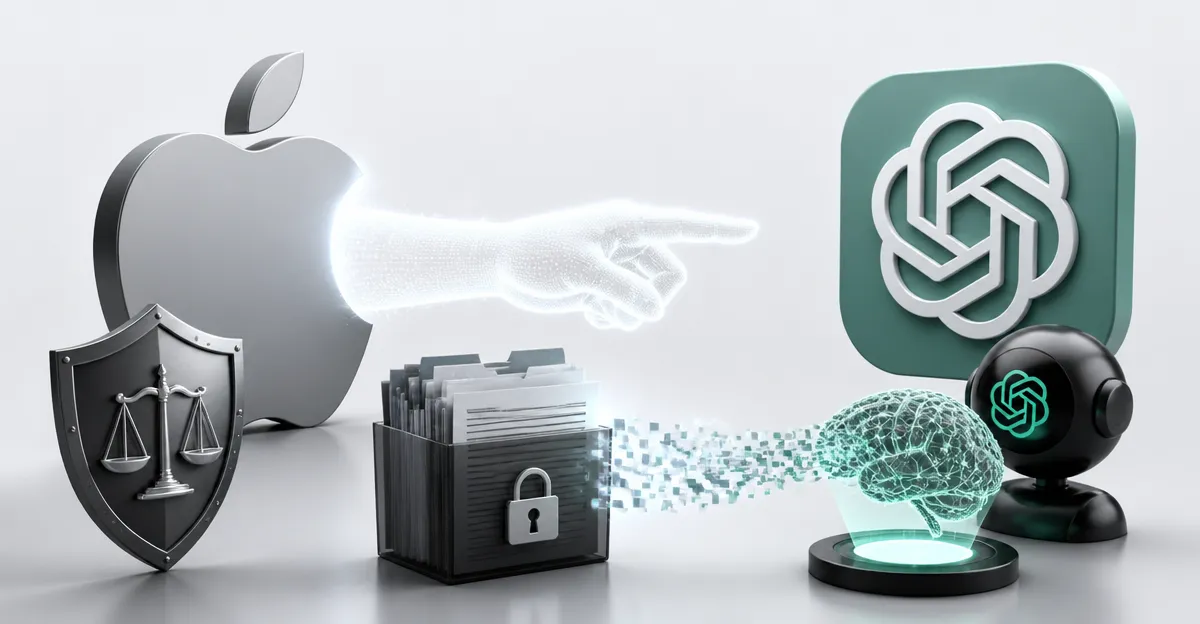
September 1, 2026, (Inside AI) — Apple has filed new court documents accusing OpenAI of destroying evidence in an escalating trade secret dispute. The filing alleges that a former Apple engineer, Chang Liu, used confidential circuit schematics to train an AI model after joining OpenAI.
The document, submitted to the US District Court for the Northern District of California, supports Apple’s request for expedited fact-finding before trial. It claims Liu not only downloaded proprietary schematics but also instructed a fellow OpenAI employee to delete relevant data, who reportedly agreed.
The core allegation centers on Liu, who left Apple in January 2026 after eight years, and Tang Tan, a 24-year Apple veteran now serving as OpenAI’s chief hardware officer. Apple’s initial lawsuit accused OpenAI of trade secret theft by recruiting ex-Apple employees and acquiring Jony Ive’s hardware startup, io.
Evidence emerged after Liu’s legal team handed over his Apple-issued MacBook on August 21. Forensic analysis starting August 26 allegedly shows Liu accessed proprietary circuit information as recently as March, months after leaving Apple, and then trained an AI model using that data.
Read: OpenAI, New York Times Case Tees Up Key Test of AI Training Under Copyright Law
“The MacBook represents the very limited information defendants provided so far (and only after weeks of delay), and shows Apple is not conducting ‘fishing expeditions’ but that its trade secrets are being used and evidence is being destroyed,” Apple’s lawyers wrote.
OpenAI has denied the allegations, calling the lawsuit “careless, aggressive, and oddly personal.” The company argues former employees retained file access only because Apple failed to revoke permissions upon departure.
Trade Secrets Collide With AI Training Pipelines
The case raises a critical legal question: can existing trade secret laws address AI models trained on misappropriated data? Courts have historically treated trade secret theft as a discrete act, but AI training embeds information into model weights, making extraction and attribution difficult.
Legal experts note that if Apple proves Liu trained a model on stolen schematics, the remedy may extend beyond damages to model deletion or retraining. This would set a precedent for how courts handle AI systems built on tainted data.
The timing is significant. John Ternus assumed the role of Apple CEO on September 1, inheriting this litigation immediately. OpenAI must respond to Apple’s supplemental filing by September 4, with a hearing before Judge Edward J. Davila scheduled for October 1.
Read: Seattle Times and Newsday Sue OpenAI and Microsoft for Copyright Infringement
Industry observers are watching closely. As proprietary engineering knowledge increasingly flows into AI workflows, companies may need new safeguards beyond access revocation, including data lineage tracking and AI-specific contractual clauses.