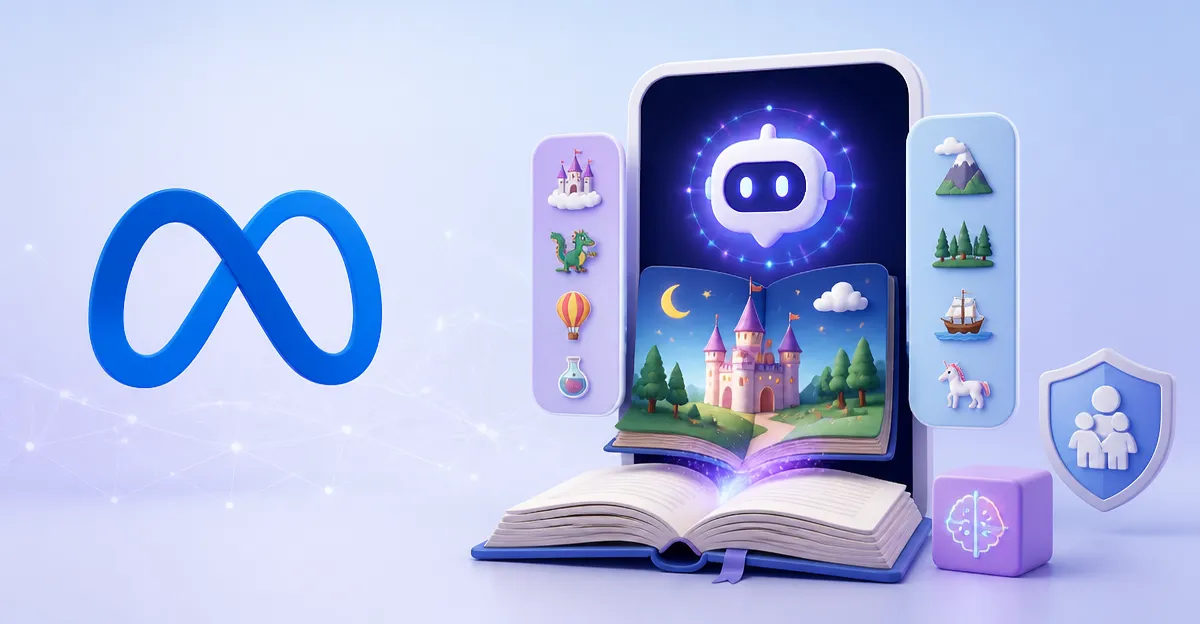
July 22, 2026, (Inside AI) — Meta is quietly piloting a new AI application called StoryKit, designed to let parents generate personalized children's bedtime stories without writing a single word. The app, first reported by 9to5Mac, is currently available in select countries to users aged 18 and above, with no social networking features.
StoryKit uses generative AI to craft narratives around custom characters, settings, and moral themes. Parents can photograph a favorite toy or person to create a character, describe a story world, and choose lessons like kindness or courage. The app automatically adds background music to the generated tales.
Meta confirmed the limited test, stating it is gauging parental feedback before any broader release. This move comes as the company aggressively expands its consumer AI portfolio, which already includes image generation, chatbots, and creative tools across its platforms.
The app's App Store listing emphasizes simplicity: users "don't need to write a single word." It also incorporates AI safety filters, though details on how these filters work remain undisclosed. The pilot's age restriction suggests Meta is cautiously navigating the sensitive intersection of AI-generated content and children's media.
This launch places Meta in direct competition with a growing niche of AI storytelling tools. Startups like Once Upon a Bot and Story Spark already offer similar services, but Meta's vast user base could give it a significant distribution advantage. However, the company faces a trust deficit: it is currently fighting a lawsuit alleging it used AI to target workers with medical conditions for layoffs, raising questions about its data ethics.
Privacy advocates have long warned about AI systems collecting children's data. While StoryKit is adult-only for now, any future expansion to child users would trigger strict regulations like the Children's Online Privacy Protection Act (COPPA) in the U.S. and the General Data Protection Regulation (GDPR) in Europe. Meta has not clarified how it handles the photos or story prompts uploaded by parents.
From a technical standpoint, StoryKit likely leverages large language models fine-tuned on children's literature. Research on AI narrative generation, such as the paper "TinyStories: How Small Can Language Models Be and Still Speak Coherent English?", shows that smaller, specialized models can produce coherent and safe stories. Meta may be using a similar approach to balance quality with safety.
Industry analysts see this as a strategic move to normalize AI in family life. "It's a low-stakes, high-engagement entry point for AI acceptance," says Dr. Sarah T. Roberts, an information studies professor at UCLA. "If parents trust an app to tell bedtime stories, they're more likely to trust Meta's AI in other contexts."
Yet, the absence of human authorship raises concerns about narrative quality and cultural sensitivity. AI-generated stories may lack the emotional depth and nuance of human-written tales, potentially flattening diverse storytelling traditions. Meta has not addressed how it ensures the stories are age-appropriate beyond basic filters.
Meta's broader AI push includes a reported $10 billion compute lease deal with Anthropic, signaling massive infrastructure investment. StoryKit is just one piece of a strategy to embed AI into everyday experiences, from messaging to entertainment.
For now, the app remains a test balloon. Its success will depend on whether parents embrace AI as a creative partner in one of the most intimate rituals of childhood—the bedtime story.