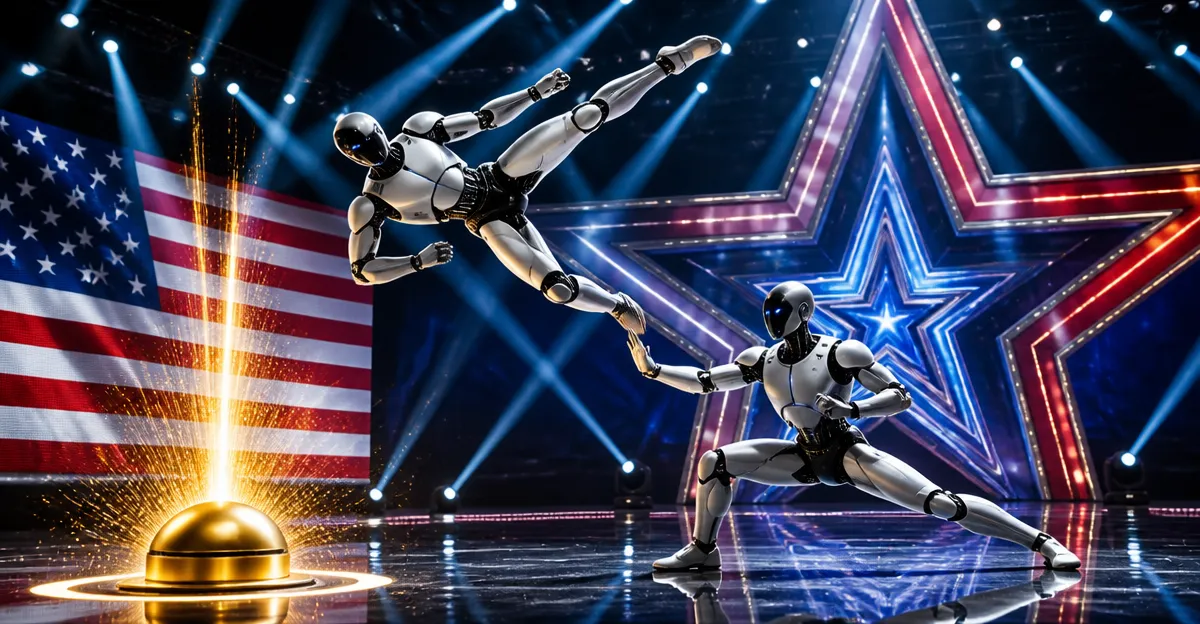
September 20, 2026, (Inside AI) — Eight Unitree G1 humanoid robots took the stage on America's Got Talent during the quarterfinals on September 8, performing a martial arts routine alongside Chinese dancer Wu Yufei. The act earned judge Sofia Vergara's Live Golden Buzzer, sending the robots directly to the finale.
The performance blended synchronized kicks, flips, and punches with human choreography, marking a significant moment for humanoid robotics in mainstream entertainment. The robots previously appeared in the Season 21 auditions in June, where they received four yes votes from the judges.
This latest routine, staged on the fourth night of the quarterfinals, incorporated more complex martial-arts-inspired movements. The robots and human dancers moved in close coordination, creating the impression of a single performance group. The act's success highlights rapid advancements in robotic balance, agility, and real-time coordination.
Unitree, a Chinese robotics company, has been developing humanoid robots for years. The G1 model, first unveiled in 2024, is designed for research and entertainment applications. Its appearance on a major American talent show underscores the growing global interest in humanoid robotics and their potential to perform tasks requiring precision and adaptability.
The performance also sparked a wave of reactions on social media. An Instagram user wrote, "Remember, we used to laughed at them, now they really showed us what true knowledge + culture means. They kept it alive till today while most of our cultures are lost. I feel like they're mocking us now."
Another commented, "I think robots are good just for entertainment but they are very dangerous, we are making future criminals."
A third user stated, "This is what America is afraid of when they put up with the propaganda that AI might wipeout humanity in coming years. China is leading."
The robots' ability to perform backflips and maintain balance during dynamic movements demonstrates progress in areas like motor control and artificial intelligence. Such capabilities are essential for robots to operate in unstructured environments, from disaster response to healthcare.
While the performance was purely entertainment, it raises questions about the future role of humanoid robots in society. As they become more capable, they may take on roles in industries such as manufacturing, logistics, and even caregiving. The reaction from viewers reflects a mix of awe and apprehension, a common response to rapid technological change.
Unitree's G1 robots have also been used in research settings, where they help scientists study human-robot interaction and develop new control algorithms. The company has not announced any commercial deployment plans for the G1, but its appearance on a popular TV show could boost interest and investment in the field.
The Live Golden Buzzer, used by Vergara, is a rare honor that bypasses the usual voting process and sends an act straight to the finale. This decision indicates the judges' belief in the act's entertainment value and its potential to win the competition.
As the finale approaches, the robots will face off against other talented acts. Their performance has already made history as one of the first times humanoid robots have advanced so far in a major talent competition. The outcome will be watched closely by both robotics enthusiasts and the general public.
In the broader context, this event is part of a trend where robots are increasingly featured in entertainment, from theme parks to movies. It also reflects China's growing prowess in robotics, with companies like Unitree competing globally. The intersection of culture, technology, and entertainment continues to evolve, and this performance is a clear example of how robots can capture the public imagination.