September 23, 2026, (Inside AI) — A quiet but seismic shift is underway in consumer technology. After years of pushing AI features that consumers largely ignored, tech companies may have finally found a use case people actually want: AI agents. These autonomous software systems can book a cab, reserve a table, or schedule an email without the user ever opening an app. The early numbers suggest this is not just another Silicon Valley fad.
Meta's Muse Agent topped Apple's App Store just two weeks after release. Google's Gemini assistant has reached 1 billion monthly active users, with token usage up sevenfold year over year. Those figures point to a behavioral change that could eventually make standalone mobile apps a secondary option. At the Snapdragon Summit in Maui, Hawaii, Qualcomm executives laid out the technical and strategic groundwork for this transition.
"Agentic AI is here to stay. As consumers, when they look at the devices around them, they don't go and talk to a data centre rack; they talk to the devices around them. But their interface to these devices is increasingly becoming a direct interaction with the agent," said Durga Malladi, EVP and GM, Technology Planning, Edge Solutions & Data Center, Qualcomm Technologies, Inc.
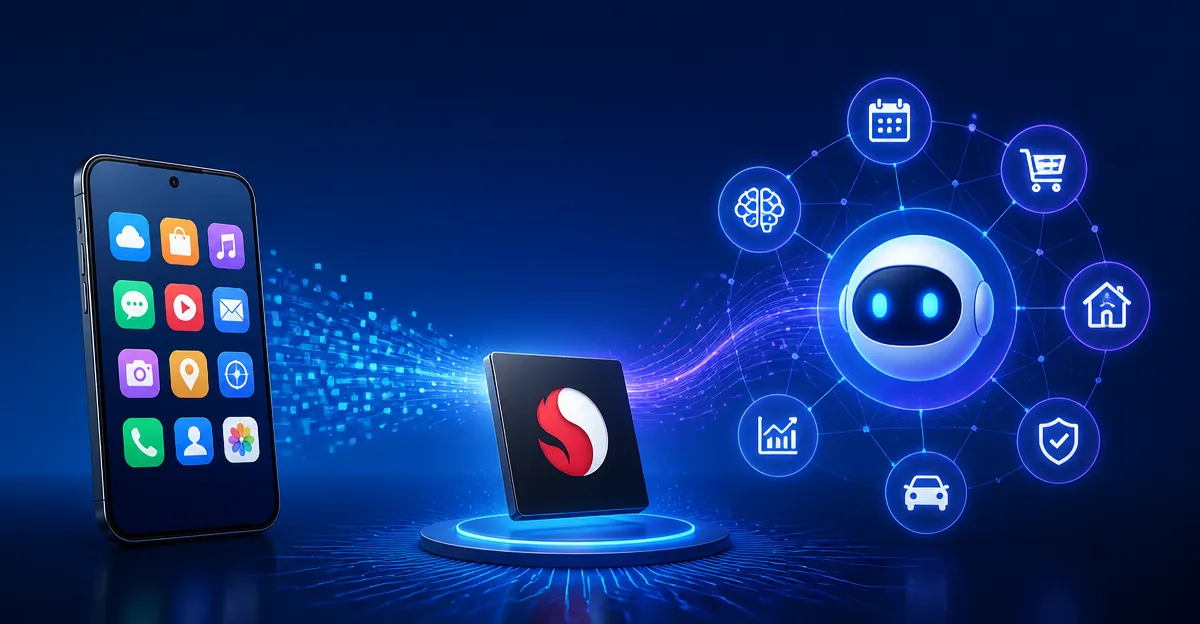
Malladi's comments came during an interview at the summit, where Qualcomm unveiled two new chipsets designed specifically for on-device AI agents: the Snapdragon 8 Elite Gen 6 and Snapdragon 8 Elite Extreme Gen 6. The launch signals that agentic AI is no longer confined to enterprise deployments. It is coming to smartphones.
Read: AI agents can do your tasks: How, and how much should you let them?
Until now, AI agents have been tested mostly in business settings, where they handle customer service, write code, and analyze data. Enterprises have adopted them at scale, but face high costs and cybersecurity risks. Consumer adoption is a different challenge. It requires trust, convenience, and a device that can process personal context without sending everything to the cloud.
"Instead of opening a lot of apps, you might simply talk to an agent, and the agent actually does a lot of things behind the scenes. You don't need to know about it," Malladi said.
That vision depends on hardware that can support personalized AI. The new Snapdragon chips are built to understand personal context, remember past conversations, and learn from messages, emails, and appointments to build a private knowledge graph. This would let agents provide nuanced answers, create travel itineraries, and complete tasks on a user's behalf.
But the shift raises a critical question: can consumers trust an agent with their bank accounts and personal data? Qualcomm CEO Cristiano Amon addressed this during his keynote, citing "trust" and "convenience" as prerequisites. For AI to act on a user's behalf, security and privacy must be guaranteed, and final control must remain with the user.
Malladi sees agentic AI as an evolving space. He expects agents to play a bigger role in daily life while apps become a second option. "We are not there yet. The apps are still going to coexist, but the utility of apps is gradually taking a back seat to agents. Instead of opening an app first, I might actually talk to my agent first. That's a shift in consumer behaviour," he said.
He also drew a distinction between enterprise and consumer AI. For businesses, AI improves operational and workflow efficiency. For consumers, it has to fade into the background to become a powerful tool. "Every time you take a picture, there's actually a lot of AI involved in image stabilisation and processing. What you see is essentially the output of computational photography. But you don't think you are using AI," he explained.
"I think there will be a point in time when consumers will use an AI agent so frequently that they forget the fact that it's actually using AI behind the scenes. The operational efficiency metric used by enterprises is different from a consumer standpoint. For consumers, it's about being more convenient, useful and productive, but in a different domain altogether," Malladi added.
The race to build consumer AI agents is already reshaping the competitive landscape. Meta, Google, Amazon, and Apple are all investing heavily in assistant-like interfaces that can act autonomously. Qualcomm's bet is that the device, not the cloud, will be the primary home for these agents. That approach could ease privacy concerns, but it also puts pressure on chipmakers to deliver performance without draining batteries.
For now, the apps are not going away. But the early success of Muse and Gemini suggests that consumers are ready to talk to their devices in a new way. The question is whether that conversation will be trustworthy enough to handle the most sensitive parts of daily life.